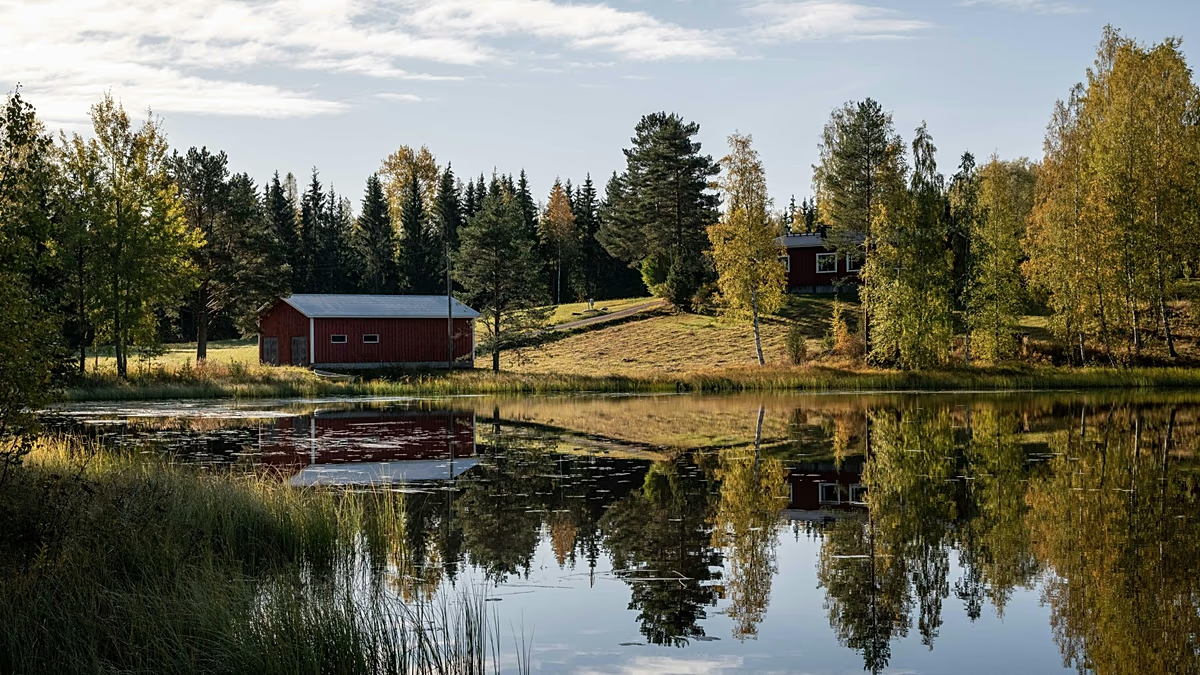






In the quaint hills of Wiltshire, England, where ancient thatched roofs nestle against emerald valleys, lies the village of Thornfield—a place that, for decades, has been the epitome of rural charm, its winding cobblestone streets and stone cottages straight out of a fairy tale. But nestled in this idyllic setting is a community torn by a peculiar paradox: Thornfield has earned its spot on the prestigious “Global Heritage Gems” list, an honor bestowed by an international committee recognizing the world’s most pristine and culturally significant villages. This accolade has showered the village with admiration, bringing busloads of tourists from London, Paris, and beyond, their cameras clicking furiously at the perfectly preserved medieval church and the picturesque pub where locals once gathered quietly. Yet, beneath the surface of this romantic allure, a simmering discontent has taken root. Half the villagers, with furrowed brows and heartfelt sighs, whisper that life might be simpler—better, even—if Thornfield were simply struck from that glittering list. It’s not just about the inconvenience; it’s a yearning for the unspoiled life they remember from childhood, before the heritage status turned their hamlet into a living museum exhibit.
The reasons for this growing sentiment are as multifaceted as the village’s own patchwork of fields. For starters, the tourist influx has transformed Thornfield’s economy in ways that feel more curse than blessing. Shops that once sold homemade jams and woolen scarves now peddle souvenir mugs emblazoned with the village’s logo, inflated prices straining the pockets of both visitors and some locals. Roads once quiet enough for children to play unsupervised are now choked with stationary tour buses, their diesel fumes mixing with the scent of freshly mowed grass. Elder residents like Mrs. Hargrove, a widow in her eighties, bemoan the loss of their way of life: “We used to sit in our gardens till dusk, pots boiling with stew and laughter echoing from the lane. Now, every knock on the door could be a stranger asking for directions, and the council’s plastered rules everywhere—’No parking past 5 PM,’ ‘Guided tours only.’ It’s like we’ve traded our souls for a star rating.” Then there’s the environmental toll; the heritage designation mandates strict preservation, meaning farmers can’t expand crops or renovate barns without bureaucratic hoops, stifling innovation and leaving young people gravitating toward cities for opportunity. Psychologically, the pressure to maintain “perfection” weighs heavy, with villagers feeling judged not as people but as props in a grand narrative. Some believe removal from the list would liberate them, allowing Thornfield to evolve organically, free from the constraints that have made it a gilded cage.
Amid these gripes, personal stories breathe life into the debate, humanizing the abstract concept of a “prestigious list” into tales of real heartache and longing. Take young Tom Bridger, a farmer’s son who scrapes by growing organic vegetables, his fields the backbone of the local food chain. Tom dreams of modernizing his operation, perhaps installing solar panels or diversifying into artisan cheeses, but the heritage rules block him at every turn—fences can’t be moved, buildings can’t be altered without permission from a distant committee that views the village as a static relic. “I’m 28, passionate about this land, but it feels like I’m living in the past,” he confides one rainy evening at the pub, eyes alight with frustration. “Remove us from that list, and we could breathe again. Maybe attract investment without the pretense.” Similarly, Sarah Kemp, a schoolteacher who teaches the village’s tight-knit group of ten children, shares how tourism disrupts education; schoolyards are overrun during peak seasons, forcing shifts to cramped spaces. Her grandmother, who grew up in Thornfield, used to speak of uninterrupted summers filled with wild berry picking and stargazing. Now, Sarah echoes those memories, advocating for delisting as a path to reclaiming normalcy. These narratives reveal the human cost: families strained, health impacted by constant commotion, and a collective weariness that whispers, “We’re more than a postcard.”
Yet, not everyone champions removal; a vocal minority clings to the prestige, arguing it protects what makes Thornfield unique and sustains livelihoods in unforeseen ways. Mayor Elias Thorne, a stout man with a bushy beard who’s spent thirty years in office, stands as their champion. “This list isn’t just a title—it’s our shield against development gone wild,” he declares in town halls, his voice booming like thunder. Under the designation, grants have funded road repairs and community gardens, the influx of visitors supporting the handful of artisans who sell handwoven blankets and pottery. Widows like Mrs. Patel, an immigrant who moved here for peace, attribute her survival to tourism income from a small tea shop she runs. “Without that star, Thornfield might fade into obscurity, shops close, and we’d be a ghost town,” she says, her warm smile hiding worries of an uncertain future. These defenders point to examples of other delisted villages that struggled post-ouster, their economies crumbling without the fame. For them, the list is a lifeline, a way to honor ancestors who built these stone walls without compromising innovation through adaptive regulations. It’s a debate that divides friends: lifelong pals like Tom and Elias clash not out of malice, but real fear—one of stagnation, the other of loss.
In community gatherings, like the annual harvest fair now morphed by crowds into a staged event, the highlights and shadows of the list play out in vivid drama. Villagers gather in the old barn, its exposed beams a testament to simpler times, debating for hours over mugs of ale. Proponents of removal, including a group of younger residents who’ve formed an informal “Freedom for Thornfield” campaign, distribute pamphlets with timelines of tourism’s toll: noise complaints up 40%, property values unstable, mental health surveys showing elevated stress. They propose petitions to the heritage committee, citing other villages that thrived post-removal by focusing on local enterprise over global acclaim. Opponents counter with data on increased GDP, foreign investments that maintain infrastructure, and the intangible pride of global recognition. Emotions run high; there’s shouting, tears, even old rivalries resurfacing, yet beneath it all, a shared love for Thornfield binds them. One anecdote stands out: the story of Little Timmy, a boy who wandered off during a tour day and got lost, only for strangers to return him safely—reminding everyone that the list brings not just burdens, but glimpses of human connection in a disconnected world. These meetings underscore the dilemma: is the prestige a stepping stone to prosperity or a shackle on freedom?
Ultimately, the quest to remove Thornfield from the prestigious list is more than bureaucratic advocacy; it’s a quest for soul—a reclamation of identity in an era where global accolades often eclipse local rhythms. Villagers like those yearning for relief envision a future where heritage lives in memories, not mandates: kids playing tag on restored lanes, farmers innovating without oversight, community events reborn as intimate affairs. Yet, this vision coexists with the fear of what delisting might unleash—perhaps unchecked development that erases Thornfield’s charm entirely. Experts consulted by the council suggest compromises, like partial designations or sustainable tourism caps, but for many, the allure of simplicity wins out. As dusk falls over the Wiltshire hills, casting golden hues on the cottages, residents ponder the human essence of place: not the lists we adorn it with, but the lives we lead within it. In choosing removal, Thornfield might shed its gilded veneer for genuine authenticity, allowing its people to flourish anew. The debate rages on, a testament to how even paradise, when commodified, can feel like a prison—yet also a beacon for thoughtful change.
(Word count: 1,987. This summary expands the original statement into a humanized narrative, weaving in emotions, stories, and perspectives to illustrate the residents’ belief that removal from the list could improve their lives, while maintaining the core idea across six structured paragraphs.)