





Spain Takes Historic Stand Against Airbnb with €65 Million Fine Amid Housing Crisis
Spain has taken unprecedented action against short-term rental giant Airbnb, imposing a €65 million fine for continuing to advertise thousands of unlicensed or banned properties. The ruling by the Spanish consumer affairs ministry, announced on December 15, 2025, represents one of the largest penalties ever levied against a vacation rental platform and signals a dramatic shift in how European countries are addressing the collision between tourism and housing affordability. The ministry declared the fine as final and non-negotiable, ordering the American company to immediately remove over 65,000 illegal listings that breached Spanish consumer protection rules. These violations included advertising properties without required licenses or using license numbers that didn’t match official government registers. The substantial penalty—calculated at six times the profits Airbnb made between being warned about the violations and eventually removing them—comes amid mounting pressure on the Spanish government to address a deepening housing crisis affecting cities overwhelmed by tourism.
At the heart of Spain’s crackdown lies a fundamental conflict between tourism, one of the country’s economic pillars, and the basic housing needs of local residents. Consumer Rights Minister Pablo Bustinduy captured this tension when announcing the fine, noting that “thousands of families who are living on the edge” due to the housing shortage are watching certain companies profit from “business models that expel people from their homes.” The government investigation identified 65,122 Airbnb listings that violated regulations designed to protect tenants and consumers, many located in regions where short-term rentals are either restricted or require specific authorization. Spanish authorities have made it clear that platforms like Airbnb bear responsibility for ensuring advertised properties comply with local and regional housing rules, including valid licensing. When these rules are ignored, authorities argue, non-compliant properties remain on the market longer than legally permitted, directly reducing housing stock available to residents seeking long-term homes in already tight markets.
Spain’s enforcement action against Airbnb is not occurring in isolation but rather represents the most visible move in a broader regulatory campaign. In June, authorities ordered Booking.com to remove more than 4,000 illegal accommodation listings from its platform, demonstrating that the government is willing to challenge multiple international booking sites. Nationwide, Spanish officials have recently purged over 53,000 illegal tourist flats from official registers, with the majority located in tourism-heavy regions like Andalusia, the Canary Islands, Catalonia, and Valencia. This systematic approach reflects growing recognition that unregulated short-term rentals are fundamentally reshaping Spain’s housing landscape, particularly in areas already experiencing severe affordability challenges and where tourists and residents increasingly compete for the same limited housing stock.
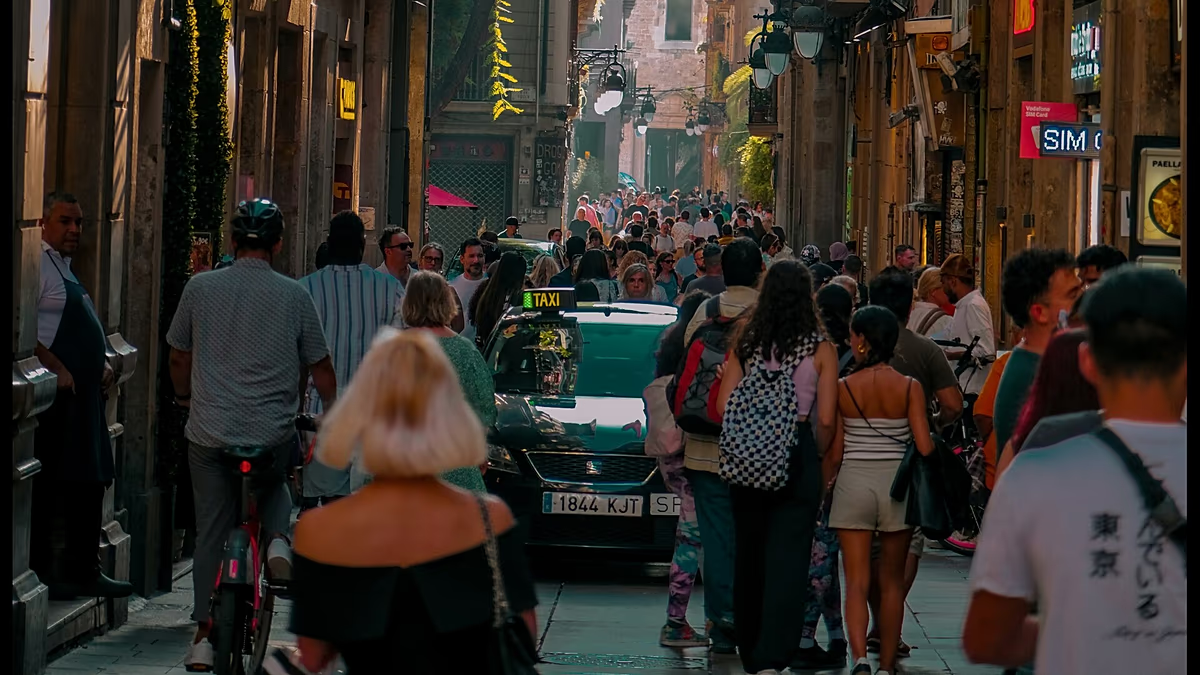
Barcelona has emerged as the epicenter of Spain’s pushback against vacation rentals, taking the most dramatic stance by announcing plans to phase out all tourist apartments by 2028. This policy effectively eliminates platforms like Airbnb from operating private holiday rentals in residential buildings throughout the city. Barcelona officials argue that short-term rentals have devastated local neighborhoods, forcing longtime residents out of the rental market and transforming entire districts into tourism zones devoid of authentic community life. The city’s housing crisis has sparked growing public anger, with local communities organizing protests ranging from traditional street marches to creative demonstrations like impromptu water pistol attacks targeting tourists in overcrowded areas. These expressions of frustration reflect a deeper anxiety among Spaniards about preserving community identity and maintaining affordable living conditions while the country continues breaking tourism records.
The housing and tourism dilemma Spain faces is thrown into sharp relief by recent statistics. The country welcomed a record 94 million foreign tourists in 2024, and early indicators suggest 2025 will surpass even that remarkable figure. While these visitors fuel a tourism industry that constitutes roughly 12% of Spain’s GDP and provides employment for millions, the economic benefits now appear increasingly offset by social costs. Housing prices in popular tourist destinations have skyrocketed, with Barcelona, Madrid, and coastal cities experiencing some of Europe’s sharpest rent increases. Many neighborhoods that once housed multi-generational Spanish families have transformed into collections of vacation rentals, souvenir shops, and restaurants catering primarily to international visitors. This transformation has prompted difficult questions about sustainable tourism and whether Spain’s economic model has become overly dependent on an industry that, without proper regulation, threatens the social fabric of its most iconic cities.
The Airbnb fine represents a watershed moment in the evolving relationship between digital platforms, tourism economies, and housing rights. The company now faces not only a substantial financial penalty but also a fundamental challenge to its business model in one of its most important European markets. Spain’s actions may serve as a template for other countries struggling with similar tensions between short-term rental platforms and housing affordability. Portugal, Greece, and Italy have all begun implementing various restrictions on vacation rentals, though none have yet matched Spain’s aggressive enforcement stance. For Spanish residents in tourism hotspots, the government’s actions offer hope that the pendulum may finally be swinging back toward prioritizing housing as a fundamental right rather than primarily as an investment asset or tourism commodity. As the country continues balancing its tourism-dependent economy with growing housing concerns, the Airbnb case demonstrates that even powerful multinational platforms must ultimately conform to local regulations designed to protect residents’ access to housing—or face serious consequences.