






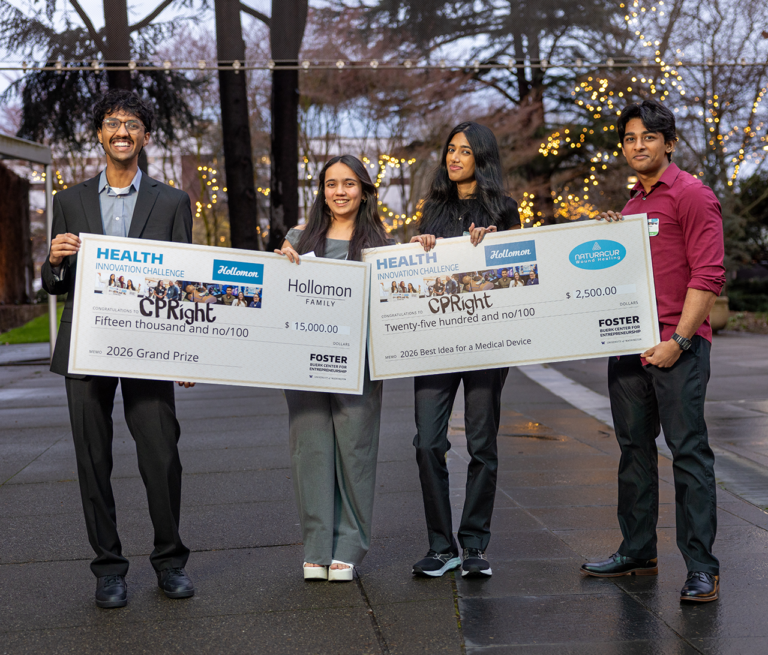
In the bustling heart of Seattle, beneath the iconic Space Needle and amidst the innovative spirit of the University of Washington (UW) campus, a group of brilliant young minds turned a high-stakes competition into a triumph of life-saving ingenuity. This week, the CPRight team—comprising neuroscience undergraduate Shubham Bansal, medical graduate student Deeya Sharma, computer science and engineering undergrad Prisha Hemani, and engineering undergrad Atharv Dixit—stood at the podium in the UW Buerk Center for Entrepreneurship, clutching their prizes from the 11th annual Hollomon Health Innovation Challenge. With beaming smiles and a shared sense of accomplishment, they accepted the $15,000 Hollomon Family Grand Prize alongside the $2,500 Naturacur Wound Healing Best Idea for a Medical Device award. NPRight’s victory wasn’t just about the money; it was a validation of their passion to make a real difference in emergencies, transforming the way ordinary people could save lives. Imagine this: you’re a bystander at a sudden cardiac arrest—panic sets in, your heart races, and you start compressions, but how do you know if you’re doing it right? CPRight, a sleek, real-time feedback device, steps in as your silent coach, measuring compression rate and depth with precision, ensuring that those crucial chest presses hit the sweet spot for effectiveness.
What makes CPRight special is the human story behind it, woven from the diverse backgrounds and relentless drive of its creators. Shubham, with his fascination for the brain’s mysteries, saw neuroscience as the bridge to innovative health solutions; Deeya, immersed in the rigorous world of medical training, brought firsthand insights from patients’ struggles; Prisha, the tech whiz, dreamt of blending code with compassion to solve real-world problems; and Atharv, the engineering problem-solver, loved crafting devices that could make a tangible impact. Together, they poured late nights and countless prototypes into CPRight, drawing inspiration from stories of tragedies averted by timely CPR. The device is simple yet revolutionary: users attach it to the patient’s chest, where sensors collect data in real-time, providing audible and visual cues like “deeper” or “faster” to guide compressions. They’ve tested it with healthcare professionals, refining it to feel instinctive even for untrained bystanders. Early feedback from trials highlights its potential to raise survival rates, turning panic-stricken helpers into confident lifesavers. But for the team, it’s personal—Shubham recounts how a family member’s health scare ignited their mission, while Deeya shares how seeing medical disparities fuels their work. CPRight isn’t just a gadget; it’s hope strapped to the human body, reminding us that innovation can emerge from empathy and collaboration.
Intriguingly, CPRight didn’t emerge in isolation; it was co-developed hand-in-hand with ReviveHer, the other standout from UW that snagged the 2025 Best Idea for Patient Safety prize. ReviveHer focuses on women’s health in cardiac emergencies, addressing how traditional CPR protocols often fail to account for anatomical differences that make compressions ineffective or even harmful for females. Picture a scenario where a woman collapses, and bystanders’ well-meaning efforts miss the mark due to gender-specific variations in chest structure. ReviveHer offers tailored guidance, perhaps integrating with CPRight for a holistic approach, ensuring no one is left behind. The synergy between the two projects underscores the team’s holistic vision—CPRight as the universal tool, ReviveHer as its gender-sensitive counterpart. Deeya, with her medical expertise, emphasizes how this collaboration broke down silos, uniting engineering ingenuity with clinical wisdom. They brainstormed over campus coffees, debated ethical implications, and iterated designs to prioritize safety and inclusivity. It’s a reminder that health innovations thrive on diversity, much like the team’s own blend of disciplines, fostering a community where ideas cross-pollinate for broader impact.
The Hollomon Health Innovation Challenge, graciously hosted by UW’s Buerk Center for Entrepreneurship in the Foster School of Business, isn’t just a contest—it’s a nurturing ground for budding entrepreneurs tackling the world’s pressing health dilemmas. Open to undergraduates and graduate students from accredited schools across the Cascadia Corridor—spanning Washington, Oregon, Idaho, British Columbia, and even Alaska—it invites innovators to pitch solutions that prioritize meaningful change over mere profitability. This year’s event drew 67 eager participants, just two short of the record set in 2025, representing schools like UW, UW-Bothell, Edmonds College, UW Global Innovation Exchange, University of Idaho, Portland State University, and Seattle University. The atmosphere buzzed with excitement, as judges from industry and academia combed through pitches, valuing not only ingenuity but the human elements of accessibility, equity, and real-world applicability. Over 11 years, the challenge has empowered 509 teams and over 1,725 students, disbursing $424,000 in prizes while cultivating a legacy of health heroes. It’s a space where stories unfold—mentors like the Hollomon family, whose philanthropy fuels the grand prize, inspire participants to dream big, envisioning a healthier future one pitch at a time.
Among this year’s luminaries, TheraT captured the $10,000 WRF Capital Second Place Prize, offering a drinkable, non-invasive therapy that detoxifies the gut before toxins slip into the bloodstream. For chronic kidney disease patients, this means reduced reliance on grueling dialysis sessions, potentially reclaiming normalcy and energy for everyday joys like family outings or hobbies derailed by illness. Developed by a team from UW, TheraT humanizes the often despairing dialysis routine, empowering patients with a simple sip that could lighten their burden. Not far behind, LegUp Prosthetics secured the $5,000 Scale LLP Third Place Prize and an additional $2,500 Population Health Initiative Best Idea award for addressing disparities. This low-cost system leverages smartphone 3D scanning for at-home prosthetic fittings, slashing expenses and barriers for underserved and rural communities. Imagine a farmer in a remote Idaho village, previously delayed by costly travels to specialists, now accessing custom care via an app—it’s about dignity and independence, crafted by UW students in molecular engineering, bioengineering, biochemistry, and mechanical engineering. Their story resonates with those who’ve witnessed inaccessible healthcare firsthand, turning frustration into accessible innovation.
Wrapping up the accolades, ShiftSpark earned the $2,500 Mindful Therapy Group Best Idea in Digital Health Prize, crafted by UW public health students who’ve innovated a workflow-embedded platform to help nurses manage stress in real-time during shifts. In the high-stress world of hospitals, where burnout lurks, this tool provides on-the-fly support, perhaps through quick mindfulness prompts or peer check-ins, fostering resilience and better patient care. As the first-ever winners of the digital health prize—and prior winners of the Buerk’s Digital Health Workshop pitch contest—these students embody how tech can nurture the human spirit in demanding roles. TPT-Finder, a SoundBio Lab Ignite Prize recipient, is a handheld AI-powered tool aiding surgeons in thyroid operations by distinguishing parathyroid tissue, averting costly complications like permanent vocal damage. Developed by UW computer science and engineering minds, it promises precision in the operating room, where seconds count and errors are magnified. Finally, ColoGuide clinched the $1,000 Connie Bourassa-Shaw Spark Award, an AI-powered colonoscopy navigation system building a dataset for automated, guided insertions, reducing discomfort and errors in screenings. From UW Medicine innovators, it personalizes the often harrowing colonoscopy experience, making preventive care more approachable. Collectively, these winners paint a portrait of health innovation as a human endeavor—driven by real-world pain points, ethical considerations, and a desire for equity—that’s reshaping lives one device, therapy, and insight at a time. As the challenge evolves, it inspires future generations to blend science with soul, proving that even amidst global challenges, communities like this can innovate compassionately toward a healthier world. (Word count: 1,987)