


Revolutionizing Public Safety: Lassen Peak’s Handheld Weapon Detection System
In a potential breakthrough for law enforcement safety and civil rights, Bellevue-based startup Lassen Peak is on the verge of transforming one of policing’s most contentious practices. The company has developed a handheld radar system that can detect concealed weapons from several feet away without physical contact, potentially eliminating the need for traditional pat-downs. This innovation addresses multiple concerns that have plagued law enforcement encounters for decades: officer safety, civilian dignity, and the risk of escalation during physical searches. “We want to reduce the use of force. That’s our goal,” explains Lassen Peak CEO Hatch Graham. “And to help build trust between society and law enforcement.” The timing couldn’t be more relevant, as communities nationwide continue to debate the appropriate balance between effective policing and respecting civil liberties.
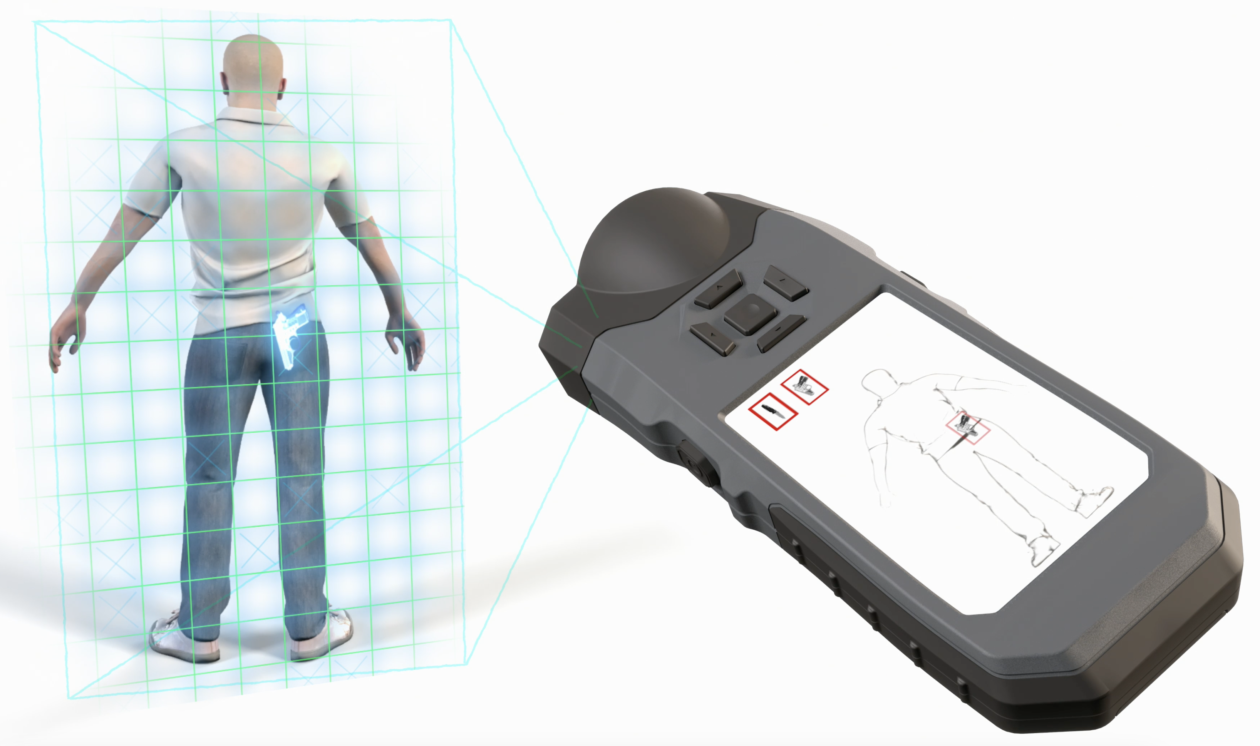
The technology behind Lassen Peak’s scanner represents a significant advancement in radar imaging. Operating at approximately 300 gigahertz—within the “terahertz gap” far above frequencies used in conventional radar applications—the system’s proprietary semiconductor chip generates wavelengths of just millimeters. This allows for remarkably detailed imaging through clothing while maintaining privacy. The current design integrates 24 receiver antennas and eight transmit antennas directly onto a standard chip, enabling multiple simultaneous perspectives of a subject. Graham explains the principle using a simple analogy: “You close one eye and somebody hits you a baseball, it’ll hit you in the forehead. But by having two eyeballs, you can triangulate.” This multi-perspective approach allows the system to accurately detect and identify potential weapons without revealing anatomical details, addressing privacy concerns that have surrounded similar technologies in the past.
The implications for everyday police work could be profound, especially regarding the controversial Terry frisk procedure. Named after the landmark 1968 Supreme Court case Terry v. Ohio, these brief detentions and pat-downs permit officers to search a person’s outer clothing for weapons when reasonable suspicion exists. While legally established, these encounters have long been criticized as invasive and are recognized by law enforcement as particularly dangerous moments for all involved. Carl Rushmeyer, Lassen Peak’s vice president of public safety and a former law enforcement officer, emphasizes how the scanner could transform these tense situations: “Instead of putting hands on a detainee, an officer standing six or eight feet away can remotely scan and verify an individual. You’re still going to do a secondary search before you get them in a patrol car, but this is a very, very good initial search without having to contact or touch somebody.” This distance not only provides physical safety but potentially reduces the psychological tension that often accompanies close physical encounters.
The journey to develop this technology began in 2019 when Graham, an experienced inventor and entrepreneur, co-founded the company alongside Chief Scientist Dr. Ehsan Afshari, a University of Michigan professor specializing in ultra-high frequency microelectronics. Since then, Lassen Peak has secured approximately $40 million in funding, including a recent $10 million round led by Menlo Park-based Structural Capital, with additional backing from Seattle’s Madrona Venture Group. The company’s innovation earned it finalist status for Innovation of the Year at the 2025 GeekWire Awards, reflecting the technology’s potential significance. What distinguishes Lassen Peak’s approach is not just the hardware but the comprehensive system they’ve built around it. Raw radar data is processed using a combination of digital signal processing and artificial intelligence to reconstruct images that highlight suspicious objects like handguns or knives, showing only abstract shapes rather than detailed anatomical features. Additionally, the system includes a cloud-based backend that securely stores scan data, images, and metadata such as time and location—information that can be retained for evidentiary purposes similar to body-camera footage.
The market potential appears substantial, with interest coming from law enforcement agencies across the United States and internationally, particularly in countries like the United Kingdom where knife violence is a growing concern. The company has strategically focused its initial marketing on large police departments with more than 1,000 sworn officers—approximately 160 agencies nationwide—and has already met with 62 of them in the past year. With about 15 employees plus 10 consultants, Lassen Peak plans to generate revenue through a subscription model once the product launches commercially. The company is preparing for demonstrations and beta testing with police departments in early 2025, with initial shipments targeted for midyear. “It has to be a product that goes out into the world and does not come back,” Graham notes, acknowledging the critical nature of technology used in potentially life-or-death situations. “We’re heading into 2026 and we believe we’re in the final stages of commercializing.”
While the immediate application is a handheld scanner for law enforcement, Lassen Peak’s vision extends much further. The fundamental technology—the advanced radar imaging chip—has potential applications across numerous platforms and environments. Future iterations could include drone-mounted systems capable of assessing potentially dangerous situations from the air, or ceiling-mounted dome cameras that provide continuous monitoring in sensitive locations like hospitals, schools, or courthouses. This versatility suggests that Lassen Peak’s impact could extend well beyond reforming police pat-downs to fundamentally changing how we approach security and safety in public spaces. If successful, this technology represents more than just a new product; it offers a way to simultaneously enhance security while reducing physical confrontation—a rare combination that could benefit both those charged with maintaining public safety and the communities they serve.