



From Crisis to Innovation: How Hyviva is Revolutionizing Home Energy Storage
It all began during the sweltering heat dome that engulfed the Pacific Northwest in the summer of 2021. Chris Muench found himself sitting in the dark of his Duvall, Washington home as the power grid failed under the strain of record temperatures. That moment of vulnerability sparked an idea that would evolve into Hyviva, an innovative startup now shipping its first hydrogen-powered energy storage units to customers. “All this started with a really hot summer day in ’21,” explains Muench, reflecting on the genesis of his company from a conference room in Redmond. The experience prompted him to install solar panels, but he quickly realized there was a critical missing piece: an efficient way to store excess energy generated during peak daylight hours. This insight led Chris and his wife Sanja to launch Hyviva in 2023, developing a solution that transforms how homeowners can capture and utilize renewable energy.
Hyviva’s timing couldn’t be better as the residential solar market faces a significant transition. Across the country, net metering policies—which allow homeowners to sell excess solar power back to utilities—are being phased out, creating a pressing need for effective home storage solutions. Paul Owen, Hyviva’s chief marketing officer, identifies this shift as “the catalyst for storage,” noting that without proper storage systems, up to 20% of a household’s daily solar generation effectively goes to waste. Beyond preventing this waste, stored solar power offers dual benefits: reducing dependence on increasingly expensive utility electricity and providing crucial backup during power outages. The company’s focus on residential installations addresses a growing consumer desire for energy independence and resilience in the face of climate change and aging infrastructure.
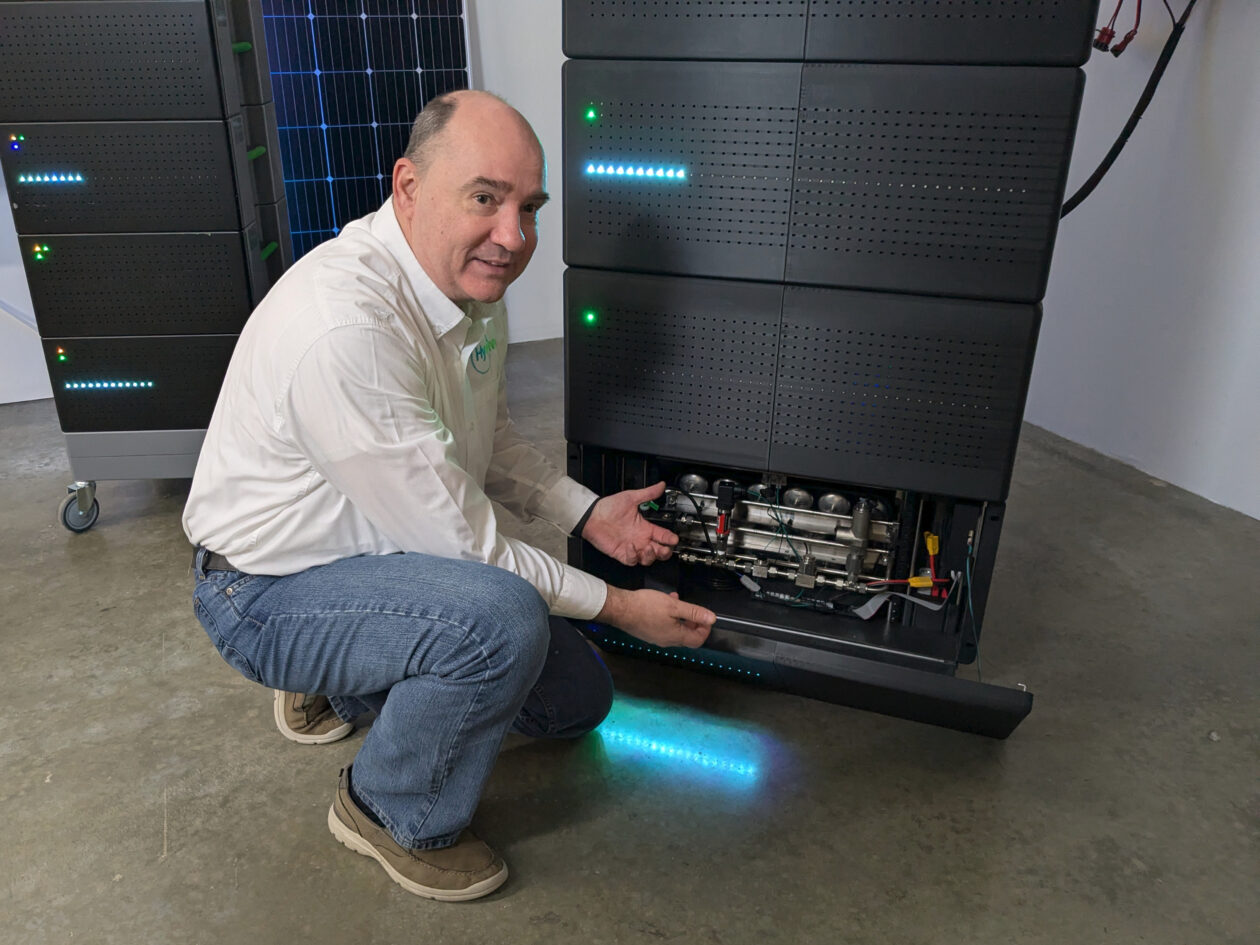
The technology behind Hyviva’s storage system represents a departure from conventional battery solutions. Their sleek, modular unit—slightly narrower than a standard refrigerator—employs a sophisticated process that essentially turns water into electricity. The system works by using an electrolyzer to split water into hydrogen and oxygen, then storing the hydrogen in slender stainless steel tanks containing metal that forms a metal hydride bond with the gas. When electricity is needed, the metal hydride is gently heated, releasing hydrogen that flows into fuel cells and converts back to electrical power. What makes the system particularly innovative is its integrated design and modular architecture. “Every module can be plugged into another module without the need of a hydrogen expert,” Muench explains. “Just ‘Lego brick’ them together, and then you decide how much power draw you want, how much storage you want, how much hydrogen you want to generate.”
While Hyviva faces stiff competition, particularly from Tesla’s dominant Powerwall system, the startup highlights several distinct advantages. Their base system holds substantially more energy—33.6 kilowatt hours compared to Tesla’s 13.5 kWh—and poses less fire risk than lithium-ion batteries. Perhaps most significantly, Hyviva’s metal hydride technology maintains its storage capacity for decades, unlike conventional batteries that degrade over time. The cost equation presents both challenges and opportunities: a single Hyviva unit comes with a steep $40,000 price tag compared to roughly $15,000 for a Tesla Powerwall 3 with installation. However, the economics shift dramatically when scaling up capacity. A larger 90-kilowatt hour Hyviva setup costs approximately $50,000, while the company estimates a comparable Tesla system would run about $82,000 installed—a compelling value proposition for households with higher energy demands or those seeking maximum independence from the grid.
The broader energy storage landscape continues to evolve rapidly, with experts projecting a need for $1.2 trillion worth of battery energy storage globally through 2034. This expanding market is attracting significant investment, evidenced by companies like Base Power securing $1 billion in new funding for their battery leasing model. Energy storage is also finding applications beyond residential use, including integration with data centers to reduce their environmental impact. Despite the growing momentum, Hyviva faces political headwinds as federal policies under the current administration potentially hinder renewable energy developments. Nevertheless, the startup is generating substantial interest from potential customers, including not just homeowners but commercial sites and utilities as well.
For the five-person Hyviva team, their journey from a power outage to pioneering energy solution represents both technological innovation and a deeply personal mission. With initial units being manufactured in Germany for European customers and U.S. production capabilities established in Redmond, the company stands at the threshold of potentially transforming how households interact with energy. Their participation in major events like the Consumer Electronics Show in Las Vegas signals their ambition to reach a wider audience. As Chief Operations Officer John Traynor notes, the enthusiastic response from potential customers has “given us the confidence that we’re on the right track.” In an era of climate uncertainty and energy transition, Hyviva’s approach to hydrogen storage offers a glimpse of how residential power systems might evolve—turning the challenge of a sweltering summer blackout into an opportunity for sustainable innovation.