


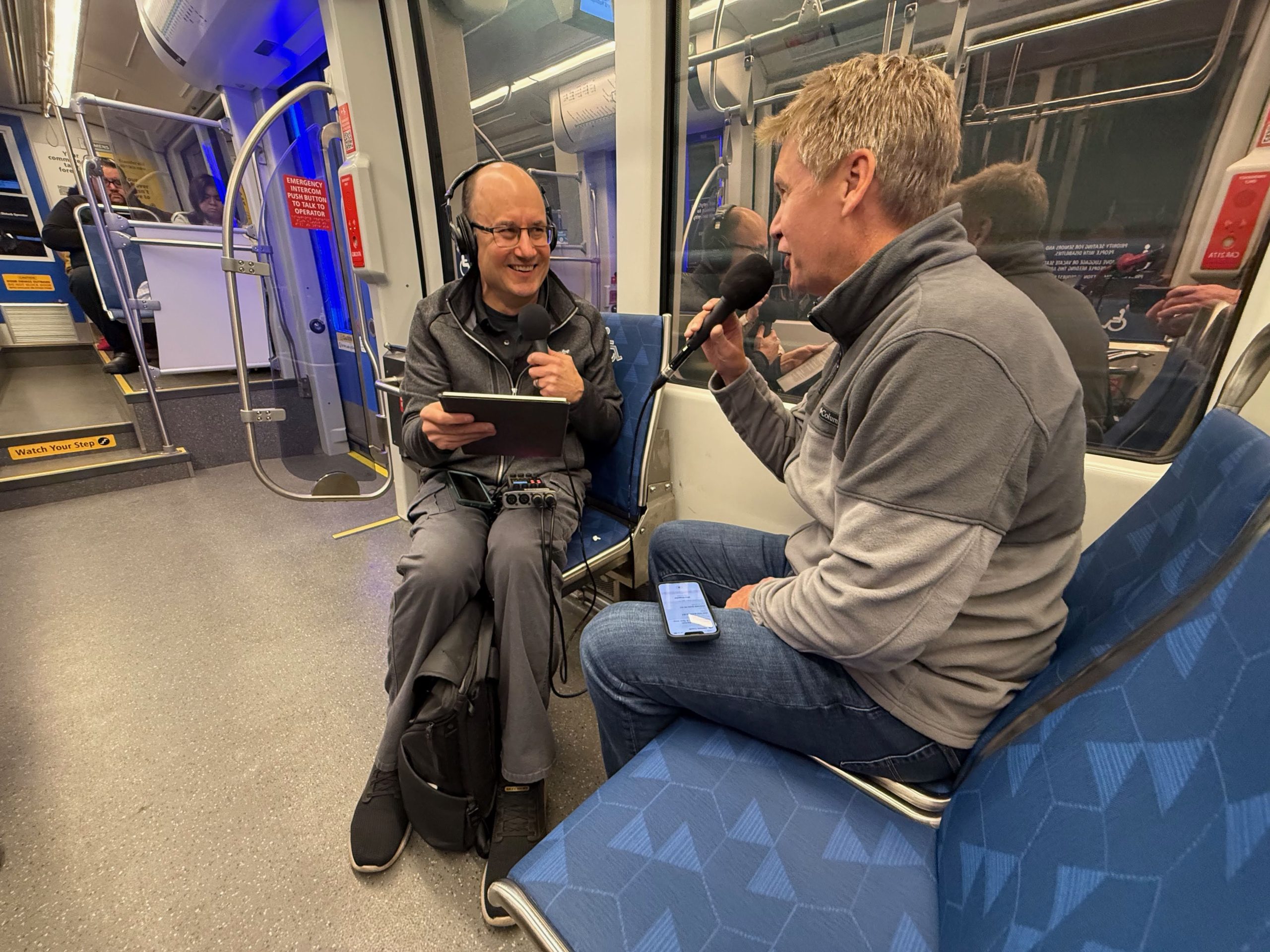
Imagine hopping on a train that’s not just any train, but the very first light rail system spanning a floating bridge across a massive lake, connecting the bustling heart of Seattle’s tech scene to the sprawling campuses in Redmond. That’s exactly what Todd Bishop and John Cook, the gutsy co-founders of GeekWire, did this week for their podcast. They ditched the studio and hit the rails, boarding Sound Transit’s brand-new 2 Line from Northgate to Microsoft’s headquarters. The bridge itself is an engineering wonder—a floating marvel that’s been a dream for decades, finally linking communities over Lake Washington. As the train glides at 55 miles per hour, the bridge bucks and shifts under the whims of wind, waves, and fluctuating lake levels. It’s no small feat, and the guys weren’t just listeners; they turned recording equipment into their quirkiest challenge. Picture this: juggling handheld microphones and a portable recorder on a crowded train car, dodging elbows and apologies as passengers weave around. “It was like trying to conduct an orchestra in a hurricane,” Todd might joke, his face lighting up at the absurdity. John, ever the optimist, would grin and say, “Hey, at least we had the scenic route to blame for the bumps.” Along the way, they didn’t stay silent bystanders—they chatted up fellow riders, swapping stories about life in the Emerald City. One passenger, a software engineer heading to work, raved about the line’s smoothness compared to past commutes in bumper-to-bumper traffic. “It’s cut my drive by an hour,” she beamed, her laptop bag stuffed with tech dreams. Another, a retired teacher, reminisced about the old days of ferries and how this felt like progress breathing new life into the region. The hosts wove in the week’s headlines too, keeping the energy high. They buzzed about Anduril Industries setting up shop with an autonomous warship facility right on Seattle’s Ship Canal—a wild blend of AI and naval innovation that had tech circles speculating. “Imagine street-smart drones patrolling waterways,” John mused aloud to his mic. Then there was the juicy news of golf phenom Bryson DeChambeau snagging Sportsbox AI, a Bellevue gem, just in time for the Masters. Bryson, known for his scientific approach to golf, saw in this AI firm a way to supercharge his swing analytics. “It’s like melding the brains of engineers with the swings of champions,” Todd chuckled, while passengers eavesdropped and nodded approvingly. The ride wasn’t just talks; it was a slice of everyday Seattle, with views of the shimmering lake unfolding like a living postcard. Mount Rainier loomed in the distance on clear days, reminding everyone why this Pacific Northwest gem draws dreamers from afar. As the train hummed, the guys reflected on how such transit shifts don’t happen overnight—they’re the culmination of grit, from grassroots pushes to corporate backing. It humanized the line, making it more than infrastructure; it was a bridge for stories, connections, and that exhilarating rush of new possibilities.
Diving deeper into the engineering magic, the hosts turned their mics to Sound Transit’s Public Information Officer, Henry Bendon, who boarded for a scripted yet spontaneous chat. Henry, with the seasoned calm of someone who’s scripted more than a few groundbreaking rides, shared the behind-the-scenes saga of making trains dance on a floating stage. It started with the unprecedented problem: how do you keep 55 mph light rail steady on a bridge that’s anything but? Wind gusts could rock it like a ship in a storm, waves slap against the pontoons, and lake levels rise and fall with the seasons, causing the whole span to heave unpredictably. “We solved it with an arsenal of hydraulic pistons, computer modeling, and relentless testing,” Henry explained, his voice carrying the weight of late-night blueprints and whiteboard wars. Engineers drilled into adaptive damping systems that counterbalance movements in real-time, pulling data from sensors embedded along the structure. Imagine teams simulating tsunami-esque waves in labs, building models that withstood simulated earthquakes. “It wasn’t just math; it was storytelling between steel and science,” he joked, humanizing the techno-wizardry. They factored in the ferry traffic below, ensuring vibrations didn’t turn boats into bobbleheads. Henry recalled the Crosslake Connection’s grand debut on March 28, and the surge in riders since—commuters pouring in, tech workers logging miles they’d once driven, families exploring newfound access to parks and eateries. “Ridership? Up by 20 percent in the first month alone,” he beamed. From Northgate’s urban pulse to Redmond’s innovation hubs, the line stitched together Seattle’s tech tapestry. It meant easier hops for Xbox developers at Microsoft, AI wizards at Bellevue firms, and startups sprouting like wild mushrooms. Riders like that software engineer earlier could now weave between Amazon’s SDE (Seattle Distribution Center) energy and Google’s sprawl without the gridlock grip. Henry waxed poetic about equity too—how transit like this democratized access for folks in underserved neighborhoods, slashing commute times and bridging divides. “Think of it as a lifeline, not just tracks,” he said, his passion spilling over. The conversation drifted into what this said about Seattle’s soul: a city that builds big, even if it takes time. No more car-choked bridges snarling into Redmond; now, a serene rail option amid the chaos. Passengers around chuckled as Henry shared tales of test runs where engineers donned harnesses to simulate the sway. It made the whole endeavor feel alive—engineers as everyday heroes, problem-solving with coffee-fueled creativity. Todd prodded, “So, no Dr. Evil vibes in the control room?” Henry laughed, “Just a lot of ‘what if’ scenarios and breakthroughs.”
As the train whispered into Redmond Station, the real magic unfolded beyond the tracks. Dismounting with that post-ride exhilaration, Todd and John slipped into Microsoft’s campus for a sit-down with Brad Smith, the company’s president—a tech titan whose resume screams Silicon Valley swagger but whose heart beats for community. Brad, ever the statesman in his crisp suit, greeted them with warm handshakes, his eyes twinkling at the irony of a podcast on wheels. They settled in a sunlit conference room overlooking the sleek buildings of Microsoft’s kingdom, the same place where virtual worlds and code collide. Brad kicked off by reflecting on the company’s two-decade odyssey in championing the Crosslake Connection, a project that morphed from pipe dream to reality. “Microsoft didn’t just write checks; we advocated,” he said, his voice steady and reflective. Back in the early 2000s, when urban planners scribbled visions on napkins, the company saw potential disruption—not just traffic woes, but blocked pipelines of talent and ideas. They lobbied with policymakers, partnered with locals, and even nudged internal resources to grease the wheels. “It was about foresight, betting on connectivity as the next frontier,” Brad elaborated. He credited persistence over glamour: “Big things here take time because people stick with it—city councils, engineers, and yes, companies like ours pushing the envelope.” Journalists and advocates hailed it as a landmark, but Brad saw it as proof of Seattle’s collaborative DNA. The region, he argued, thrives when visionaries unite. Echoing themes from the ride, he noted how the line empowered choices that didn’t exist before. “A month ago, someone might have sighed at another two-hour crawl; now, it’s a 45-minute train ride with Wi-Fi and views.” For workers, it meant reclaiming hours for family or hobbies; for students, easier access to internships in Redmond’s tech nexus. Brad even joked about the “geeks on rails” vibe, where developers could hop the train to brainstorm over coffee, ideas flowing like the lake below.
What truly humanized the chat was Brad’s take on that unlikely alliance: Microsoft and Amazon, archrivals in cloud wars and AI supremacy, teaming up on regional transit. Picture it—the same duo battling for market share, now shoulder-to-shoulder for civic good. “In the cloud, we’re competitors; locally, partners,” Brad said with a hint of wisdom worn from years of industry drama. He recalled joint ventures, like supporting the 2 Line through consortiums that pooled funds and influence. “Amazon’s not the enemy here—they’re neighbors solving the same gridlock,” he mused, dodging rivalry by focusing on shared wins. It spoke to Seattle’s ethos of cooperation amid cutthroat tech; fierce foes in boardrooms, comrades in community halls. Brad dug into the rhetoric: how collaboration buoys innovation, proving that monopoly fears melt when practical benefits arise. “It’s not zero-sum; it’s additive,” he urged, citing examples where big names funded parks and transit together. On a personal note, Brad shared memories of watching the project evolve—from skeptical zoning meetings to triumphant ribbon-cuttings. It wasn’t all smooth sails; there were NIMBY (Not In My Backyard) pushbacks and funding droughts. But persistence paid off. As the conversation turned philosophical, Todd asked what this decades-long saga revealed about building big in the Pacific Northwest. “Perseverance is key,” Brad replied, his tone earnest. “Ideas spark, but execution demands stamina—through elections, economies, and egos.” He likened it to coding: debug, iterate, ship. Riders on the line embodied that, turning commuting into community-building.
Wrapping up the episode with a flourish, the hosts challenged Brad with a trivia question that struck surprisingly close to home, blending levity with legacy. As the Microsoft president settled back, a sly grin creeping in, Todd leaned forward and asked: “Name the first computer game ever created.” Brad didn’t miss a beat, his eyes lighting up with nostalgia. “Pong,” he said, referencing the 1972 hit from Atari that birthed the gaming revolution—coincidentally, a game that once resided on primitive computers, much like the early days of Microsoft’s own software dreams. The room erupted in chuckles; Brad, tied to Xbox empires and global tech empires, acknowledging the humble origins of an industry he helped shape. “It’s a reminder that simplicity sparks giants,” he noted, tying it to the Crosslake project: an idea as simple as “connect the dots” evolving into today’s bustling line. The trivia wasn’t random—it underscored how geeky innovations ripple outward, from arcades to AI. John piped in, “You could’ve named something Microsoft-y, like Minesweeper.” Brad laughed, conceding the point but emphasizing game’s universal appeal. It humanized him, stripping away the corporate veneer to reveal a guy who appreciates play and progress. As the mics wound down, the team reflected on the journey: from floating bridges to founding games, Seattle’s spirit shone through—innovative, inclusive, relentless. Subscribers tuning into Apple Podcasts or Spotify could relive it, but for Todd and John, it was a testament to their podcast’s roots: geeky hearts in a wired world. With the lake shimmering outside, the episode ended on an upbeat note, inviting listeners to envision their own cross-connections—whether physical railways or digital ones. The 2 Line wasn’t just transit; it was a metaphor for breaking barriers, one ride at a time. As they packed up, Brad offered parting wisdom: “Dream big, ride easy.” The hosts nodded, knowing the week’s adventure had done just that.