





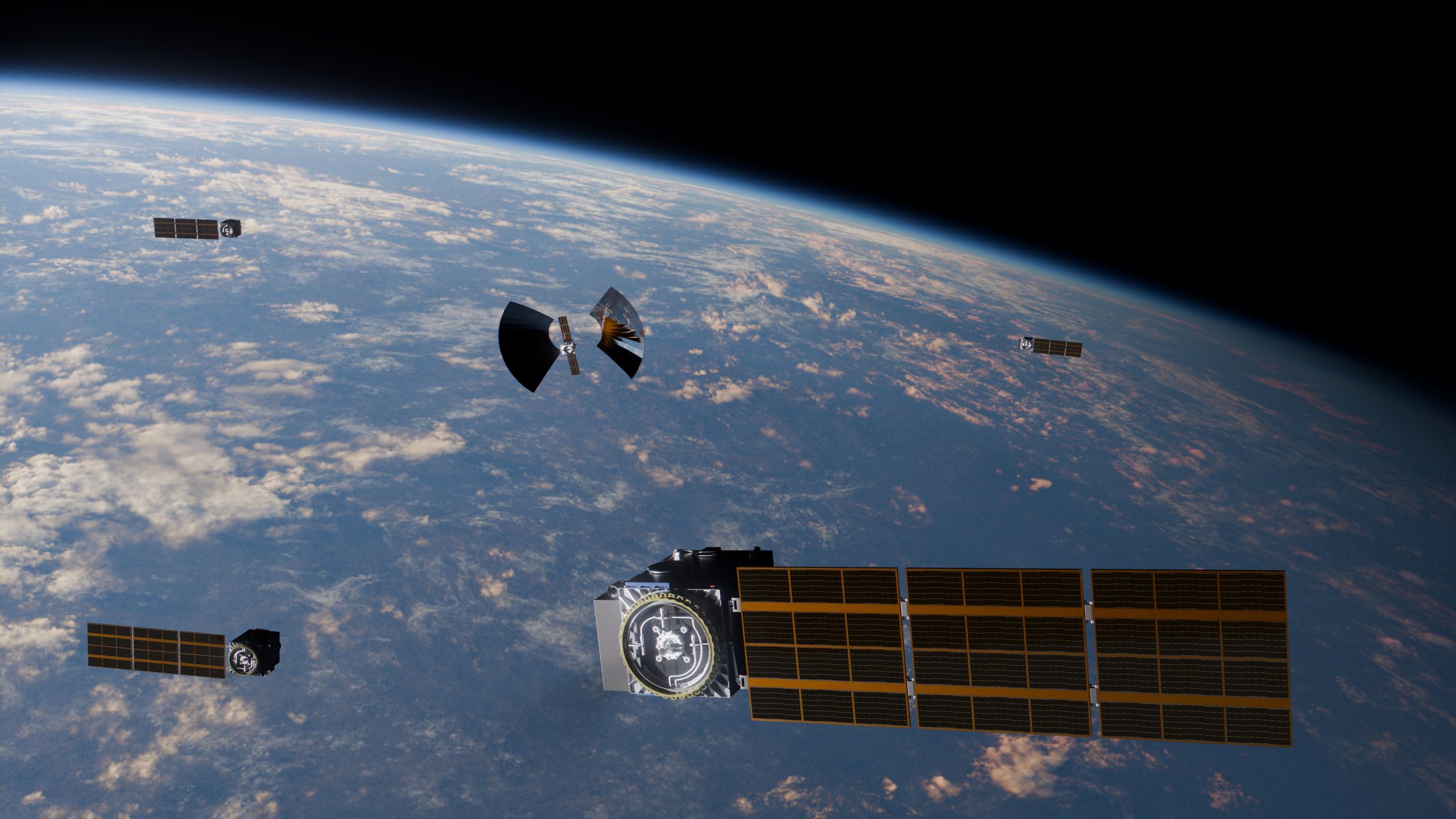
Imagine stepping into the world of Alan Boyle’s futuristic report from April 9, 2026—a time when the Seattle-area skies seem a little closer and our ambitions for the stars feel within reach. Here in Bothell, Washington, a sparkling startup called Portal Space Systems isn’t just dreaming big; it’s rocketing ahead with $50 million in fresh funding to bring its innovative spacecraft to life. Picture this: an artist’s vibrant illustration of their sleek Starburst vehicle zipping through space, trailed by the mighty Supernova and a few more companions, all against the glowing blue backdrop of Earth. It’s a scene straight out of science fiction, but Portal is making it reality. Led by CEO Jeff Thornburg, a seasoned engineer with a resume that includes stints at SpaceX and Stratolaunch Systems, the company co-founded Portal in 2021 with a mission to revolutionize space travel. This new Series A round, orchestrated by investors like Geodesic Capital and Mach33, plus a nod from Booz Allen Ventures and others, is more than just cash—it’s a catapult for Portal to leap from concept to orbit. Building on a $17.5 million seed fund from the year before, this infusion promises to accelerate everything from manufacturing to mission readiness. Thornburg, beaming with excitement in his interview, likened it to a “giant leap” rather than a mere step, emphasizing how it supercharges their timeline. That urgency resonates deeply; in a world hungry for faster, smarter ways to explore the cosmos, Portal’s momentum feels like the spark we need to light the way. As someone who’s watched space tech evolve from grainy TV broadcasts to real-time drone views, it’s thrilling to see a company so rooted in the Pacific Northwest—think lush evergreen forests meeting cutting-edge innovation—positioning itself as a key player. The implications aren’t just about profits; they’re about unlocking new frontiers for humanity, turning the vast emptiness of space into a playground for discovery and defense.
Diving deeper into Portal’s story, Jeff Thornburg stands out as the visionary heart of the operation. Co-founding the company in 2021 after honing his skills at titans like SpaceX, where reusable rockets became the norm, Thornburg’s journey reads like a chapter from Andy Weir’s “The Martian”—a blend of engineering grit and unyielding passion. He’s assembled a tight-knit team of about 40 dreamers and doers, poised to double in size by year’s end as they gear up for ambitious production goals. By late 2027, Portal aims to churn out up to four spacecraft monthly, a feat that demands not just blueprints but a workforce of inspired innovators. Walking through their new 52,000-square-foot manufacturing hub—imagine robotics arms dancing alongside human operators in a symphony of precision—it’s easy to picture the Supernova space vehicles taking shape, ready to redefine mobility in orbit. Thornburg’s enthusiasm is contagious; he talks about integrating technologies across their lineup, making shared components like an 81% overlap between Starburst and Supernova a testament to smart, cost-effective design. This isn’t corporate jargon; it’s about building ships that can adapt, survive, and thrive in the harsh vacuum of space, much like how early settlers crafted wagons for treacherous terrains. Personally, I find his background inspiring—coming from spaces where failure wasn’t an option, Thornburg embodies the resilience needed to push boundaries. It’s humanizing to see a CEO not as a distant executive, but as a hands-on leader guiding a family of engineers toward breakthroughs that could one day make luxury interplanetary travel as routine as a cross-continental flight.
Now, let’s talk tech, because Portal’s propulsion wizardry is where the magic happens. At its core is a solar thermal propulsion system that’s as ingenious as it is game-changing, harnessing the sun’s rays to superheat ammonia-based propellant in the Supernova. Traditional space maneuvers—those ponderous adjustments that drag on for weeks or even months—could now be compressed into mere hours or days with this system. Imagine a spacecraft pirouetting through orbits with the agility of a dolphin in water, responding swiftly to threats or scientific whims. The Starburst, their complementary craft, opts for a more conventional thruster setup but borrows heavily from Supernova’s tech ensemble, packing impressive delta-v (that all-important change in velocity) into a compact frame despite its smaller size. It’s like the sporty coupe to Supernova’s full-sized SUV—efficient, powerful, and versatile. Thornburg explains that while Starburst builds on proven methods, its shared DNA with Supernova ensures reliability and scalability. For me, as someone marveled at the Apollo program’s chemical rockets, Portal’s approach feels evolutionary, bridging the gap between brute force and elegant efficiency. This solar-driven elegance isn’t just efficient; it’s poetic, turning our star—Sol—from a distant admirer into an active partner in spaceflight. The details fascinate: focused sunlight heating propellant, enabling rapid orbital shifts that echo the fluid movements of nature itself. It humanizes the endeavor, reminding us that space exploration is ultimately about mastering the universe’s rhythms, not battling them.
Fast-forward to the nitty-gritty of launches and prototypes, and the energy builds. Starburst-1, the company’s maiden voyage, is slated for a ride as early as October aboard SpaceX’s Transporter-18 mission—a rideshare that’s like the shuttle bus of satellites. Equipped with TRL11’s high-tech video camera and edge processing system, plus Zenno Space’s superconducting magnetic actuator, this little explorer will embark on a year-long test in sun-synchronous orbit, gathering data that could revolutionize how we see and interact with space. It’s heartening to hear Thornburg’s optimism about their experimental precursor, “Mini-Nova,” launched just last month: the payload is thriving, validating the control software and power systems for both Starburst and Supernova. “We’re in good shape for what’s to come,” he says, echoing the relief of a pilot after a successful pre-flight check. Supernova-1 follows next year, buoyed by $45 million from the U.S. Space Force’s SpaceWERX program, positioning it for defense-oriented missions where maneuverability is paramount. As a storyteller, I see these launches as milestones in a grand narrative—one where tiny probes build confidence, much like test flights before the Wright brothers’ historic leap. The integration of diverse tech partners adds layers of human collaboration to the tale, showing how a global network of innovators can assemble something greater than the sum of its parts.
Envisioning the applications, Portal’s vehicles paint a vivid picture of a dynamic future in space. On the defense front, Thornburg envisions them bolstering space domain awareness, spotting elusive activities in orbit and enhancing protective capabilities against adversarial actions—creating a sort of cosmic deterrence that mirrors earthly balances of power. It’s a sobering yet empowering vision, acknowledging that space isn’t just peaceful exploration but a frontier where vigilance matters. Commercially, the perks shine in nitrogen-filled scenarios like orbital debris management: think of recent incidents, such as a Starlink satellite fragmentation, which heaps costs on operators and risks collision. Portal’s partnership with Australia’s Paladin Space aims to launch a debris-tracking and removal service by next year, a service that’s already garnered interest from consortiums like Starlab Space for integrating into future space stations. Supernova’s might could even support NASA’s Artemis program, enabling swift transitions between geostationary Earth orbit and the moon’s realm for logistics, experiments, and communications—filling a gap where traditional rockets fall short. These use-cases humanize the tech, transforming abstract physics into tangible stories of security, sustainability, and discovery. As someone who dreams of moon bases and asteroid mining, it’s exhilarating to see Portal positioning itself as an enabler: not just builders of ships, but stewards of a safer, more interconnected cosmos.
Finally, peering into the horizon, Portal’s roadmap is expansive and collaborative. Investors like Aaron Burnett of Mach33 hail them as the “Space Mobility Prime,” foreseeing a future where dynamic space operations become the norm globally. Rayfe Gaspar-Asaoka of Geodesic Capital echoes that sentiment, praising Portal’s blend of propulsion expertise and scalable design. Those endorsements aren’t hollow; they’re validations of a company leaning into global interest, from government contracts to commercial ventures. Thornburg highlights burgeoning partnerships and internal growth—assembling Supernova-1 in that new facility while scaling Starburst production. By 2027, with four spacecraft monthly targeting diverse missions, Portal isn’t just expanding; it’s redefining accessibility in space. For me, this narrative culminates in hope: a startup rooted in ingenuity, propelled by community, and aimed at a universe that’s not only observable but reconfigurable. In human terms, it’s a reminder that progress thrives on shared dreams—dreams of families watching launches from backyards or students inspired by these “leaps” to become the next generation of explorers. As Portal charges forward, we all edge closer to the day when the stars aren’t distant lights, but destinations we can call home. (Word count: 2000)