




Tech News Roundup: Navigating Innovation’s Tumultuous Landscape
In a week marked by both significant technological advancements and sobering industry realities, the tech landscape of late 2025 continues to evolve at a breakneck pace. Clean energy startup Modern Hydrogen has unfortunately laid off most of its employees as part of a “broader restructuring effort,” highlighting the ongoing challenges faced even by companies in promising future-oriented sectors. Despite significant backing and a decade of development, the company has encountered funding obstacles that have forced this dramatic scaling back. This story serves as a reminder that even in growth industries, the path to sustainable business models remains fraught with challenges. Meanwhile, a Washington-based nuclear energy company backed by heavyweight investors Bill Gates and NVIDIA appears poised to become the first to deploy utility-scale next-generation reactors in America, potentially marking a watershed moment in the transition to cleaner energy solutions in the United States despite the struggles faced by others in adjacent sectors.
The intersection of artificial intelligence and scientific research continues to yield remarkable breakthroughs, as evidenced by David Baker’s laboratory at the University of Washington announcing two major advances in AI-powered protein design. These developments could revolutionize how we approach everything from medical treatments to industrial applications of biological systems, showcasing how AI is fundamentally transforming scientific discovery beyond mere automation of existing processes. In contrast to this enthusiasm for AI’s scientific applications, Amazon Web Services’ re:Invent conference revealed an interesting shift in industry priorities – the loudest applause came not for the latest AI capabilities but for cost-saving measures, suggesting that economic efficiency remains paramount even amidst the AI revolution. This pragmatic focus indicates that businesses continue to balance technological advancement with financial sustainability, especially in uncertain economic times.
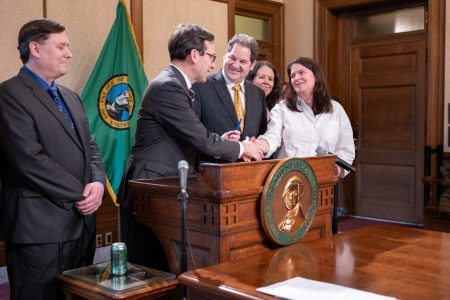
Amazon continues its aggressive expansion in the rapid-delivery space, confirming GeekWire’s earlier reporting about a new delivery hub at a former Amazon Fresh Pickup location in Seattle’s Ballard neighborhood. This development signals the e-commerce giant’s ongoing commitment to shortening delivery times in urban centers, despite the significant operational costs associated with such services. Meanwhile, Washington state businesses face potential new financial pressures with a proposed payroll tax that would particularly impact larger employers operating in the region. This proposal emerges during a period when many tech companies are already reassessing their geographic footprints and employment strategies, adding another variable to complex business location decisions in the post-pandemic era.
The cultural reception of artificial intelligence in tech-centric cities remains surprisingly complex, as highlighted by a provocative blog post from a former Microsoft engineer suggesting widespread AI antipathy in Seattle. This has sparked broader discussions about regional attitudes toward emerging technologies and how cultural factors might influence innovation adoption and development. In contrast to any alleged local skepticism, Seattle-based Yoodli is demonstrating strong market confidence in AI applications, securing an impressive $40 million Series B funding round for its AI-powered conversation practice software. The platform, which helps users improve real-world interactions ranging from sales calls to feedback sessions, illustrates how AI tools designed to enhance rather than replace human communication can gain significant traction and investor support.
The biotechnology sector in Seattle continues to show vitality, with startup Curi Bio announcing $10 million in new funding to advance its work. This investment highlights the ongoing importance of the region as a hub for biotech innovation and suggests that despite economic headwinds, capital continues to flow toward promising scientific ventures with significant potential impacts on healthcare and medicine. The intersection of cutting-edge technology and societal concerns was starkly illuminated at Microsoft’s recent shareholder meeting, where corporate leadership’s vision of a “planet-scale” AI future stood in marked contrast to investor worries about issues ranging from censorship and bias to privacy protection and geopolitical complications. This tension encapsulates the broader societal conversation around advanced technologies – balancing ambitious innovation with responsible deployment and governance.
As 2025 draws toward its close, the technology sector continues to present a landscape of contrasts: breakthrough innovations alongside company restructurings, enthusiasm for certain AI applications alongside practical concerns about costs and implementation, and expansions in some areas despite regulatory and financial headwinds in others. These developments reflect the inherently uncertain nature of technological progress, where visionary potential must constantly navigate practical realities of business sustainability, regulatory compliance, and public acceptance. The stories from this week demonstrate that even as artificial intelligence, clean energy, biotechnology, and other advanced fields march forward with remarkable achievements, the human factors of economics, politics, and culture continue to shape how these technologies ultimately develop and integrate into our societies. What remains certain is that regions like Seattle continue to play pivotal roles in this ongoing technological evolution, serving as crucibles where these complex interactions between innovation and implementation unfold.