







OCOchem: Turning CO₂ into Valuable Chemicals While Navigating Climate Tech Challenges
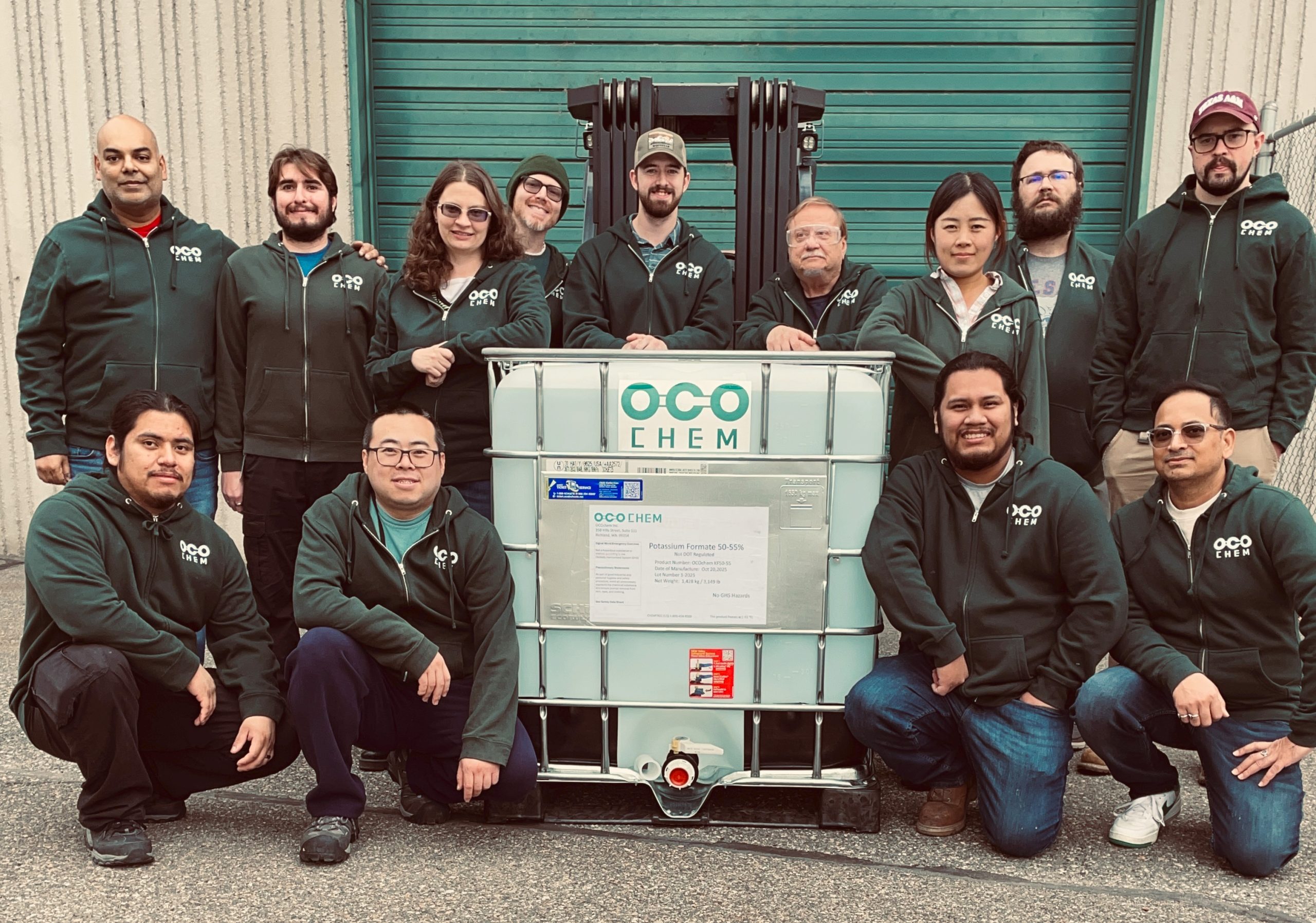
In the industrial heartland of Richland, Washington, a small but determined team at OCOchem is achieving what once seemed like science fiction: transforming carbon dioxide—the very greenhouse gas driving climate change—into valuable industrial chemicals. This past October marked a milestone when the company shipped its first metric ton of potassium formate to a New York-based customer, who will use it as a deicing agent. It’s a tangible achievement that demonstrates how carbon can be recycled rather than simply released into the atmosphere, potentially transforming industrial waste into industrial opportunity.
Led by CEO Todd Brix, a former Microsoft executive who founded the company in 2017, OCOchem has now raised a total of $11.2 million from investors and secured an additional $8.3 million in government grants, including a recent $2.15 million funding round. This continued investment comes against the backdrop of a cooling regulatory environment for sustainability initiatives and a broader decline in climate tech investments. What makes OCOchem stand out is the elegant simplicity of its core technology: proprietary electrolyzer cells that convert water and captured industrial carbon dioxide into formic acid and formate compounds. These versatile chemicals can be used for everything from producing clean-burning hydrogen fuel to serving as ingredients in other valuable chemical processes. “We’re opening up new vistas,” explains Brix, as customers discover the company’s sustainable and affordable solutions for producing chemicals and clean fuels.
The company’s momentum is building through strategic partnerships that showcase the versatility of their technology. A December agreement with German company b.fab will supply formate to feed microorganisms that biosynthesize proteins, amino acids, and other commercially valuable compounds. Perhaps more significantly, OCOchem has partnered with agricultural giant ADM (Archer-Daniels-Midland) to build a commercial pilot plant at ADM’s Illinois facility, home to the world’s largest bioethanol refinery. The partnership represents a perfect circular economy in action—the refinery produces carbon dioxide as a byproduct of the fermentation process, which OCOchem’s technology will transform into formate for use in other product lines. Meanwhile, the company continues to fine-tune processes at its 40,000-square-foot facility in Richland that was commissioned in May 2023, gradually scaling up production capacity.
The political landscape for climate technologies has been turbulent, but some recent policy changes have actually benefited carbon reuse efforts like OCOchem’s. The One Big Beautiful Bill Act maintained the tax credit for carbon capture and importantly increased the credit for processes that reuse carbon in industrial applications from $60 to $85 per ton—now matching the credit provided when carbon is permanently sequestered underground. This policy adjustment recognizes that carbon recycling, not just carbon burial, deserves equal incentives in the fight against climate change. It’s a rare bright spot in what has otherwise been a challenging regulatory environment for sustainability initiatives.
OCOchem’s 17-person team brings deep technical expertise to this challenge, including Chief Technologist Arun Agarwal, who previously spent 12 years in R&D focused on renewable chemicals, energy, and oil and gas. This combination of startup agility and seasoned technical knowledge has enabled the company to move quickly in a field that’s becoming increasingly competitive. European companies, backed by substantial public investment from the European Union, are pursuing similar carbon dioxide-to-formate conversion technologies. Even automotive giant Toyota has research labs working on related processes. But Brix remains confident in OCOchem’s position, noting that his company has “built the largest CO₂ electrolyzer, worked fast to do that, and is operating at the highest performance today.”
As the global community continues seeking solutions to reduce carbon emissions, OCOchem represents an important model of technological innovation that turns problems into opportunities. Rather than viewing carbon dioxide solely as a pollutant to be captured and buried, their approach recognizes it as a potential feedstock for creating valuable products. This paradigm shift—from carbon as waste to carbon as resource—could be transformative for industries struggling to reduce their climate impact. While the company faces a “race” against competitors in Europe and Asia, Brix characterizes it as “a good race”—one where multiple winners could emerge with technologies that help address climate change while creating economic value. As OCOchem scales from shipping its first ton to potentially thousands or millions of tons, it demonstrates how entrepreneurial innovation might help bridge the gap between environmental necessity and industrial reality.