





Visionaries Reshaping Our Future: The 2025 Uncommon Thinkers
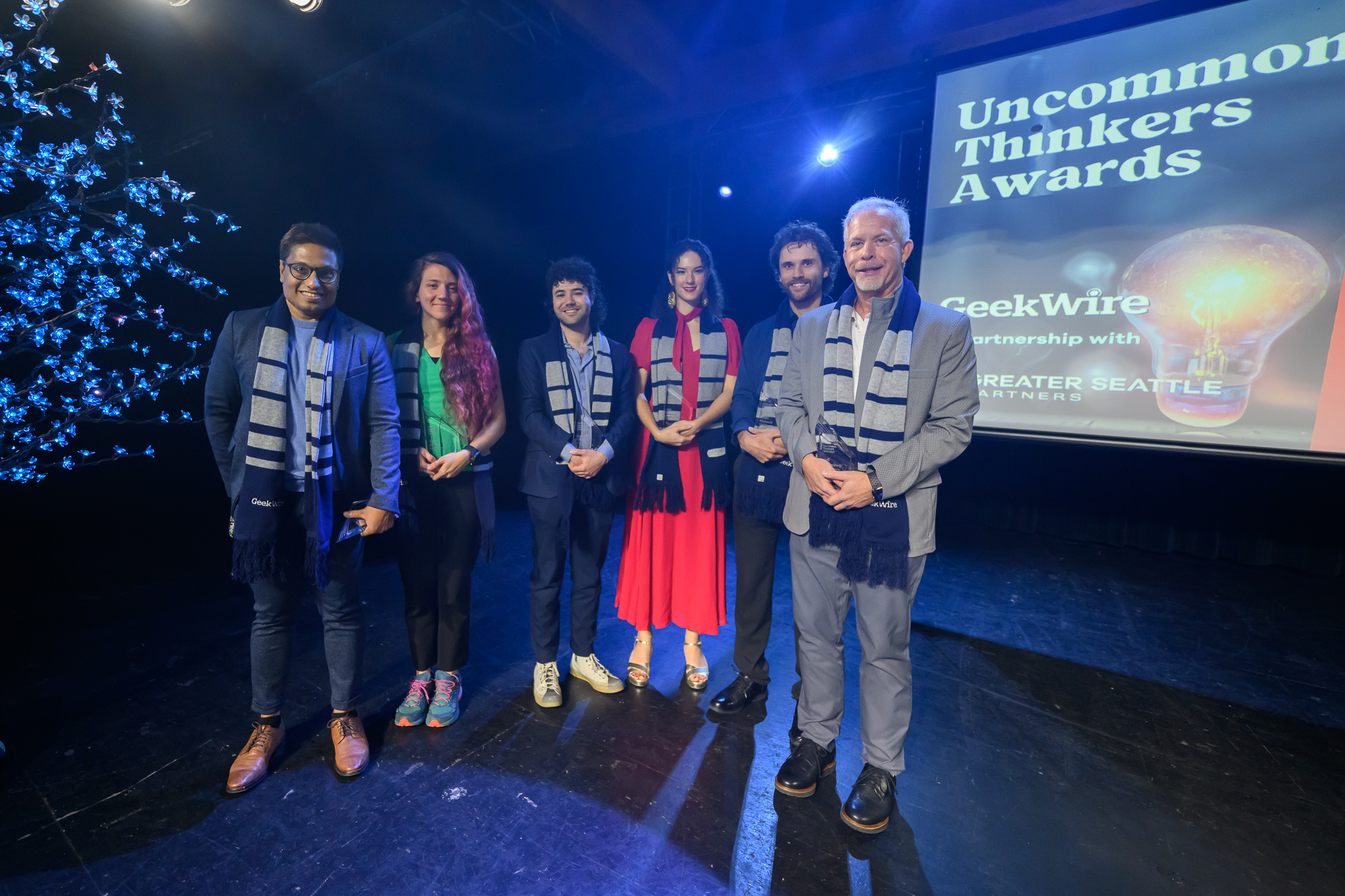
At the recent GeekWire Gala, a remarkable gathering took place that offered a glimpse into humanity’s brightest possible future. Six extraordinary innovators—dubbed the “Uncommon Thinkers”—took the stage to share visions that transcend conventional boundaries of science, technology, and social connection. Selected in partnership with Greater Seattle Partners, these inventors, scientists, and entrepreneurs are not merely participating in their industries—they’re fundamentally transforming them. Their backstage conversations revealed something precious in our often cynical times: genuine cause for optimism. Each of these visionaries carries a unique perspective on how to solve seemingly intractable problems, from space travel to cancer treatment to environmental contamination. What unites them is a willingness to challenge assumptions that others take for granted, combined with the scientific rigor and entrepreneurial drive to turn radical ideas into reality.
Jeff Thornburg of Portal Space Systems brings decades of rocket science expertise from SpaceX and Stratolaunch to an audacious venture: spacecraft propelled by concentrated sunlight. This isn’t science fiction but a revival of dormant NASA concepts, reimagined for commercial viability. When asked about his company’s future impact, Thornburg made a telling correction—not “if Portal succeeds” but “when we’re successful.” This confidence stems from a clear vision: becoming “the backbone of Earth-Moon logistics,” enabling sustainable commerce in Earth orbit, supporting permanent human presence on the Moon, and eventually reaching Jupiter’s moons. Thornburg represents a new era of space entrepreneurship, where bold ambitions are matched with practical engineering knowledge. His work embodies the transition from government-dominated space programs to private ventures that can move more nimbly while still pursuing grand objectives. By harnessing sunlight as propulsion, Portal offers a pathway to space exploration that doesn’t depend on carrying massive amounts of fuel, potentially revolutionizing how humanity accesses and utilizes the solar system.
In the realm of medicine, Anindya Roy’s work at Lila Biologics demonstrates how artificial intelligence is transforming drug discovery at an astonishing pace. Trained in Nobel Prize-winner David Baker’s lab at the University of Washington, Roy witnessed firsthand the before-and-after impact of machine learning on protein design. What was once an overwhelming numbers game—ordering hundreds of thousands of designs with success rates below 1%—has become remarkably efficient, with 5-20% success rates requiring only a few hundred designs to find promising drug candidates. “If you told me a couple of years ago that we can design an antibody from a computer, I would not believe you,” Roy admitted, highlighting the revolutionary nature of this approach. By creating proteins that have never existed in nature, specifically designed to fight cancer, Roy’s team is bypassing the traditional limitations of drug discovery. This represents not just an incremental improvement but a fundamental reimagining of medical research—one that could dramatically accelerate our ability to address devastating diseases with precisely tailored therapeutic solutions.
While most tech CEOs focus on building unassailable business moats, Jay Graber of Bluesky is pursuing a radically different approach to social media. As the leading alternative to X (formerly Twitter), Bluesky operates on a decentralized model that actually helps users maintain ownership of their content and relationships—even if they choose to leave the platform. Graber describes Bluesky and its underlying AT Protocol as a “collective organism,” positioning herself not as a controlling authority but as a guide and steward of a growing ecosystem. This philosophical stance offers a refreshing counterpoint to the tech industry’s typical power dynamics. “More as guides and stewards, rather than just dictators or emperors as they like to style themselves,” is how Graber characterizes the leadership approach she believes would benefit the industry and world. By building portability and user autonomy into the foundation of her platform, Graber challenges the entrenched assumption that social networks must trap users and their data to succeed. Her vision suggests a more humane digital future where technology serves genuine human connection rather than exploiting it.
The artificial intelligence revolution has spawned massive, well-funded ventures like OpenAI and Google’s AI initiatives, but Kiana Ehsani of Vercept proves that outsized innovation doesn’t always require outsized resources. After moving from Iran to Seattle for her PhD and spending four years at the Allen Institute for AI, Ehsani launched a company competing directly with these giants in the emergent AI agent space—with just a fraction of their backing. Her vision transcends today’s computer interfaces: moving beyond mouse, keyboard, and touchscreen to create a natural interaction model, akin to speaking with a helpful coworker. Ehsani tempers expectations with pragmatic insight, noting that today’s AI agents resemble the early, limited capabilities of ChatGPT three years ago rather than current performance. Her advice for those exploring AI agents resonates with practical wisdom: “Start small, start with simple tasks that you don’t want to do, and then slowly build on top of it to see the magic.” This grounded approach, combined with ambitious long-term vision, exemplifies how meaningful technological progress happens—not in dramatic overnight transformations, but through persistent, incremental advancement toward a clearly defined goal.
Perhaps the most immediate human impact comes from Brian Pinkard’s work at Aquagga, tackling the pervasive threat of “forever chemicals” (PFAS) that have infiltrated our water, food chain, and bloodstreams. Current industry approaches merely relocate the problem—filtering out these substances only to landfill or incinerate them elsewhere. Pinkard’s solution is fundamentally different: technology originally designed for chemical weapons destruction that subjects PFAS to extreme heat and pressure, breaking these persistent compounds down into harmless salts. “I’m a skeptic, I’m cynical, I’m a scientist,” Pinkard said, emphasizing that he needed to see proof before believing such decomposition was possible. His vision extends beyond PFAS remediation to transforming hazardous waste processing entirely, challenging what he calls the “thermodynamic insanity” of current methods that truck enormous volumes of wastewater to incinerators. Pinkard’s work represents science at its most essential—developing practical solutions to protect human health from invisible but significant threats. By permanently neutralizing these chemicals rather than moving them elsewhere, Aquagga addresses environmental contamination at its molecular level, potentially ending the cycle of pollution that has become a defining challenge of our industrial age.
These Uncommon Thinkers, along with Chet Kittleson of Tin Can (who creates WiFi-enabled landline phones helping children connect without screens), represent diverse approaches to innovation united by a common thread—the courage to question established assumptions and the persistence to develop alternatives. From the depths of space to the molecular structure of proteins, from social media infrastructure to artificial intelligence interfaces, from environmental chemistry to balanced technology use, these visionaries are redefining possibilities. Their work reminds us that the most profound innovations often emerge not from incremental improvements to existing systems, but from fundamentally rethinking those systems’ underlying premises. In a time when technological progress sometimes seems to create as many problems as it solves, these Uncommon Thinkers offer something precious: evidence that human creativity, scientific rigor, and entrepreneurial determination can address our most significant challenges while creating a more sustainable, healthy, and connected world. Their uncommon thinking may well become the common sense of tomorrow.