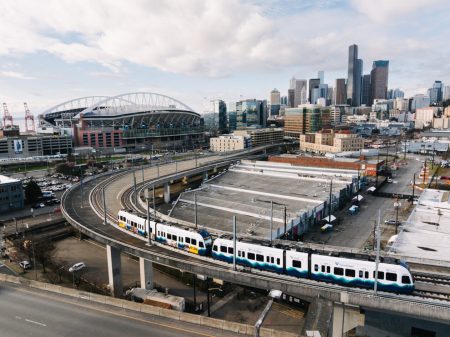







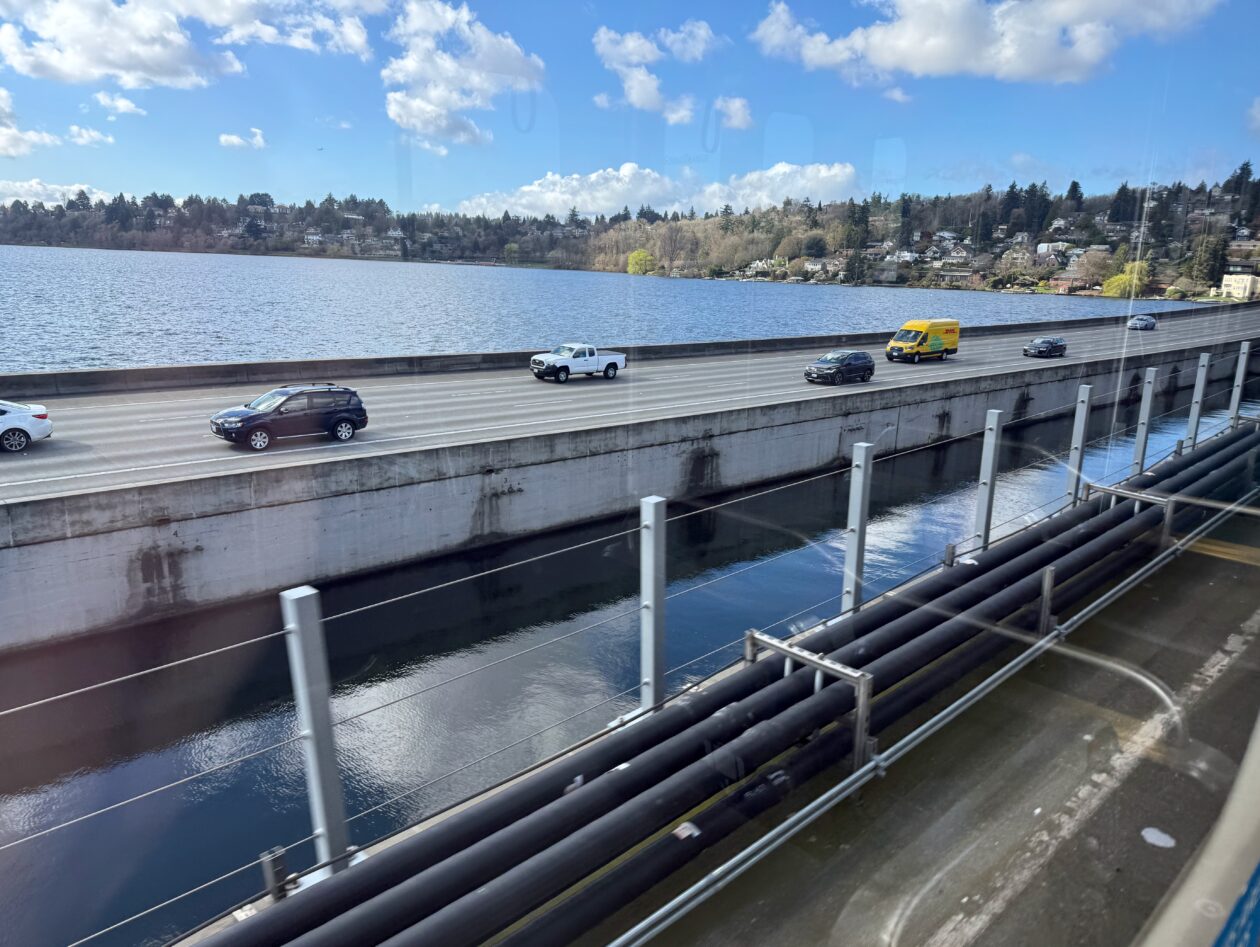
Imagine stepping onto a sleek, modern train car, the kind that glides silently through cities, and feeling the gentle hum as it pulls away from South Bellevue station, heading toward Seattle. But this isn’t just any ride—it’s a journey across Lake Washington on a floating bridge, a feat of engineering that’s never been done before. As the train approached the expansive waters on that crisp Thursday morning, I couldn’t help but wonder: What if it swayed or jolted? Would the bridge, designed to support cars and trucks, handle the weight of a full train and its passengers? The reality, though, surpassed my imaginings. The ride was impeccably smooth, almost mundane in its steadiness, at a steady 55 mph over the 1.2-mile span. Glimpsing out the window at the shimmering lake below and the eastbound traffic whizzing along I-90, you realize this is a world first—a light rail line defying expectations on a floating structure. For many commuters glued to their phones or dozing through the daily grind, they’ll never suspect the marvel beneath their seats. It’s all quiet, comfortable, and surprisingly unremarkable, which is exactly the point: safety first, then seamless transit. GeekWire reporters tagged along for a media preview, zigzagging from South Bellevue through new stops at Mercer Island and Judkins Park in Seattle’s Central District. Public riders would start flocking in just two days later. The experience felt like a portal to a better-connected future, where the Eastside and city core converge without the usual hassles of highways chock-full of frustrated drivers. You start to picture it not as a train on a bridge, but as a lifeline, stitching together the fabric of a booming region where tech empires and sleepy neighborhoods coexist.
As the train emerged from the tunnel onto that open lake vista, it felt like the world opened up. Sound Transit’s CEO, Dow Constantine, was there too, clutching a strap with wide-eyed enthusiasm, urging everyone to take in the sight. “Look at this. Look. At. This,” he exclaimed, his voice echoing with genuine awe as Lake Washington stretched out beneath us, flanked by I-90 traffic flowing both ways. Gazing northward or southward toward Mount Rainier’s distant peak, it struck me how this view symbolized more than beauty—it promised a seismic shift in daily life. Constantine turned to the thousands of tech workers at giants like Microsoft and Amazon, whose campuses sprawl from Seattle to Bellevue, Kirkland, and Redmond. “Get ready for a significant upgrade in your quality of life,” he said with a grin, imagining mornings without the dread of gridlock. No more white-knuckling drives, no more two-hour commutes that should take 20 minutes. “You’ll hop on and know exactly when you’ll arrive—predictable, reliable, every time.” He painted pictures of easier work-life balances, like streamlining the office shuffle or recruiting talent without geography being a barrier. Companies are buzzing about it, he added, seeing it as a catalyst for bringing people back to the office or luring skilled workers from one side of the lake to the other. It’s the kind of change that feels personal, almost intimate, transforming drudgery into opportunity amidst the region’s explosive tech growth.
But to truly humanize this milestone, you have to remember the pain it alleviates. That 13-mile trek between Seattle and Microsoft’s Redmond hub has been a notorious nightmare for years, a bottleneck born from population booms fueled by tech prosperity. Roads have buckled under the weight of daily commutes, turning what should be a quick drive into a gamble with time and sanity. Bellevue’s skyline has risen dramatically, especially around Amazon’s sprawling operations—25,000 corporate workers there, plus another 50,000 in Seattle, all coping with the chaos. King County Councilmember Claudia Balducci, who’s deeply invested as a Sound Transit board member representing Bellevue, Kirkland, Mercer Island, and Redmond, spoke passionately about her constituents. These are the tech folks who’ve longed for this connection, dreaming of ditching the steering wheel’s stress. “Sitting behind the wheel is completely lost, unproductive, stressful time,” she reflected, her words resonating with anyone who’s ever cursed traffic jams. “Sitting in a train, you can read, you can do work. I think it’s just going to be a game changer.” She shared stories of daily riders already flocking to the existing line between downtown Bellevue and Redmond Technology Station, where 10,000 people dart around Microsoft all day. Now, with the full 2 Line integration, projections hit 43,000 to 52,000 riders daily by 2026, with trains every 10 minutes from dawn to midnight, nonstop—even on weekends. It’s a narrative of liberation, where humanStories of everyday struggles give way to empowered routines.
Balducci’s enthusiasm spills over into visions of economic transformations. “People make conscious decisions about where to locate their businesses and their homes based on fixed transit,” she explained, noting how light rail stations anchor major developments. A bus stop might not lure a corporate giant like Amazon, but hubs like these? They do. Tech behemoths are already clustering around them, drawing housing, shops, and livelihoods in their wake. Imagine a neighborhood pulsing with energy, families strolling to cafes, entrepreneurs pitching ideas—all magnetized by the stations’ glow. Riders wouldn’t just commute; they’d explore, visiting friends across the lake or popping into new spots for impromptu dates or adventures. Balducci mused about ripple effects we can’t fully foresee: a shifted economy, a reimagined feel to the region where innovation flows freely. It’s not just infrastructure; it’s a catalyst for human connections, blending work, play, and community in ways that make life feel fuller, less partitioned. As we rode, you sensed this undercurrent—a quiet revolution brewing beneath the surface, promising not just efficiency but a richer tapestry of experiences for everyone involved.
Of course, none of this magic happens without the unseen heroes: the engineers who made it all possible. As the train glided effortlessly over the lake, I pondered the invisible complexities beneath the smoothness. The tracks nestle onto the existing Homer M. Hadley Memorial Bridge, a 1989 structure originally built for cars, now retrofitted for rails. They had to seamlessly blend fixed and floating segments, allowing for natural flex as the bridge responds to water and weather. Craig Delalla, a seasoned Sound Transit systems engineer, put it bluntly: “Once you introduce repurposing roadways and tunnels and floating bridges, there’s just more integration, more complexity. All the systems—power, control, structural—they all have to work together.” It’s a “big deal” over water, he emphasized, a symphony of precision where one misstep could disrupt everything. Yet, from inside the car, it’s all invisible peace, reinforcing that true innovation prioritizes user comfort. The ride felt like a testament to human ingenuity, blending old infrastructure with cutting-edge tech to create something seamless and safe. Paired with striking stations like Mercer Island’s, adorned with sculptor Belize Brother’s “Stroke”—suspended paddles evoking motion and life—you start to see how art and engineering intersect, making transit not just functional, but inspiring.
Alighting at Judkins Park in Seattle’s Central District, the transformation from lake-crossing wonder to urban oasis was striking. Laminated glass windscreens at the platform showcased Barbara Earl Thomas’s cut-paper art, “A Walk in the Neighborhood”—vibrant images of people, pets, and scenes that make the space feel alive and personal. Looking out at downtown Seattle’s high rises piercing the skyline, it hit me how this link bridges divides. Back inside the car, with operator Nur at the controls, the entire journey felt human-scaled: a smooth vessel carrying dreams across waters, punctuating the day’s rhythms with accessibility. From initial curiosities about swaying bridges to these tangible shifts—reduced commutes, economic booms, and serene surprises—the Crosslake Connection proves that progress can feel as natural as breathing. It’s more than transit; it’s a narrative of progress, where tech saviors, beleaguered commuters, and innovative dreamers unite, charting a path toward a more connected, lively Seattle region. By unveiling this on Saturday, Sound Transit isn’t just launching a line—it’s inviting everyone to rewrite their stories, one swift, silent ride at a time. The lake’s expanse, once a barrier, now feels like an open invitation to explore, work, and thrive without the old constraints weighing heavy. In the end, humanizing this marvel means seeing it through the eyes of those affected: workers gaining hours in their day, families bridging distances, and dreamers finally reaching their destinations with ease and wonder.