






AI Coding Tools Reshape Software Development: Claude Code Meetup in Seattle
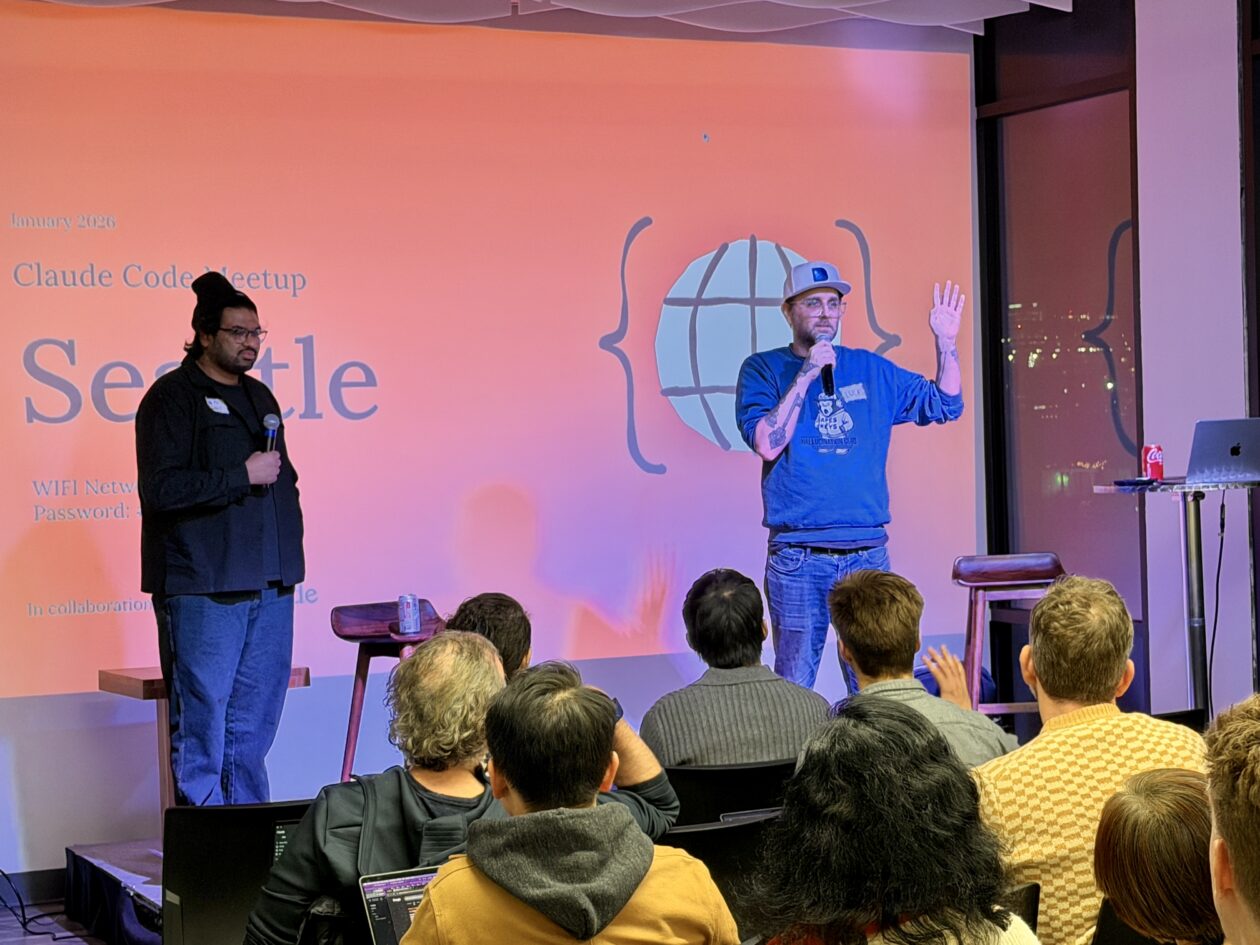
In a packed tech gathering at Thinkspace in Seattle, more than 150 software engineers and developers came together to explore the rapidly evolving world of AI-assisted coding. The Claude Code Meetup, organized by Pioneer Square Labs, showcased how Anthropic’s specialized AI tool is transforming software development workflows and sparking renewed enthusiasm in the tech community. The event highlighted a significant shift in how developers approach their craft—moving from writing code to architecting solutions with AI as their collaborator.
Claude Code represents a new generation of AI programming tools that have made remarkable capability leaps in recent months. As Carly Rector, a product engineer at Pioneer Square Labs explained during her demonstration, “The biggest thing is closing the feedback loop—it can take actions on its own and look at the results of those actions, and then take the next action.” This self-correcting ability marks a crucial evolution in AI coding assistants, which can now navigate around previous limitations including context-window constraints. The technology effectively functions as a supercharged pair-programmer, capable of handling increasingly complex workflows and interacting with both code and applications to solve problems autonomously. Anthropic’s underlying models have improved to the point where Claude Code can maintain longer threads of reasoning and execute sophisticated development tasks that previously required extensive human intervention.
The enthusiasm at the Seattle meetup reflected broader industry excitement about how these tools are reshaping professional workflows. Johnny Leung, a software engineer at Stripe, described a fundamental shift in his professional identity: “It’s kind of evolving the mentality from just writing code to becoming like an architect, almost like a product manager.” This sentiment was echoed by many attendees who demonstrated creative applications of Claude Code beyond traditional development tasks. R. Conner Howell showcased how the tool can function as a personal cycling coach by querying performance data and generating customized training plans, illustrating how AI coding capabilities can extend into unexpected domains. The demonstrations revealed not just incremental productivity improvements but potentially transformative changes to how software engineers conceptualize problems and solutions. For many developers, these tools are unlocking creativity rather than merely automating routine tasks.
The impact of Claude Code extends beyond technical capabilities to reigniting passion within the developer community. Damon Cortesi, a veteran software engineer who co-founded Seattle startup Simply Measured and now works at Airbnb, attended his first tech meetup in over five years. “There’s no limit to what I can think about and put out there and actually make real,” he remarked, capturing the sense of expanded possibility that many developers feel when working with these advanced AI tools. This enthusiasm comes amid rapid commercial growth—Claude Code reportedly reached a $1 billion run rate just six months after its May launch. Meanwhile, Anthropic has expanded its physical presence in the Seattle tech scene, opening a local office in 2024 as it reportedly seeks another $10 billion in funding at a staggering $350 billion valuation. The company also recently released Claude Cowork, described as Claude Code’s “non-developer cousin” designed for general knowledge work rather than programming specifically.
However, this technological evolution raises profound questions about the future of software development as a profession. New York Magazine columnist John Herrman captured this tension in a piece titled “How Claude Reset the AI Race,” noting that “if you work in software development, the future feels incredibly uncertain.” The anxiety about job displacement contrasts with the enthusiasm shown at events like the Seattle meetup. Interestingly, Anthropic revealed that it used Claude Code to build Claude Cowork itself—a notable example of AI tools being used to create other AI products. This recursive development model suggests new possibilities for how software might evolve in the coming years. At the same time, analysts at William Blair expressed skepticism that businesses will simply start building their own software with these new AI tools, arguing that “determining what to build next and how it should function within a broader system is fundamentally more important and more challenging than the technical act of building and coding it.”
As the evening concluded, Caleb John, a Seattle entrepreneur working at Pioneer Square Labs, addressed the crowd with a forward-looking perspective: “We’re excited to see all the cool things you do with Claude Code. It’s really a new era of software development.” This sentiment captures the current moment in the evolution of programming tools—a time of both transformation and possibility. Claude Code joins similar offerings like OpenAI’s Codex and Google’s Antigravity in a rapidly expanding ecosystem of AI-powered development tools. What distinguishes this generation of tools is their ability to not just suggest code snippets but to reason through complex problems, debug their own work, and adapt to feedback. For the developers gathered in Seattle, these capabilities represent not just incremental improvements but a fundamental reimagining of what it means to create software. As they shared use cases and techniques, they were collectively exploring the early days of what might become a new paradigm in human-computer collaboration—one where AI handles increasingly complex portions of the development process while human creativity and judgment focus on higher-level concerns.