



Blue Origin Unveils TeraWave: A Bold Step into Ultra-High-Speed Satellite Communications
Jeff Bezos’ space company Blue Origin has announced an ambitious plan to create TeraWave, an ultra-high-speed satellite data network that will directly compete with Elon Musk’s Starlink for high-end enterprise and government clients. Revealed through an FCC application filed in early 2026, TeraWave represents a significant evolution in satellite communications, promising speeds that dramatically outpace current offerings in the market. With symmetrical data speeds reaching up to 6 terabits per second—6,000 times faster than the 1 gigabit per second downlink speeds offered by Amazon Leo (formerly Project Kuiper)—Blue Origin is clearly targeting data-intensive applications and customers with exceptional bandwidth requirements.
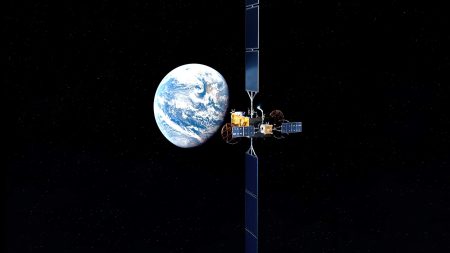
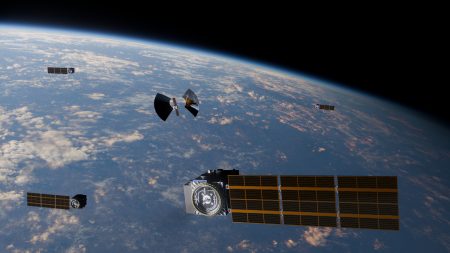
The technical specifications of TeraWave reveal the scale of Blue Origin’s ambition. The planned constellation will consist of 5,408 satellites distributed across both low Earth orbit (LEO) and medium Earth orbit (MEO). The majority—5,280 satellites—will be placed in LEO and deliver access speeds up to 144 gigabits per second, while a smaller complement of 128 satellites in MEO will provide the terabit-level speeds that give the network its name. Blue Origin plans to begin deploying these satellites in late 2027, likely using its own New Glenn rockets to place them in orbit. This multi-orbit approach is designed to create a network that can facilitate ultra-high-throughput connections between global data hubs while also providing gigabit-scale connections to users in regions not well served by fiber optic infrastructure—potentially bringing transformative connectivity to underserved parts of the world.
What makes TeraWave particularly interesting is how it positions Blue Origin within the broader ecosystem of Bezos-founded companies. Amazon Leo, the satellite broadband internet service that emerged from Bezos’ vision while still Amazon’s CEO, is currently deploying over 3,200 satellites in low Earth orbit. TeraWave appears to target a higher-end market segment than Amazon Leo, but there’s undeniable overlap in their enterprise and government customer bases. This raises intriguing questions about the relationship between these two Bezos-linked ventures. Is TeraWave part of a coordinated strategy between Blue Origin and Amazon, or does it represent a parallel effort that might eventually lead to consolidation? Industry consultant Tim Farrar speculates that this could be part of an ongoing negotiation with Amazon, or perhaps an alternative source of launch demand for Blue Origin in case Amazon scales back its space investments.
The timing of Blue Origin’s announcement coincides with SpaceX’s plans to enhance its Starlink network with V3 satellites capable of terabit-level downlink speeds. This suggests that the race for dominance in high-speed satellite communications is intensifying, with both companies recognizing the growing demand for ultra-high-throughput connections driven by artificial intelligence, cloud computing, and other data-intensive applications. TeraWave could play a crucial role in connecting a rapidly expanding ecosystem of data centers and enterprises that depend on lightning-fast connections. By establishing itself in this market, Blue Origin is not just competing with SpaceX but potentially creating a new standard for what satellite communications can achieve in terms of speed and capacity.
One key advantage that Blue Origin might leverage is vertical integration—the ability to use its own rockets to launch its satellite constellation. As Farrar notes, this approach has served SpaceX well, allowing the company to control costs by creating its own launch demand. Unlike Amazon, which must pay retail prices for launches, Blue Origin can potentially achieve more favorable economics by using its own launch vehicles. This cost advantage could prove crucial in building out a network with the scale and sophistication of TeraWave, especially when competing against the well-established Starlink system. Furthermore, as a private company focused on space technology, Blue Origin may have more flexibility than Amazon to make the long-term investments required for next-generation satellite networks without the same pressures from public shareholders.
The emergence of TeraWave signals a new chapter in the commercialization of space and the evolution of global communications infrastructure. With data speeds measured in terabits rather than gigabits, these next-generation satellite networks will enable applications that were previously impossible or impractical. From supporting advanced AI operations to facilitating real-time collaboration across continents to providing connectivity in the most remote regions, systems like TeraWave could fundamentally transform how businesses, governments, and eventually consumers access and utilize data. As Blue Origin prepares to begin deploying satellites in 2027, the competition between TeraWave and similar high-capacity networks will likely drive further innovation in both satellite technology and the applications it enables. For Jeff Bezos, TeraWave represents not just a business opportunity but a continuation of his long-standing vision to build infrastructure that expands human possibilities—a vision that now extends from Earth’s surface to the orbital paths hundreds of kilometers above.