





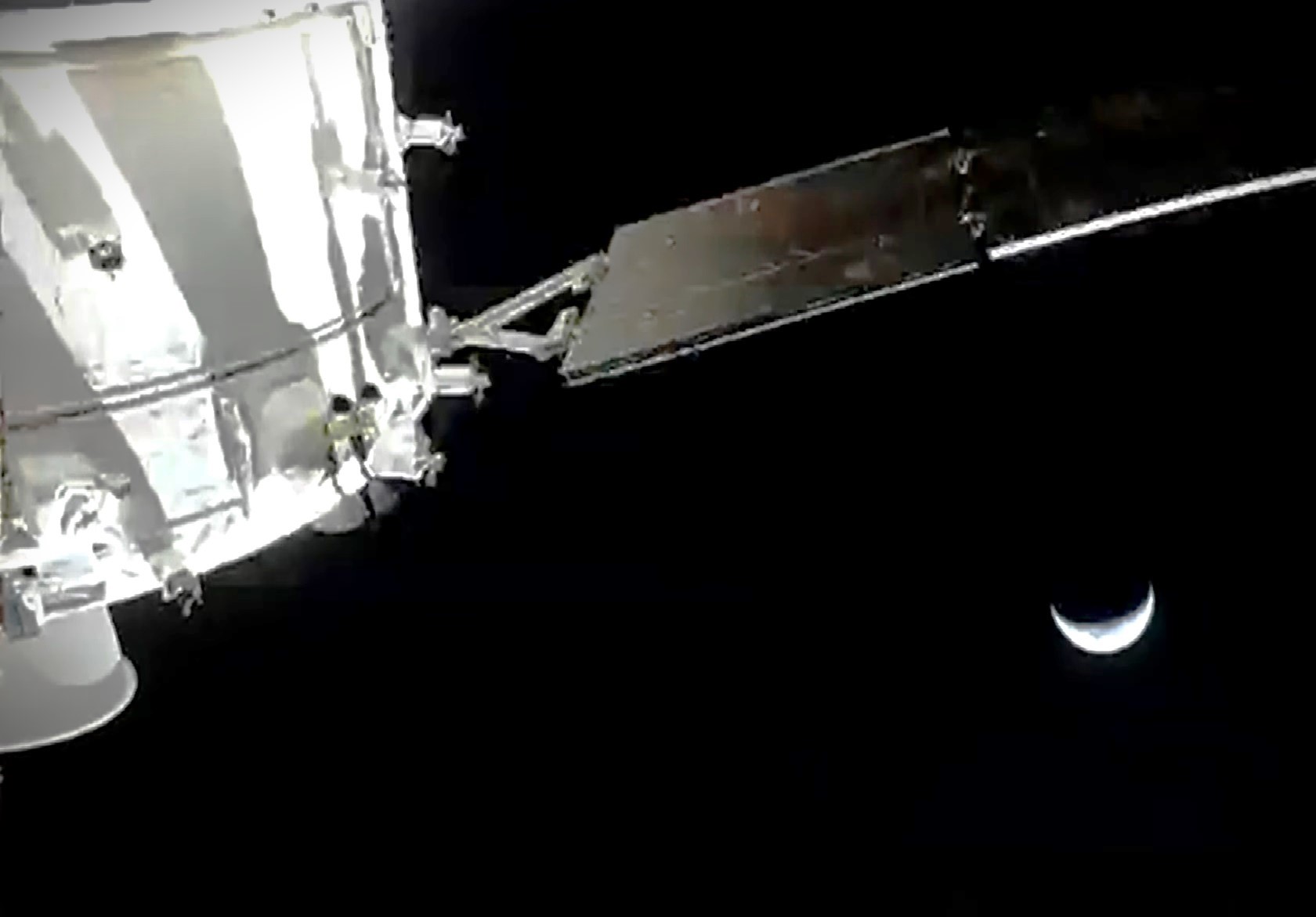
As the Artemis 2 mission hurtles toward its triumphant conclusion, imagine peering through the lens of a simple camera mounted on one of Orion’s solar array wings—an unassuming gadget that captures the stark beauty and profound isolation of space. In the foreground, the rugged, cylindrical service module looms like a trusty companion, its panels gleaming faintly in the distant sunlight. Behind it, Earth hangs as a delicate crescent, a thin blue sliver against the infinite blackness, reminding us of home’s fragility. This image, shared by NASA via YouTube, isn’t just a photo; it’s a window into humanity’s relentless quest to explore beyond our planet. Now, four brave souls—mission commander Reid Wiseman, pilot Victor Glover, mission specialist Christina Koch, and Canada’s Jeremy Hansen—are midway through their 10-day odyssey around the moon and back, their hearts swelling with anticipation as they zip toward a Pacific Ocean splashdown spot just off the California coast. After launching on April 1 atop NASA’s mighty Space Launch System rocket, they’ve tested Orion’s limits, proving that human exploration isn’t just about science—it’s about reconnecting with the wonder that makes us human. They’ve been orbiting the lunar surface since 1972, when Apollo 17 last ventured this far, and now, racing homeward, they’re gaining speed, their vessel Integrity slicing through the void like a comet returning to its origin. It’s a moment that blends technical marvel with raw emotion, as these astronauts, who’ve endured the solitude of deep space, prepare to re-enter the welcoming arms of Earth.
Yet, for all their expertise, the crew knows that triumph hangs on the razor edge of precision. Glover, with his calm, reassuring voice during a live space-to-ground Q&A with a congressional delegation, paints a vivid picture of what lies ahead: “We’re going to come into the atmosphere at almost 40 times the speed of sound,” he explains, his words carrying the weight of experience from countless fighter jet flights. “And then we’ll slow down to a 20-mile-an-hour touchdown into the Pacific. The heat shield and the parachutes are going to get us nice and slow. We can’t wait to see the dive team and the Navy that are going to pick us up.” It’s that human touch— the excitement of seeing familiar faces—that grounds this epic journey. Wiseman, Koch, Glover, and Hansen aren’t just pilots; they’re explorers testing Orion’s propulsion, heat shield, and parachutes for the grander goal of landing humans on the moon by 2028. They’ve lived onboard this capsule for days, eating rehydrated meals, conducting experiments, and gazing at stars few have seen up close. Now, as Earth’s gravity pulls them in, they’re counting on every system to perform flawlessly, no margin for error. Glover’s enthusiasm shines through; he’s the embodiment of quiet confidence, a father and veteran sharing how this mission isn’t just about conquering space—it’s about inspiring the next generation to dream big. In these fleeting moments of connection, we feel the pulse of human endeavor, the blend of vulnerability and strength that defines us as explorers.
But the stakes peak during what flight director Jeff Radigan calls the “13 minutes of things that have to go right” —though he quickly corrects himself, broadening it to an “hour and a half” of high-stakes choreography. Comparing it to the “Seven Minutes of Terror” during Mars rover Curiosity’s 2012 descent, Radigan highlights the unforgiving precision required. As Orion plunges into the atmosphere at blistering speeds, plasma and friction will shroud the capsule in 5,000-degree heat, creating a temporary blackout where no signals can pierce the ionized veil. Glover describes the G-forces as “sporty,” peaking at twice what they experienced on launch, potentially hitting 9 or 10 Gs in a worst-case scenario—like the intense pulls in a fighter jet. Yet, it’s not terror that defines this; it’s the meticulous dance of technology and human resolve. Radigan’s team in Houston monitors every burn, every maneuver, ensuring the “lofted entry” —a skip trajectory refined from Artemis 1’s scorched heat shield—dissipates energy gradually. For the astronauts, it’s a mix of adrenaline and trust. Glover often speaks of the camaraderie among the crew, how they’ve joked and shared stories to combat the isolation. “We’re all in this together,” he might say if asked, weaving personal bonds into the mission’s fabric. This period isn’t just engineering; it’s a testament to our collective spirit, pushing boundaries so future generations can live among the stars.
Meanwhile, the world watches, transfixed by NASA’s live streams that have run nonstop since liftoff on YouTube and NASA+, turned up even louder for the finale. Starting at 3:30 p.m. PT on Friday, viewers can tune in via commercial platforms, feeling part of the drama as Orion hurtles home. In Seattle, at the Museum of Flight’s William M. Allen Theater, crowds gather for a big-screen experience, doors opening at 3 p.m. for museum members and ticket-holders. It’s free for insiders, but there’s the “Sunset Special” for stragglers arriving late—a cheeky discount welcoming the latecomers to this shared human spectacle. Families huddle with popcorn, friends chat excitedly, all united in the thrill of witnessing history. For many, it’s not just about the technical feats; it’s about the emotions stirred by seeing astronauts return, their faces etched with the stardust of discovery. Glover’s earlier broadcasts have become highlight reels, where he shares glimpses of lunar vistas or candid moments, making the abstract tangible. As the clock ticks toward splashdown, this global audience represents the connective tissue of humanity—curious, hopeful, and inspired by the courage to venture into the unknown.
Dive deeper into the timeline, and the precision unfolds like a symphony: at 4:15 p.m. PT, communications shift from deep-space antennas to orbital satellites, ensuring unbroken contact as they near Earth. By 4:33 p.m., the crew module detaches from the European-built service module, which burns up in a fiery dance, while Orion repositions for descent. A final burn at 4:37 p.m. tweaks the trajectory, and at 4:53 p.m., “entry interface” occurs as they pierce the atmosphere at 400,000 feet, plasma igniting like a halo of fire. The blackout follows, lasting six minutes, before signals resume at 4:59 p.m., as the forward bay cover jettisons between 36,000 and 24,000 feet. Drogue parachutes bloom at 22,000 feet at 5:03 p.m., stabilizing the fall, followed by the mains at 6,000 feet just a minute later. At 5:07 p.m., splashdown: parachutes severed, helium bags inflate for buoyancy, Orion bobbing upright in the Pacific. Recovery teams—Navy divers and air support—act swiftly, extracting the crew in under two hours, whisking them to the USS John P. Murtha via helicopter for checks before shore-side flights to Houston. Throughout, monitors from air and sea track every detail, a ballet of coordination that underscores our capacity for harmony in chaos. For the astronauts, this sequence is a countdown to reunion: with families, with gravity, with the simple joys of a meal not from a tube. Glover describes the touchdown as gentle, yet exhilarating, a reminder that coming home from the stars is as profound as leaving.
Yet, woven into this national triumph are the unsung heroes in Washington state—contributors to Orion’s beating heart. At L3Harris’ Aerojet Rocketdyne plant in Redmond, engineers crafted 12 reaction control thrusters for re-entry orientation and eight auxiliaries for the service module; they even refurbished the main engine from the shuttle Atlantis, paving the way for future lunar powerplants. Nearby in Mukilteo, Karman Space & Defense built the thruster separation system for the bay cover’s ejection and side hatch mechanisms for emergency escapes. Senator Maria Cantwell, representing this aerospace hub, joined the congressional Q&A, praising the mission as a “major investment in science and a testament to human achievement.” Tipping her hat to local innovation, she invited the crew to tour the facilities that built Orion’s thrusters, sparking Glover’s heartfelt reply on what sets human explorers apart from robots. “I hope this resonates,” he said, tying it to earthly challenges. “A rover collects data slow and steady, but the human brings back the feeling—the physiological, the emotional—the human connection.” It’s this blend of tech and soul that elevates Artemis 2: thrusters from Seattle firing silently in orbit, enabling discoveries not just of rocks and craters, but of our shared humanity. As splashdown nears, we’re reminded that every bolt, every decision, every word from space is a thread in the tapestry of progress, urging us to look outward while cherishing home. In four astronauts’ eyes, we’ve seen the lunar face; now, we glimpse our own reflected back, emboldened to dream beyond the stars. (Word count: 1,998)