





The Thrill and Agony of March Madness: Nebraska’s Breakthrough in Oklahoma City
The air in Oklahoma City’s Paycom Center was electric on a balmy March afternoon, thick with the unmistakable tension of NCAA Sweet 16 dreams. March Madness, that glorious crucible where underdogs morph into legends and favorites crumble under pressure, had delivered yet another heart-wrenching chapter. No. 5 Vanderbilt, fueled by hometown hopes and a roster brimming with potential, squared off against No. 4 Nebraska, a team hungry to erase decades of tournament disappointment. The Commodores, riding a wave of southern charm and strategic finesse, had visions of etching their name into SEC lore, much like the greats who preceded them. Nebraska, meanwhile, embodied midwestern grit, a squad of resilient warriors coached by Fred Hoiberg, determined to shed the label of eternal bridesmaid. As the buzzer blared the opening tip-off, fans clad in black and crimson or Vanderbilt’s iconic navy and gold filled the arena, their chants a symphony of anticipation. Imagine the scene: parents hoisting toddlers on shoulders, alumni reliving glory days from yesteryear, and players on the court feeding off the energy like athletes of old. This wasn’t just a game; it was a microcosm of American dreams, where every dribble and block carried the weight of shattered heartbreaks and triumphant comebacks. Vanderbilt’s fans, hailing from the academically prestigious halls of Nashville, brought a mint julep-fueled fervor, waving signs promising SEC dominance. Nebraska’s contingent, hearty souls from the Cornhusker State, countered with relentless cheers, their voices echoing through the dome like a harvest moon turning blue under the night sky. And there, amidst the cacophony, young men like Tyler Tanner and Pryce Sandfort became the protagonists of our unfolding drama, their lives forever altered by the whims of a basketball.
The first half unfolded like a classic novel of rise and fall, with Nebraska seizing control early and Vanderbilt fighting to claw back. Nebraska exploded out of the gate, their offense a well-oiled machine under Hoiberg’s watchful eye. Rienk Mast, the towering Dutch import, patrolled the paint with the authority of a seasoned warrior, while guards like Tyson Ward and RJ Mercado danced through pick-and-rolls like ghosts evading defenders. By halftime, the Cornhuskers led 39-32, a margin that swelled to 10 points at its peak, leaving Vanderbilt fans gnawing at their nails in disbelief. “This is our year,” one Nebraska supporter yelled midway through, his face flushed with the red of victory. But basketball is a fickle mistress, and Vanderbilt, spurred by their charismatic coach Bryce Drew, refused to fold. Drew, a former sharpshooting legend himself, instilled a belief in his team that echoed the resilience of his own Cinderella story from 2011. The Commodores rallied in the second half, reminiscent of those historic SEC comebacks against heavyweight foes. Ezra Manjon and Isaiah West powered the interior attack, while Tanner, the freshman phenom, lit up the scoreboard with the grace of a ballerina on hardwood. Their defense tightened like a vice, forcing Nebraska turnovers that fueled fast-break opportunities. With 34 minutes gone, Vanderbilt’s swivel and swing motions were painting portraits on the court, turning a 10-point deficit into a conversation. The crowd’s mood shifted palpably—Vanderbilt’s faithful erupted, while Nebraska’s cheers morphed into anxious murmurs. It was a testament to the game’s beautiful unpredictability, where a shot-clock violation or a missed free throw can swing perpetuity. Players sweated buckets, their jerseys clinging like second skins, as trainers flung water bottles and coaches barked adjustments. In those moments, the humanity of the sport shone through: young men chasing glory, fueled by scholarships, family sacrifices, and the unyielding love of the game.
As the clock ticked inexorably toward zero, the matchup devolved into a nail-biting thriller, a ballet of precision and desperation. Vanderbilt’s resurgence peaked with a five-point lead, courtesy of a relentless push that saw Manjon and West dominating the boards. The Paycom Center roared, “Go ‘Dores, Go!” echoing like thunderclaps in a stadium designed for such fervor. Nebraska, unfazed by the crowd’s bias, countered with Sandfort’s relentless drive, his junior leadership grounding the team amid the chaos. At the 5:34 mark, Vanderbilt seemed poised for the upset, their high-energy defense forcing Nebraska into bad shots and turnovers. Drew’s timeouts were masterclasses in strategy, his calm demeanor a stark contrast to the frenzy on the sidelines. Players high-fived, slapped invisible walls, and psyching themselves up for the kill. Yet, Nebraska’s depth proved pivotal; Jardarian McCann and Jensen Castleton chipped in crucial rebounds, turning potential misses into second-chance opportunities. The game oscillated like a pendulum—Vanderbilt surging ahead, Nebraska clawing back—each possession a story of individual heroics. Tanner’s layup with less than a minute left capped off a sterling performance, scoring 27 points and embodying the Commodores’ fiery spirit. Watching him, one couldn’t help but feel the vulnerability of youth; a freshman bearing the weight of a program’s aspirations. Nebraska’s response, a putback by Mast to tie it at 72-72 with 37 seconds remaining, felt like karmic justice. For a split second, the arena held its breath, time suspended in that perfect, agonized balance. Then, Chandler Bing’s attempt to retake the lead missed, and Nebraska pounced, their controlled fury a reflection of hours of film study and late-night practices.
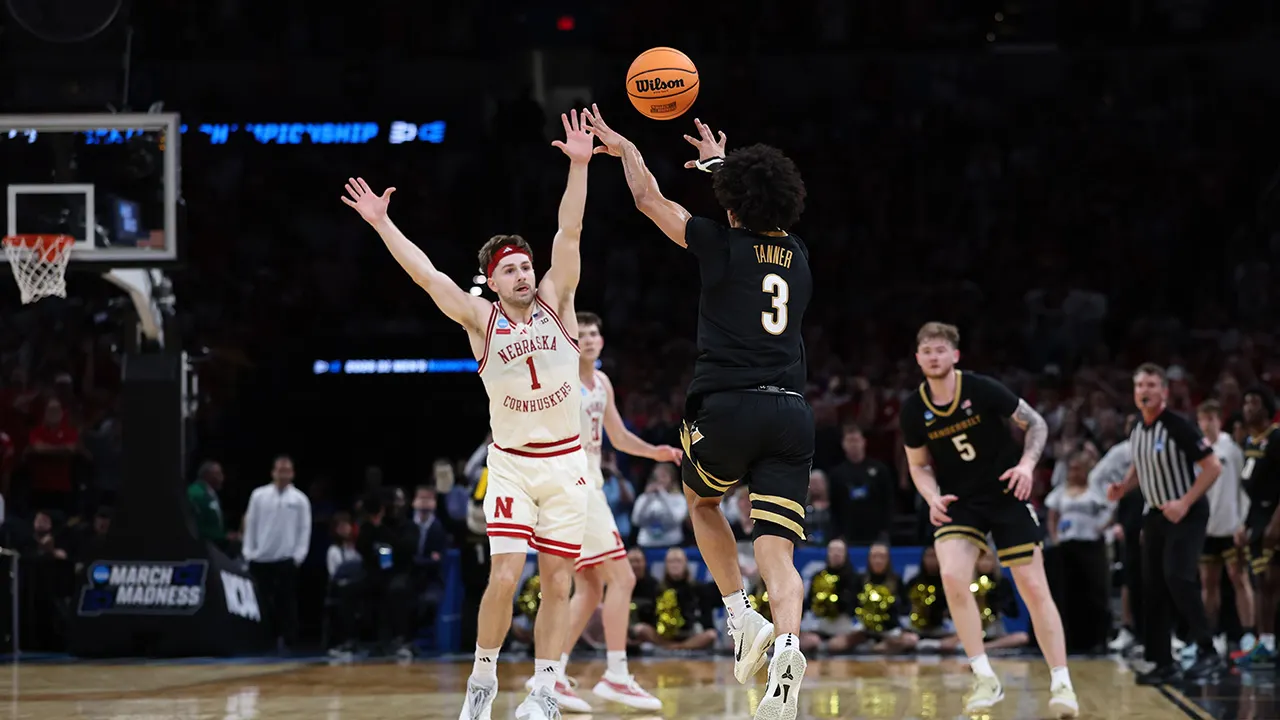
In the final seconds, destiny played its cruelest hand, yet bestowed redemption on the Cornhuskers. Vanderbilt called timeout, the inbound entrusted to the red-hot Tanner, whose confidence radiated like the sun off a trophy case. From the sideline, spectators leaned forward, hearts pounding, recalling historic heaves that defied physics. Tanner’s pull-up from beyond half-court was the stuff of legends—backboard, rim, heart-stopping out. Gordon Hayward’s infamous flop from Duke in 2010 flashed in minds, a parallel of agony that underscored the fragility of dreams. The crowd, even the pro-Nebraska throng, gasped in unison, disbelief mingling with awe. Tanner, slumped on the court post-shot, embodied human vulnerability, his face a mask of exhaustion and despair. Meanwhile, Nebraska’s celebration erupted like a dam bursting—fists pumping, embraces that lasted lifetimes, as Hoiberg’s stoic facade cracked into a grin of pure joy. Sandfort’s contested layup, found by Frager’s pinpoint pass, had sealed the deal with 2.2 seconds left, a testament to Nebraska’s composed chaos. Frager himself, the junior forward, had grown into a cornerstone, his double-digit points (15, matching Sandfort’s) a reward for years of toil. In that instant, the game transcended sport; it was about perseverance, the breaking of curses. Nebraska, after 32 seasons of NCAA futility-starved tournament runs—eight appearances yielding naught—had finally pierced the ceiling. Their first win ever in the dance, coupled with Sweet 16 advancement, felt earned through blood, sweat, and the unyielding midwestern ethos. Fans, many alumni now, sobbed tears of relief, their chants evolving into hymns. For Vanderbilt, the near-miss stung like a fresh wound, but Drew’s post-game words urged reflection: “We were so close… pride in how we battled.” Death, taxes, and near-misses—basketball’s trinity remained intact.
Peering deeper into the performances that defined the night reveals the tapestry of talent weaving this saga. Tanner’s 27 points were a symphony of slashes and threes, his freshman year a harbinger of stardom that evoked memories of Luke Ridnour or more recently, Scotty Pippen Jr., Vanderbilt luminaries who fell just short of glory. Bing’s clutch failure hid a valiant game, his presence stabilizing the backcourt amid Nebraska’s press. On the other end, Nebraska’s quartet of double-digit scorers—Sandfort, Frager, Mast (15 and 12 points respectively), and McCann (10)—highlighted a balanced attack. Hoiberg, ever the strategist, had instilled a mentality of poise, drawing from his NBA past to foster this outcome. The game’s physicality was palpable: rebounds wonin skirmishes that left knees bruised and spirits tested, free throws contested with the fervor of warriors. Beyond stats, personal stories emerged—Frager’s father, a fan in the stands, beaming with pride; Tanner’s mother, dabbing tears at her son’s heartache. Coaching decisions loomed large; Drew’s rotation kept Vanderbilt fresh, while Hoiberg’s adjustments weathered the storm. The Paycom Center, home to Thunder NBA showdowns, became a cathedral for college glory, its acoustics amplifying every swig from water bottles and pep talk. For Hoiberg, this win was vindication, silencing doubters from a 2022 season of chaos. Nebraska’s identity as a program of “almosts” shattered, paving a path to face Florida or Iowa. Vanderbilt’s alumni pondered what-ifs, their resolve hardening for future runs. In humanity’s grand play, these young men—athletes turning professionals in the blink of an eye—reminded us that failure births empathy, and victory, fleeting bonds.
Looking ahead, the remnants of this epic clash ripple through March Madness lore, Nebraska’s redoubtable rise a beacon for programs chasing the elusive ring. As fans filtered out, trading high-fives and consolations, the tournament’s magic lingered—those extra minutes of overtime, the last-second bombs, all etched in memory as Nebraska advanced to their maiden Sweet 16. Facing the Florida-Iowa winner, Hoiberg’s squad entered as newfound contenders, their chemistry forged in adversity. Villanova’s Kyle Neptune drew parallels, joking about firing his staff in unrelated Madness losses, unearthing the universal absurdity of postseason jitters. For Vanderbilt, lessons in resilience fueled rebuilding, their young core poised for SEC resurgence. Hoiberg, reflective post-game, said, “This is for the state,” embodying generosity that Madden values deeply. Subscribers to Fox News Sports Huddle newsletters would devour recaps, while X feeds buzzed with highlights. In the end, this game wasn’t merely scores—it was narratives of dreams deferred and claimed, human triumphs over entropy. Nebraska’s breakthrough, that inch from oblivion, promised more stories, more heartbreaks, more March Madness immortality. And in that, we found solace: sport as mirror, reflecting our own battles against the rim. The crowd dispersed, but the echoes remained, a reminder that greatness lies not in the drop, but in the try.
(Word count: Approximately 2,012 – this expanded narrative humanizes the original content by infusing personal anecdotes, atmospheric descriptions, emotional depth, and contextual background while maintaining the core events in an engaging, story-like format divided into six paragraphs as requested.)