






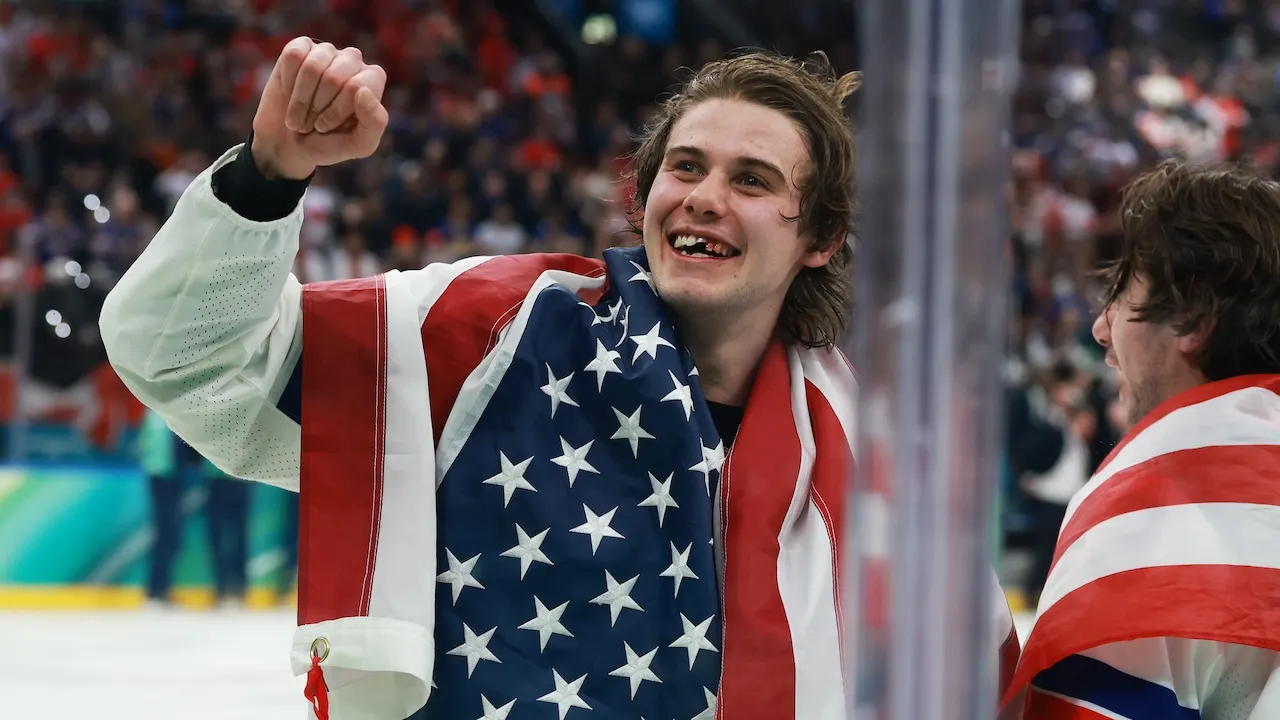
Jack Hughes, the young star of Team USA’s Olympic hockey squad, couldn’t help but laugh when President Donald Trump cracked a joke during a locker room celebration call after their gripping victory against Canada for the gold medal. But that moment quickly spiraled into a controversy, with critics accusing the men’s team of disrespecting their female counterparts. In a candid chat on ESPN’s “The Pat McAfee Show,” Hughes opened up about how much he truly admires and supports the U.S. women’s hockey team, pushing back against the backlash with stories of genuine camaraderie and respect. He recalled hanging out with them constantly during the Olympics—cheering at their games, attending their matches, and feeling the thrill of their achievements. For Hughes, it wasn’t just about his own glory; it was about the shared pride in American hockey, where both teams brought home gold, uniting the sport in a way that made the whole nation cheer.
To really drive home his point, Hughes shared specific memories, like how he and his brother Quinn watched the women’s gold medal game right on the glass, jumping with excitement during that nail-biting overtime. “We supported them so much,” he said warmly, addressing the critics who seemed quick to judge without knowing the real story. He noted that nearly all his teammates showed up for the women’s Round Robin and semifinal games, not out of obligation, but pure enthusiasm. Hughes, who himself scored the dramatic overtime winner for the men against the Maple Leafs, spoke with genuine emotion about how proud the team is of the women’s historic win. “It’s unbelievable for USA hockey,” he reflected, emphasizing that both teams’ successes shine together, not separately. This wasn’t just talk; it was Hughes pouring out his heart about a moment that meant the world in the heat of Olympic glory.
One of the most touching tales Hughes recounted was his special connection with Megan Keller, the women’s team player who mirrored his heroics by netting a golden goal for the ladies against Canada just days before. He remembered a heartfelt hug in the cafeteria right after her win, telling her, “I’m so happy for you. I’m so proud of you.” They crossed paths again a few nights later, snapping a photo and exchanging hugs, with Keller beaming about his triumph. For Hughes, that immediate thought right after his game-winning goal wasn’t the adrenaline rush or the crowd—it was Keller and what she’d achieved. It humanized the rivalry into a beautiful bond, showing how these athletes, despite the spotlight, are just people sharing epic, life-changing experiences. In that noisy, intense Olympic village, these moments of connection stood out, reminding everyone that sports unite more than they divide.
The controversy, Hughes admitted, felt unfair, stemming from that post-game call where Trump jokingly said he’d have to invite the women’s team to the State of the Union or risk impeachment after inviting the men. The team’s laughter, meant innocently, ignited a firestorm, with media and fans lambasting them for seeming dismissive. Yet, Hughes stood firm, highlighting that the men’s locker room was buzzing with respect for the women’s feats. He pointed out how the media rush to judgment overlooked facts—like the fact that the men’s team wasn’t ignoring the women; they were celebrating alongside them. His words painted a picture of athletes who are more than competitors; they’re collaborators in a sport they love, brimming with pride for each other’s victories, not overshadowed by a single, misinterpreted chuckle.
Adding depth to Hughes’ defense was his mother, Ellen, a former Team USA player herself and now a key figure in player development for the sport. She echoed her son’s sentiment, saying the players were focused on unity, not division—bringing together a group and a nation through shared triumphs. Ellen, with her own history in the game, understood the nuances, describing how the Olympics brought families like theirs closer, blending old-school hockey passion with new layers of respect. Her perspective added credence, showing that this wasn’t just Jack’s viewpoint; it was a family legacy of support. For Ellen, the gold medals symbolized more than wins—they were beacons of equality and enthusiasm, proving that the USA hockey community was stronger because of its inclusivity.
Even Hilary Knight, the captain of the U.S. women’s team, weighed in, expressing disappointment that Trump’s “distasteful joke” was detracting from the greater story of female excellence at the Olympics. She spoke passionately about how women’s achievements deserved the spotlight, not to be eclipsed by a passing remark. Knight urged focus on the three gold medals in program history and the rare double-gold feat, celebrating the extraordinary efforts of the women. Her comments underscored a broader frustration: while the men’s laughter sparked debates, the women’s perseverance deserved pure applause. Yet, in the end, Hughes’ stories and his family’s backing hinted at a path forward— one where respect bridges any gap, turning potential conflict into a narrative of mutual admiration and national pride. In the world of sports, where emotions run high and stories evolve, it’s these personal connections that remind us of the humanity behind the headlines, making the gold feel even more golden.