

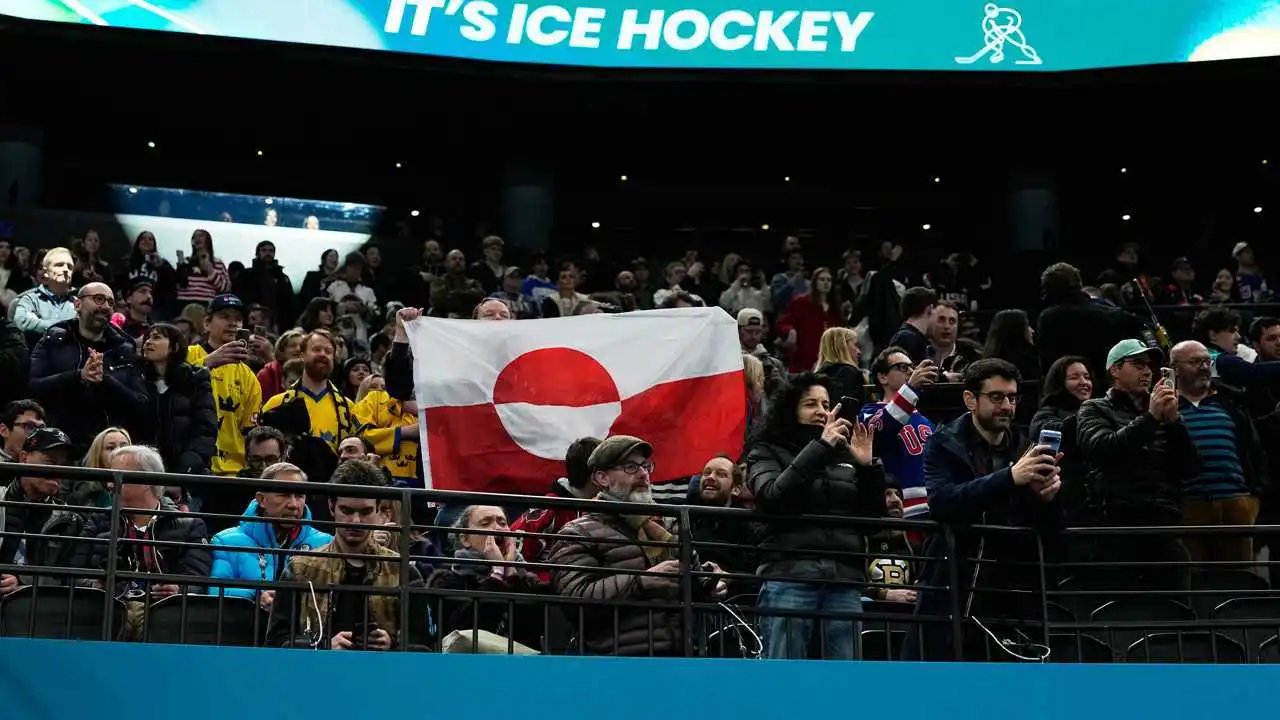
As the crisp air of Milan buzzed with the roar of skates and the faint echo of cheers from distant arenas, the 2024 Winter Olympics unfolded like a tapestry of global unity and spirited competition. Picture this: families bundled up in colorful scarves, sipping hot cocoa amidst the Italian Alps, the air tingling with anticipation. It was during a pivotal men’s hockey match between powerhouse Team USA and underdog Denmark that an unexpected flash of geopolitical flare-up turned heads. In a stadium alive with chants and claps, two Latvian fans, Vita Kalniņa and her husband Alexander Kalniņš, who had traveled all the way from Germany to support their home Latvians, seized a moment in the stands. They unfurled a massive Greenland flag during warmups, and again when Denmark surged ahead with an early goal. It wasn’t just any banner—it was a bold, cloth manifesto against a distant whisper of American ambition: Donald Trump’s once-floated idea to purchase Greenland from Denmark for the United States. As Americans cheered their team’s gritty comeback, this act sparked murmurs of protest, blending ice hockey’s pure adrenaline with the intrigue of international politics. Imagine the scene: blaring horns, the thud of a puck against boards, and there, amid the sea of red, white, and blue jerseys, a splash of Greenlandic green waving defiantly. For those in the crowd, it was a reminder that even in the simple joy of sport, the world’s complex threads—colonial legacies, national pride, and economic pacts—could weave into the fabric of a single game. Vita and Alexander, ordinary Europeans with hearts tethered to Ice Age legacies and Nordic roots, embodied that quiet defiance. They weren’t rowdy agitators; they were thoughtful observers, reacting to headlines that had crossed oceans and stirred dinner-table debates. “We are Europeans, and I think as Europeans we must hold together,” Alexander shared later with a reporter, his voice steady, eyes reflecting the earnest humanity of someone committed to borders drawn by history rather than commerce. His words painted a picture of unity not as a slogan, but as a lived ethic—picking sides not for ideology’s sake, but to honor the voices of Greenlanders themselves. In Greenland’s vast expanses, where ancient Inuit cultures meet modern autonomy movements, such symbols resonate deeply. The flag wasn’t just fabric; it was a nod to self-determination, echoing the island’s desire to chart its own path amidst Danish sovereignty and American overtures. Vita, with her warm smile and stories of Latvian winters, added a personal touch—reminders of how global events feel intimate when they’re aired on international screens. As the game shifted, Denmark’s early lead fueled their momentary bravado, but the U.S. team’s resilience shone through, turning the tide in a thrilling display of on-ice drama. This incident wasn’t isolated; it mirrored broader conversations about when politics should stay off the field and when spectators become subtle activists. In a world of streaming feeds and viral clips, these fans’ gesture became a living documentary, inviting empathy for perspectives often overshadowed by louder narratives. It humanized the Olympics, reminding everyone that beneath the athletic glory, real people with real stakes are watching, hoping and protesting in equal measure.
Diving deeper into the human element, let’s meet the people whose reactions colored the event’s canvas. Dennis Petersen, a Danish fan with a salt-and-pepper beard and a hat embroidered with Viking motifs, sat rows away from the Kalniņ couple, his face a mix of amusement and frustration. As a father of two from Copenhagen, he lived the everyday grind—commuting to work, packing Kids’ lunches with smørrebrød—but hockey games were his escape, his sacred space for pure enjoyment. “It doesn’t matter whatever sport it is—it could be tennis, it could be bobsledding, it can be ice hockey, it could be football—it has nothing to with politics,” he insisted, his Danish lilt warm yet firm, like a stern but kindly uncle. For him, the Olympics transcended borders; they were about athletes pouring sweat and dreams onto the ice, not about frosty real estate deals. Rem de Rohan, an American expat from California with sun-kissed skin and a booming laugh that echoed in the stands, agreed in spirit. Rooting for the U.S. with unbridled passion, he envisioned the Games as a global party, where rivalries faded into shared applause. “I think this is the time for people to kind of put that down and compete country versus country and enjoy,” he said, gesturing broadly as if to embrace the entire arena. “We love rooting on every country that’s been here.” Rem’s enthusiasm captured the celebratory soul of the event—think tailgates in snowy parking lots, high-fives between strangers of different tongues, the kind of connections that erase lines drawn by maps. Yet, these voices weren’t without nuance; beneath their words lurked the universal tension of sports and politics intertwining. For fans like Dennis, raised in a Nordic culture valuing consensus and caution, the flag felt intrusive, a wrinkle in the smooth fabric of competition. He recalled childhood memories of watching Danish teams triumph on grainy TVs, dreams of glory that politics could tarnish. Rem, meanwhile, embodied the American spirit of optimism, his support for the U.S. rooted in family traditions—watching Stanley Cup games with his dad, who hailed from Boston’s tough streets. Their exchanges with reporters painted portraits of folks grappling with bigger questions: Is sport a neutral ground, or does it reflect society’s fractures? Vita and Alexander’s protest challenged that neutrality, humanizing adversaries in a way that invited reflection. Official responses from the Olympic Committee emphasized respect and focus on athletes, but in the stands, it was the emotional pulse that mattered. Petersen respected the Kalniņs’ passion, even if he disagreed, while de Rohan hoped the win would sweep away distractions, paving the path for unity. This clash of perspectives added layers to the story, showing how one event could bridge divides or deepen them, depending on the eyes watching.
Meanwhile, as the puck flew and scores ticked, the digital world ignited with a firestorm of opinions, turning the arena’s drama into worldwide clickbait. Social media platforms buzzed like a hive of over-caffeinated bees, where fans from sofa armchairs weighed in with memes, jokes, and heartfelt rants. “Now that the USA is up 4-2 could we place a wager that if the USA wins the game, Denmark gives up Greenland?” quipped one Twitter user, likely a cheeky American expat in some cozy living room, fingers flying over a laptop amid a pile of empty snack bowls. Another chimed in, “Team USA won, do we get Greenland now?” capturing that playful trionismo that blends national pride with absurdity. These weren’t just isolated tweets; they were echoes of broader cultural chasms, where armchair diplomats and meme creators turned geopolitical theatre into viral gold. For many, the Greenland flag stunt was fodder for light-hearted jabs, a way to cope with the game’s tension. Yet, among American conservative influencers, it sparked a cascade of comeback-themed humor—videos of folks in Eagles jerseys acting out “Greenland annexation” speeches went viral, amassing millions of views. Imagine scrolling through your feed during dinner: a influencer donning a mock crown, declaring the win a “diplomatic victory” while sipping a fizzy soda. It humanized the online frenzy, showing how social media isn’t just pixels; it’s a mirror of everyday giddiness and exasperation. One post from a Danish user lamented the intrusion, sharing photos of their flag-waving ancestors, evoking a sense of injured pride. Contrast that with optimistic Americans celebrating the underdog spirit, their comments laced with references to past Olympics highs— like the Miracle on Ice. This digital dialogue bridged the physical distance, making strangers feel like neighbors sharing a laugh or a grievance. Vita Kalniņa, seeing some of these threads, felt vindicated but wary; Alexander joked about going viral for the right reasons. In essence, the platforms amplified the event’s humanity—raw emotions, quick wits, and the joy of shared absurdity—turning a sports moment into a global conversation. Warnings about “caution” in related news, like railway “sabotage” fears for Americans, added a layer of real-world anxiety, tucked between emoji-laden threads. It reminded everyone that behind the screens were people—parents, students, retirees—whose takes shaped collective narratives, often with more heart than headlines.
Shifting gears to the ice itself, the hockey game’s narrative unfolded like a high-stakes novel, with Team USA scripting an unforgettable comeback that had fans on the edge of their seats. Imagine the roar of the crowd as Denmark took that early 2-1 lead after the first period, the Danes’ jerseys gleaming under the lights, their spirits buoyed by home-like cheers. But the Americans, a roster streaked with NHL stars and young firecrackers, refused to crumble. In a dazzling offensive barrage, they netted three straight goals in the second period, flipping the script into a 6-3 landslide victory. Brady Tkachuk, the Ottawa Senators’ powerhouse with his Halloween-style rough grit, slammed home a marker; Jack Eichel of the Vegas Golden Knights added a silky wrist shot; Noah Hanifin, also from Vegas, thundered a blue-line blast. It was poetry in motion—puck dancing across blades, sticks clashing in a symphony of effort. Even the sibling duos shone: brothers Brady and Matthew Tkachuk each contributed points, as did Jack and Quinn Hughes, weaving familial bonds into the team’s triumph. All told, 14 players from the U.S. notched points, each goal scored by a different hero, a testament to depth that felt human—unassuming players rising to the occasion, their sweat telling stories of grueling practices and late-night flights. Denmark’s shots? A mere 21, overshadowed by America’s dominant 47, painting a picture of relentless pressure. For spectators like Ren de Rohan, this comeback was exhilarating, a redemption arc straight out of cinema. He recounted tales of past U.S. disappointments at Olympics, making this win feel personal, like a family reunion after too long apart. Danish fans like Dennis Petersen, though disappointed, applauded the sportsmanship, acknowledging the Americans’ skill. Vita Kalniņa watched with bated breath, the Greenland flag’s moment fading into the thrill of the plays. This game wasn’t just stats; it was human drama—athletes pushing limits, coaches pacing sidelines, families sharing roars. The victory humanized victory, showing resilience as a shared trait, transcending flags and feeds.
Looking ahead, the U.S. team’s momentum builds towards their next challenge, keeping the Olympic flame burning bright. With preliminary play culminating on Sunday against Germany at 3:10 p.m. ET, the Americans stand as heavy favorites, their confidence soaring from the Denmark drubbing. This German squad, boasting just eight NHL players, presents what many see as low-hanging fruit, though hockey’s unpredictability always hums in the background. A win would secure a direct berth into the knockout stage, a golden ticket to deeper glory; even an overtime loss might suffice, their journey hinging on Canada’s match against France, plus intricate point math with Slovakia, Finland, and Sweden. For fans, it’s a recipe for nail-biting anticipation—imagine deploying betting apps in the dead of night, or gathering around TVs with homemade banners. Rem de Rohan, the enthusiastic American, plans to drown out travel tales from Italy amidst the excitement, his optimism infectious. Vita and Alexander, reflecting on their protest’s spotlight, now root for Latvia while pondering Greenland’s future, their views enriched by the game’s lessons in unity. Conservative voices online amplify the win’s symbolism, blending sport with speculative geopolitics, humanizing the buzz with jokes that mask serious undercurrents. The Associated Press’s insights add layers, reminding us of journalistic rigor in these chaotic times. Exhaustion from sabotage warnings weighs lightly, but the Games march on, urging caution while celebrating triumphs. Embracing the spirit, fans subscribe to newsletters, follow updates on X, and dream of podiums. In this fleeting spectacle, human stories triumph—connections forged in stands, lessons learned on ice, and hopes carried home, making each twist a shared heartbeat.
In wrapping up this Olympic tale, the blend of sport, protest, and digital echo resonates as a microcosm of our interconnected world, where ice rinks mirror global debates. From the Kalniņs’ courageous flag-waving to the U.S. team’s resilient comeback, the event pulses with life—personal stories underlining universal themes of unity, resilience, and humor. As the Games draw new spectators with intriguing features like audio options for articles, the narrative evolves, inviting more voices to the conversation. Fans like Petersen, de Rohan, and countless online contributors add warmth, transforming cold stats into heartfelt recollections. Warnings about “caution” in travel highlight the Olympics’ vulnerability, yet the spirit endures, fostering bonds across divides. Ahead, as Team USA eyes Germany, the anticipation builds, a testament to sport’s power to humanize strife. In every cheer and critique, we see ourselves—ordinary folks chasing dreams amidst extraordinary drama, reminding us that even in protest or triumph, humanity shines brightest on frozen fields.<|control677|>As the winter chill embraced the Milan Cortina arena on a crisp Saturday afternoon, the 2024 Winter Olympics thrived with energy, drawing global spectators to witness not just athletic prowess but moments of unexpected political flair. Families huddled in their seats, munching popcorn and waving flags, the air thick with the scent of rubber from freshly sharpened skates and the distant hum of international chatter. Amidst this mosaic, the men’s hockey preliminary round clash between Team USA and Denmark became more than a game—it morphed into a stage for symbolic gestures that united and divided. Enter Vita Kalniņa and her husband Alexander Kalniņš, a Latvian couple residing in Germany, who seized the spotlight during warmups. Unfurling a sizable Greenland flag, they held it high, adding layers of intrigue to the competition. Their act wasn’t born from impulse; it stemmed from a deep-seated European solidarity, protesting Donald Trump’s earlier proposal to acquire Greenland from Denmark. The flag fluttered buoyantly as Denmark scored the game’s opening goal, soaring in triumph before the American comeback unfolded. This human element—two everyday fans turning spectator stands into a subtle diplomatic arena—humanized the event, reminding viewers that sports arenas pulse with real-world concerns. Alexander later explained their motivation with quiet conviction: “We are Europeans, and I think as Europeans we must hold together. The Greenlandic people decide what will happen with Greenland, but as it is now, Greenland is a part of the Danish kingdom and, as Greenland is a part of Denmark, as in this case, we support both countries against the U.S.” Vita’s supportive nods underscored their journey from distant Latvia, their hearts tied to Nordic heritage and European unity. The game itself pulsed with tension, Denmark’s early 2-1 lead feeling like a momentary upset, but the U.S. pivoted dramatically, dominating to secure a 6-3 victory. This unforeseen protest added emotional depth, blending geopolitics with the raw thrill of hockey, showing how one couple’s initiative could spark worldwide conversations, amplifying the Olympics’ role as a mirror for global currents. In a time when news cycles blur lines between entertainment and events, their story embodied the human desire to advocate amid celebration, making the arena feel less like a neutral ground and more like a living conversation.
Delving into the reactions of those present, a tapestry of personal viewpoints emerged, each voice revealing the Olympics’ capacity to bridge or widen gaps. Dennis Petersen, a Danish fan sporting a woolly scarf and the enthusiastic demeanor of a local pub regular, expressed disappointment tinged with pragmatism. As a lifelong hockey enthusiast from Copenhagen, he cherished the purity of the sport, away from life’s complexities. “It doesn’t matter whatever sport it is—it could be tennis, it could be bobsledding, it can be ice hockey, it could be football—it has nothing to do with politics,” he stated, his voice carrying the warmth of shared cultural anecdotes. For Petersen, whose family gatherings often revolved around Danish team victories on grainy TVs, the Greenland flag felt like an unwelcome intrusion, a wrinkle that disrupted the dreamlike escapism of the Games. He recounted memories of coaching neighborhood kids, teaching them the basics of stickhandling while instilling values of fair play, making his stance a personal crusade for the sanctity of competition. On the American side, Rem de Rohan, a jovial Californian with a penchant for hearty laughs and impromptu cheer chants, advocated for unity. “I think this is the time for people to kind of put that down and compete country versus country and enjoy,” he shared, his infectious energy reflecting a life enriched by cross-cultural experiences—from U.S. backyard barbecues to international travels. De Rohan, whose ancestors immigrated generations ago, saw the Olympics as a unifying event, a chance to celebrate humanity’s shared passions rather than divisions. He spoke of tailgating before games, exchanging stories with fans from rival nations, turning potential adversaries into allies. Together, these fans’ perspectives highlighted the event’s duality: a platform for joy that occasionally wrestles with external tensions. Vita and Alexander’s act prompted inward reflection for many, forcing occupants to reckon with how politics infiltrates even the most neutral spaces. Petersen’s practical outlook clashed gently with de Rohan’s optimism, yet both underscored the human yearning for harmony in sport, revealing layers of empathy and exasperation beneath the surface excitement.
As the digital age amplified the arena’s buzz, social media erupted with banter and quips, transforming the Greenland flag incident into viral fodder that connected fans worldwide. Users, lounging in cozy homes or scrolling during commutes, traded lighthearted takes that humanized the absurdity of geopolitics. “Now that the USA is up 4-2 could we place a wager that if the USA wins the game, Denmark gives up Greenland?” one poster cracked, their tone playful amid the game’s suspense, perhaps typed out between sips of coffee or bites of breakfast toast. Another echoed, “Team USA won, do we get Greenland now?” capturing the whimsical trionismo that blends national pride with exaggerated optimism. For conservative American influencers, the U.S. victory ignited a cascade of memes and skits—think viral videos of mock annexation announcements, with actors donning wigs and cups of pretend champagne, racking up likes from distant viewers. This online frenzy wasn’t mere distraction; it mirrored everyday human tendrils, from armchair analysts debating in living rooms to groups gathering for watch parties. Danish posters voiced indignation through poignant shares, evoking ancestral tales of Nordic resilience, while others humorously “surrendered” virtual territories. Vita Kalniņa, peeking at the threads, felt a mix of validation and mirth, her family’s voyage to protest now part of this larger dialogue. Educators and families dissected the humor, discussing global relations over dinner tables, showing how social platforms extend the bleachers’ camaraderie. Warnings about travel caution, tied to rumored sabotage elsewhere, added a sobering note, urging spectators to appreciate the safety underpinning such joy. In essence, these digital exchanges humanized the Olympics, turning isolated cheers into collective narratives infused with wit, frustration, and shared humanity, proving that in an era of algorithms, sport remains a universal connector.
Zooming into the on-ice action, the hockey match’s comeback held fans in thrall, showcasing American grit that turned early doubts into unbridled joy. Denmark’s initial 2-1 advantage felt precarious, their team channeling home-field vigor as fans envisioned a historic upset. Yet the U.S. surged forward decisively, unleashing a barrage in the second period to claim a commanding 6-3 win. Stars like Brady Tkachuk, the Senators’ relentless enforcer with that signature intensity, and Jack Eichel of the Golden Knights dazzled with precise plays; Noah Hanifin added defensive might from Vegas. Sibling pairs added charm—Brady and Matthew Tkachuk, gifted forwards, each tallied points, while Jack and Quinn Hughes wove familial synergy into the team’s fabric. Impressively, all American goals were scored by different players, with 14 contributing to the scoring column across a blizzard of 47 shots versus Denmark’s 21. For onlookers like de Rohan, this parabola of perseverance resonated deeply, echoing personal triumphs over setbacks in his own journeys as an expat entrepreneur. He described the crowd’s swells as physical manifestations of collective heartbeat, a reminder of why hockey tugged at heartstrings worldwide. Danish fans, though vanquished, saluted the effort, Petersen noting the Americans’ skill as deserving tribute despite the political overlay. Vita and Alexander, observers with European roots, appreciated the athletic spectacle, their initial protest fading into admiration for the game’s artistry. This triumph humanized victory, portraying athletes not as automatons but as driven souls—coaches sketching strategies late into nights, players pushing physical limits for national glory—infusing the sport with relatable drama and inspiration.
Gazing forward, Team USA’s star continues to rise as they prepare for their Sunday clash against Germany at 3:10 p.m. ET, poised as formidable underdogs against a team with limited NHL representation. Victory looms as a springboard to the knockout stage, with contingencies like an overtime setback or results from Canada’s France matchup offering lifelines amid calculations involving Slovakia, Finland, and Sweden. For fans, anticipation builds like a slowly simmering pot, filled with hopeful predictions and group viewings. De Rohan envisions celebratory gatherings, his optimism a beacon amid global uncertainties. Vita and Alexander, reflecting on their impactful moment, now eagerly follow Latvia while contemplating broader European dialogues sparked by their stand. Online buzz persists, conservative voices spinning the win into enduring geopolitical jests, adding layers to the narrative. As the Associated Press reports detail, the Games’ spirit thrives despite external cautions, inviting subscriptions and digital engagement. This progression humanizes the Olympics’ arc, showing how each game weaves threads of perseverance, community, and aspiration, leaving spectators hungering for more.
In retrospective warmth, the Denmark versus USA hockey encounter at the 2024 Winter Olympics stands as a vivid testament to sport’s intertwining of triumph, protest, and camaraderie, enriching lives far beyond the rink. From the Kalniņs’ evocative flag-raising to the U.S. team’s stirring revival, threads of personal conviction and collective elation emerge. Petersen and de Rohan’s earnest viewpoints highlight empathy’s role in navigating divisions, while social media’s tapestry of humor bridges distances. On the ice, raw athleticism converges with emotional depth, fostering universal bonds. As the competition advances with Germany’s challenge, the human pulse endures, reminding all that beneath global spectacles lie stories of resilience and connection. In celebrating these elements, the Olympics affirm sport’s transcendent power, inviting ongoing dialogue and shared celebration amid life’s complexities, forever altering how we perceive unity on frozen grounds.