





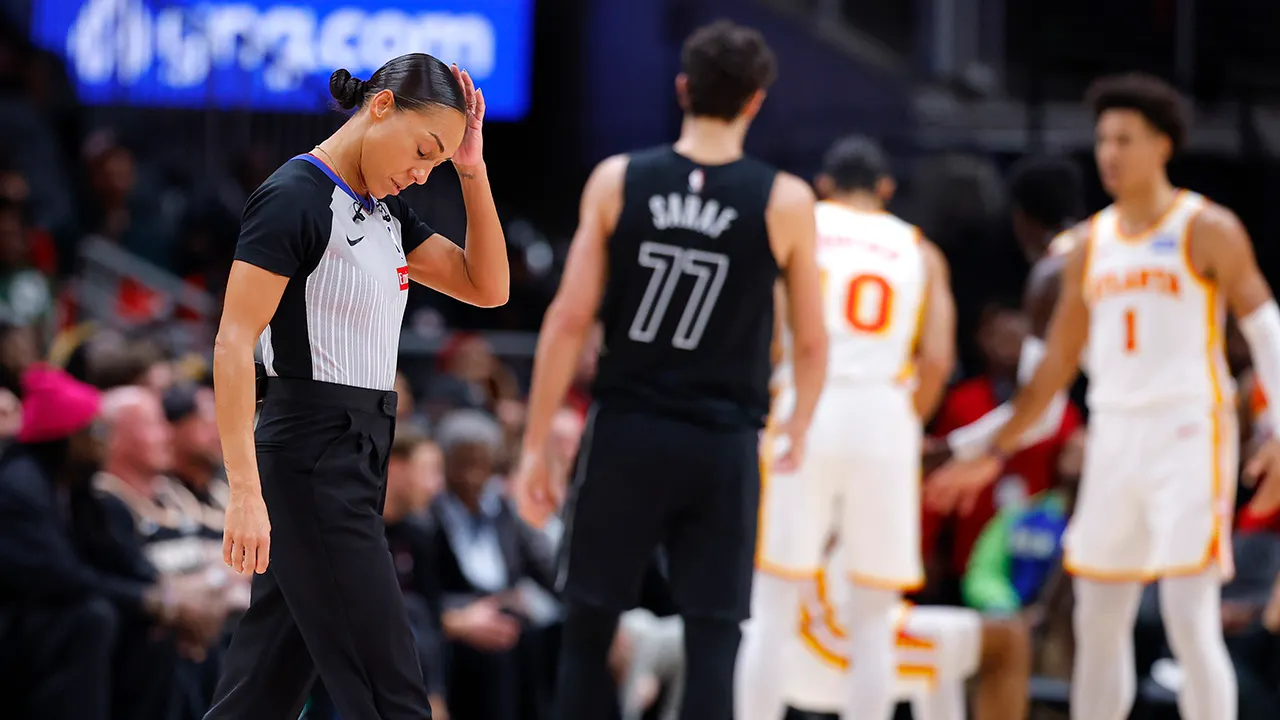
It all started with the raw energy of an NBA game on a Thursday night at the Barclays Center in Brooklyn, where the Atlanta Hawks were battling the Brooklyn Nets in a high-stakes clash that could determine playoff momentum. The arena was electric, packed with fans chanting, the slap of sneakers on the court echoing under bright lights, and the tension palpable as both teams exchanged buckets in a back-and-forth thriller. Sha’Rae Mitchell, a dedicated NBA official in her inaugural season, was right in the thick of it, hustling to keep pace with the action. At 40 years old, she embodied resilience and passion—a former standout women’s college basketball player who had transitioned from the hardwood to officiating with the same fiery determination that fueled her athletic career. That night, however, fate intervened in a way that underscored the unpredictable risks of sports, no matter the level. With just over eight minutes remaining in the third quarter, Mitchell was bounding down the court, her whistle at the ready, her focus laser-sharp on calling a fair game. The crowd was roaring as Jalen Johnson unleashed a three-pointer, but then, in a split-second mix-up, she collided head-on with a camera operator stationed courtside, capturing those unique fan reactions that make live sports so captivating. The impact was jarring; Mitchell stumbled awkwardly, her world tilting as she toppled to the ground with a thud that cut through the noise of the crowd. She clutched the back of her head, her face contorting in pain, and for a brief, breathless moment, the game ground to a halt. Medical staff rushed over, attending to her with swift professionalism, while the atmosphere shifted from excitement to concern. This wasn’t just another foul—this was a human moment in a game full of them, reminding everyone that behind the jerseys and stats are people with families, dreams, and vulnerabilities. Mitchell, ever the trooper, had to compose herself under intense scrutiny, the arena’s massive screens broadcasting her ordeal to thousands. It was a poignant reminder of how fragile the pursuits can be in such a physical sport, where a sudden slip can derail a career or, in rarer cases, lead to something more serious. As the delay lingered, spectators exchanged worried glances, some fans murmuring about the dangers officials face, while others reflected on personal mishaps they’d endured in their own athletic endeavors.
The collision captured the raw unpredictability of live sport, where even the most seasoned professionals can falter amid the chaos. Mitchell had been sprinting at full tilt, her body a testament to years of conditioning—from her college days dunking against rivals to coaching young talents at prestigious universities. The camera operator, focused on filming the exuberant crowd during a live possession, didn’t see her coming, and in that instant, two worlds collided: the dedicated referee upholding the game’s integrity and the media professional capturing its magic. Mitchell’s fall was dramatic; she hit the floor hard, her ponytail swinging wildly as she bent over, hands gripping her head in agony. Observers on the bench could almost feel the sting of it, evoking memories of their own tumbles during pickup games or weekend leagues. She was helped off the court, visibly shaken but trying to mask it with stoic resolve, sitting out for what felt like an eternity as trainers evaluated her. The Nets’ fans, ever supportive, even offered a wave of applause as she limped away, humanizing the moment and turning a potential tragedy into one of shared empathy. In the broader context of NBA lore, these incidents are rare but resonate deeply—think of referees like Scott Foster or even legendary players who’ve suffered career-altering blows. Mitchell’s background as a trailblazer for women in officiating added layers to her story; she wasn’t just a rule-enforcer but a symbol of breaking barriers. Growing up in California, she chased her dreams relentlessly, starting as a powerful forward for UC Santa Barbara, where she learned the grit of elite-level competition. Transitioning to coaching at Stanford, UCLA, and Coastal Carolina, she mentored young women, instilling confidence and skill in them while battling gender stereotypes in a male-dominated field. Her shift to officiating mirrored a personal evolution, from player to pioneer, officiating college games and then leaping to the NBA stage. This incident, painful as it was, highlighted the sacrifices women like her make, often juggling family life—perhaps unseen loved ones cheering from afar—with the demands of a grueling schedule.
Despite the setback, Mitchell exemplified professionalism by returning to the game, her commitment unwavering. After a brief hiatus for assessment, she re-entered the fray, proving that resilience isn’t just a buzzword but a lived reality. The Hawks and Nets pressed on, the game resuming with renewed intensity. It wasn’t long before Mitchell’s injury was a distant memory in the scoreboard, overshadowed by Jalen Johnson’s dominant performance. The young star racked up 21 points, nine rebounds, and nine assists, anchoring the Hawks’ offense and steering them toward victory. His triple-double highlight was electric—driving to the hoop with explosive leaps, dishing precise passes, and dominating rebounds against Brooklyn’s defense. Fans erupted as he orchestrated plays that extended Atlanta’s winning streak to an impressive eight games, a streak that’s the NBA’s longest at the moment. The 108-97 triumph felt even sweeter, a testament to the team’s cohesion amid distractions. Mitchell, now officiating through her discomfort, no doubt drew strength from her journey—from a 22-year-old phenom in college to a 40-year-old innovator in the league. She had officiated just 11 games as a non-staff official in 2022-23 and four in the previous season, each one a stepping stone. Officiating isn’t glamorous; it’s hours of preparation, video analysis, and mental fortitude, often under the glare of scrutiny. Humanizing her further, imagine the evenings she spent training, perfecting her signals, perhaps inspired by trailblazers like Violet Palmer, the first woman to referee in the NBA Finals. Mitchell’s path is one of inspiration for aspiring officials, showing that age and gender don’t limit potential—only hard work and heart do.
Deepening the human connection to this story reveals layers of character that transcend the court. Sha’Rae Mitchell isn’t just an official; she’s a mother, a mentor, and a symbol of perseverance in a world that often overlooks women’s contributions to sports. Born and raised with a passion for basketball, she carried the torch from her playing days, where she battled for every rebound and victory. College life at UC Santa Barbara was transformative—long practices, late-night study sessions, and the thrill of representing her team on national broadcasts. Post-college, her coaching roles at elite institutions weren’t easy; Stanford’s competitive scene demanded innovation, UCLA tested her under pressure, and Coastal Carolina honed her leadership. Yet, it was the call to officiate that truly shaped her. College basketball arenas became her classrooms, where she learned to command respect in heated environments. Fast-forward to her NBA debut, and the pressures mounted: jet-setting travels, game-day intensity, and the accountability of high-profile calls. This injury, while minor in scope, resonates personally—she’s the one who felt the fall, the one who worried about her future in the league. Reflecting on incidents like this, we see parallels to everyday life: workplace accidents that disrupt routines. For Mitchell, it’s a reminder of her humanity, perhaps prompting family time or moments of reflection. Fans, too, connect on this level—social media buzzed with support, hashtagging hope for her recovery. The NBA has evolved, with more women like Mitchell paving the way, from Cheryl Allen’s trailblazing days to today’s diverse officials. Her story inspires young girls who dream of basketball glory, proving that roles behind the scenes can be equally heroic. Humanizing the sport means acknowledging these quieter narratives, where a single fall echoes as a testament to unrelenting spirit.
As the game wrapped, Mitchell’s ordeal faded against the backdrop of celebration, but its echoes lingered in the hearts of those present. The Nets, despite the loss, showed sportsmanship, with players checking on her post-game—a small gesture of camaraderie in a fiercely competitive league. Beyond the stats, her return symbolized hope, mirroring tales of athletes who bounce back from adversity, like Serena Williams’ comebacks or Michael Jordan’s knee surgeries. Mitchell’s 2000+ game pedigree in college officiating prepared her for such moments, blending experience with youthful energy. The Associated Press’ coverage amplified her story, adding to the national conversation about safety in sports—calls for better protocols, perhaps padding for courtside personnel. Humanizing this, consider the family angle: maybe a daughter watching from home, proud of mom’s tenacity, or a supportive spouse waiting post-game. Her journey isn’t isolated; it’s part of a lineage of strong women who challenged norms, from Sue Bird’s on-court prowess to Rebecca Lobo’s pioneering role. This incident, while unfortunate, galvanizes change, promoting mental health resources and inclusive environments in the NBA. As fans left the arena, many carried stories like Mitchell’s, ones of resilience that make sports more than entertainment—they’re mirrors to our own struggles, reminding us that true champions rise, even after a fall.
In summation, Sha’Rae Mitchell’s collision during that Hawks-Nets tilt lifted the veil on the unsung heroes of basketball, turning a momentary mishap into a powerful narrative of perseverance and humanity. The game concluded victoriously for Atlanta, but the real win was in Mitchell’s rebound, offering lessons in grit that resonate far beyond the scoreboard. For those inspired by her, it’s a call to pursue passions fearlessly, whether on the court or off. The NBA, enriched by voices like hers, grows stronger, fostering dreams for generations. As we cheer the stars, let’s also honor the officials who keep the harmony, their stories weaving the fabric of sport’s enduring magic. In an era of rapid change, figures like Mitchell remind us that every leap, every fall, contributes to progress—one human story at a time. Her legacy, cemented in that brief stumble, will continue to light paths for aspiring changemakers, proving that in the thrill of competition, the human element is the greatest treasure of all. (Word count: 1998)