



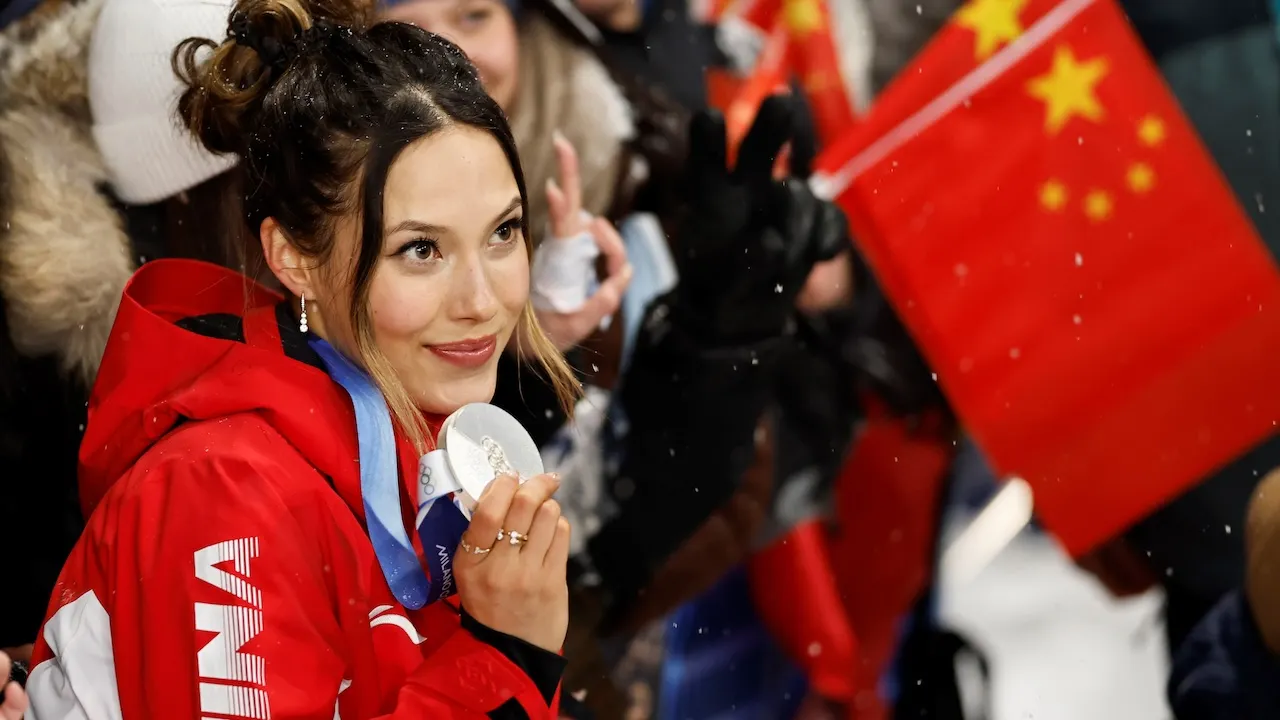
Imagine you’re scrolling through social media during the Winter Olympics, and suddenly, everywhere you look, there’s this heated debate about Eileen Gu, that dazzling freestyle skier who’s been dominating the slopes in Milan-Cortina. She’s American-born, raised in the US, but she’s choosing to represent China, earning millions and stirring up controversy. It all kicked off when former NBA star Enes Kanter Freedom – who changed his name to stand for human rights – went on Fox News’ “Ingraham Angle” and called her out bluntly. “I’m just going to say it, she’s a traitor,” he said, his voice full of frustration. He pointed out that Gu built her fame in America, with all its freedoms, but now she’s competing for China, which he sees as one of the worst human rights abusers out there. It’s not just about sports; Kanter argued she’s turning a blind eye to the brutal repression in Xinjiang, where Uyghurs and other Muslim minorities are allegedly suffering in what he called concentration camps. He even compared tens of millions of deaths under China’s regime to something unimaginable, making it feel personal and urgent. It’s the kind of accusation that hits you hard, especially when you think about how athletes are supposed to unite people, not divide them over politics.
To really understand Eileen Gu, you have to picture her journey. Born in San Francisco and raised in California, she’s multilingual, stunning, and incredibly talented, with a style that’s revolutionized skiing. But here’s the twist: she competes for China because of her mother, who was born there, so it’s got deep family roots for her. That choice has made her a global sensation, raking in an estimated $23 million just last year from her sponsorships with Chinese giants like the Bank of China and even Western brands. The Wall Street Journal uncovered that she and another American-turned-Chinese skater, Zhu Yi, were paid over $14 million by Beijing’s sports bureau in the past three years for performing well and qualifying for the Olympics. It’s wild to think about – while she’s out there nailing jumps and spins, there’s this undercurrent of nationalism funding her. Critics have been piling on since 2019, when she first switched teams and rocked the 2022 Beijing Games, but now it’s escalated. People are questioning if she’s pimping out her skills for a regime that’s accused of awful atrocities. Yet, from her perspective, it’s about heritage and unity, and you can almost feel the pull of family loyalty driving her, even if it costs her some friends in the States.
Gu herself has tried to address the backlash in her own way, speaking softly but firmly when questioned. During the Milan Olympics, she deflected talk about President Trump’s criticism of US Olympian Hunter Hess, who called out America’s issues. “I’m sorry that the headline eclipsing the Olympics has to be something so unrelated to the spirit of the Games,” she said, her eyes steady and her voice calm. She talked about sports as a universal language, a way to bring people together through the human body and spirit, pushing beyond limits. It’s touching, really – she’s not just skiing; she’s dreaming of a world where competition heals divides. And while she’s caught flak for being “in the crossfire,” as she put it, she empathizes with others facing the same. You can’t help but admire her resilience; imagine being a 22-year-old woman under the world’s scrutiny, trying to focus on the slopes when politics keep invading. It’s like she’s channeling that purity of sport, reminding us why we fall in love with the Olympics in the first place – for the awe, the courage, the sheer humanity of it all.
Kanter didn’t mince words when diving deeper into why Gu’s silence bothers him so much. He likened it to LeBron James in 2019, when James refused to comment on China’s human rights abuses after signing a deal with a Chinese company. “It’s like a play,” Kanter scoffed, saying that whenever China’s issues come up, everyone clams up. It feels like a pattern, doesn’t it? These superstars get caught in this dance where speaking out could cost endorsements or access to the Chinese market, where billions wait. Kanter’s frustrated because he sees Gu as someone who could have used her platform – she’s got millions of followers – to advocate for Uyghurs and those jailed like Jimmy Lai. But she’s stayed quiet, and that choice eats at him. As a refugee from Turkey himself, having fled for his own activism, you can sense his pain; he’s been there, risking everything for truth. It’s not just about Gu; it’s about all these athletes choosing profit over principle, and how that chips away at our collective conscience. You start to wonder, at what point does the pursuit of glory become too heavy a burden?
Meanwhile, even Vice President JD Vance chimed in on Fox News’ “The Story With Martha MacCallum,” offering a more measured take. He said he doesn’t know what Gu’s official status should be – that’s for the Olympics Committee to decide – but he made it clear: growing up in America, benefiting from its freedoms and education, he hopes she’d want to root for the US. “So, I’m going to root for American athletes, I think part of that is people who identify themselves as Americans. That’s who I’m rooting for.” It’s that classic American pride kicking in, isn’t it? Vance isn’t calling her a traitor like Kanter did, but you can feel his disappointment, like a dad hoping his kid chooses the right path. It’s humanizing – here are leaders and athletes grappling with identity, loyalty, and where global sports fit into all this. The Olympics were meant to be apolitical, but they’re not; they’re a mirror to our world’s fractures, forcing us to stare.
As we wrap this up, think about Gu’s on-snow achievements: she’s already grabbed two silver medals in Milan-Cortina’s slopestyle and big air events, coming oh-so-close to gold. With the halfpipe final on Saturday, she could still chase more glory. But beyond the medals, this story is about bigger questions – loyalty vs. freedom, family vs. country, profit vs. principles. It’s raw and real, like a conversation at the water cooler or around the dinner table. Some see Gu as opportunistic, wearing China’s flag while turning a blind eye to its dark side; others view her as a bridge-builder, celebrating her roots. Kanter, Vance, and Gu herself are all just people caught in this whirlwind – ambitious, flawed, hopeful. The Olympics remind us of human potential, but also our divisions. Maybe next time you watch her soar, you’ll root for her skill, or question the system behind her fame. Either way, it’s a reminder that sports can inspire, but sometimes, they shine a light on truths we’d rather not face. And in our messy, beautiful world, that’s where real stories emerge.
(Word count: 1,247)