





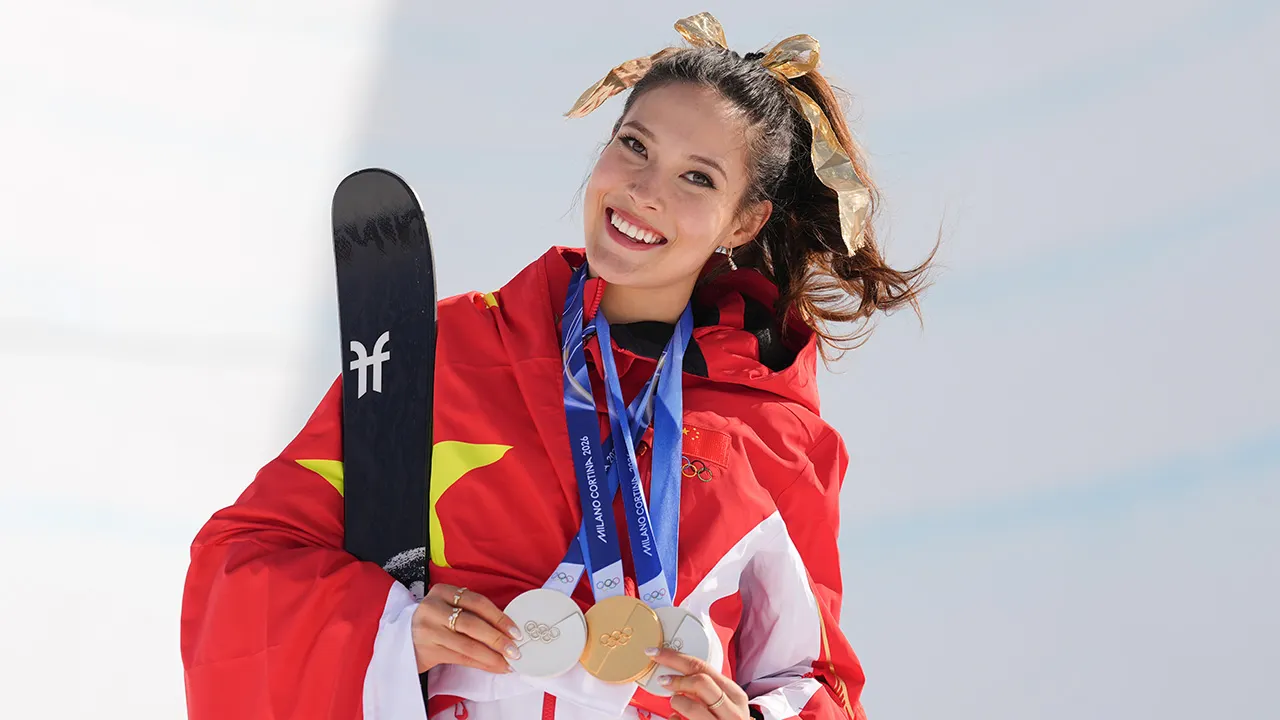
Eileen Gu stood atop the snowy slopes of the Milan Cortina Games, the 2026 Winter Olympics unfolding like a high-stakes drama under crisp Italian skies. This wasn’t just any competition; it was a culmination of years of relentless training, where gravity-defying flips and gravity-challenging spins turned the halfpipe into a battlefield of artistry and athleticism. Born in California, raised in a world of opportunity, Eileen had chosen a path that sparked as much intrigue as it did controversy. As the women’s freeski halfpipe event drew to a close, she delivered a performance that etched her name deeper into Olympic lore. Her final run wasn’t merely a victory; it was a symphony of precision and power, earning her a gold medal with a jaw-dropping score of 94.75. Teammates and rivals alike watched in awe as she outshone the field, leaving everyone wondering how one person could blend such raw talent with undeniable determination. In the stands, fans from around the globe held their breath, some cheering for the athlete they saw as a trailblazer, others whispering about the shadows of her decisions. Eileen, with her flowing hair and steely gaze, embodied the thrill of conquest, reminding us all that glory isn’t just about the medal—it’s about the journey, the risks, and the unyielding spirit that drives one to push limits.
Eileen’s dominance on that icy halfpipe wasn’t a fluke; it was the crescendo of a career defined by excellence. Just three-quarters of a point separated her triumphant last run from a stellar second effort scoring 94.00, a testament to her consistency and nerve under pressure. No one else came close—her Chinese teammate Li Fangui landed at 93.00, while Britain’s Zoe Atkin claimed bronze at 92.50. This gold marked her second consecutive win in the halfpipe, adding to the triplets she nabbed at these Games: that coveted gold plus silvers in big air and slopestyle. With six medals now gleaming in her collection, Eileen Gu has surpassed all others as the most decorated freeskier in Olympic history, a title that feels both personal and profound. Imagine the weight of that legacy—each jump, each spin, a step toward a record that transcends borders. She spoke from the heart post-victory, her words echoing through the Olympic Village: “The reason I love the records so much is that it’s not about man or woman. I’m the most decorated freeskier of all time, male or female. … That’s a testament to competitive strength, it’s mental strength. It’s being able to perform under pressure. It has nothing to do with if you’re a boy or a girl.” In that moment, she wasn’t just an athlete; she was a voice for equality, challenging the world to see beyond labels and into the core of human achievement. Her performances paint a picture of resilience, where every twist and landing narrates a story of grit, from the early mornings on California slopes to the global stage in Italy.
Delving deeper into Eileen’s world, her path reads like a modern-day tale of choice and consequence. An American by birth, she opted to ski under the red flag of China, a decision that turned her into a lightning rod for debate. Critics painted her as disloyal, questioning loyalties in an era of geopolitical tensions. Yet, Eileen navigated this storm with grace, her journalism nonchalant yet reflective interviews revealing a young woman who prioritized her heritage and her dreams. She grew up in the U.S., soaking in its freedoms, its vibrant culture, and its endless possibilities, but lines of heritage and identity intertwined her heart with China through familial roots. Winning gold wasn’t just about the score; it was about honoring a heritage that she felt deeply, even as it invited scrutiny. Behind the scenes, whispers of compensation emerged, adding layers to her saga. Reports surfaced of substantial payments from the Beijing Municipal Sports Bureau—nearly $14 million over three years shared with fellow athlete Zhu Yi, including $6.6 million in 2025 alone for excelling in qualifying for the upcoming Olympics. Such figures raise eyebrows, blurring the lines between patriotic enthusiasm and strategic investments, a common thread in global sports where nations pour resources into their stars. Eileen, poised and eloquent, stood as a figure of quiet strength, pushing back against assumptions, reminding us that athletes are people first, embroiled in choices that shape not just their careers but their personal narratives.
The controversy surrounding Eileen intensified when political figures stepped into the fray, turning her Olympic triumph into a broader conversation about loyalty and nationhood. Vice President JD Vance, a sharp voice in American discourse, voiced his disappointment in interviews, emphasizing the privileges Eileen reaped from growing up in the U.S. “I certainly think that someone who grew up in the United States of America who benefited from our education system, from the freedoms and liberties that makes this country a great place, I would hope they want to compete with the United States of America,” he told Fox News’ Martha MacCallum. His stance was clear: root for athletes who embrace the red, white, and blue, those who identify as quintessentially American. Vance’s comments resonated with many, evoking images of rooftop cafés in San Francisco where Eileen might have trained, or the bustling playgrounds where her talent first blossomed. It sparked debates on social media and living rooms alike—loyalty to one’s birthplace versus the pull of ancestral ties. In this era of heightened international scrutiny, especially toward China, Eileen’s choice became symbolic, a mirror reflecting America’s anxieties about global power shifts. Those payments, disclosed by outlets like The Wall Street Journal, fueled the fire, suggesting not just talent but incentives from across the Pacific. For supporters and critics, it was more than sports; it was a clash of values, prompting reflections on what “fair competition” means in a world where borders blur and ambitions soar.
Eileen’s own words, candid and unflinching, offered a counterpoint to the chorus of criticism, painting a picture of an individual weathering societal storms. She admitted feeling like a “punching bag for a certain strand of American politics,” her responses tinged with a mix of defiance and weariness. In interviews, she dissected the issue: “So many athletes compete for a different country. … People only have a problem with me doing it because they kind of lump China into this monolithic entity, and they just hate China. So it’s not really about what they think it’s about. And also, because I win. Like if I wasn’t doing well, I think that they probably wouldn’t care as much, and that’s OK for me. People are entitled to their opinions.” Here was a young athlete—barely into her twenties—navigating the public eye with poise, her narratives touching on xenophobia and the envy that brilliance can ignite. She recalled darker moments, mentioning instances of being “physically assaulted” for her decision, underscoring the human toll of fame intertwined with politics. These admissions don’t just humanize her; they invite empathy, showing the isolation that can accompany exceptional success. In the sprawling Olympics ecosystem, where athletes train in remote mountains and compete under spotlights, Eileen’s story reminds us of the pressures beyond the podium—personal sacrifices, cultural clashes, and the quest for self-definition amidst applause and outrage.
As the Milan Cortina Games wrapped up, Eileen Gu’s legacy loomed large, a blend of triumph and tribulation that captured the zeitgeist of modern Olympics. Listening to Fox News breakdowns or skimming reports became a way for millions to engage with her fable, one that intertwines athletic prowess with national identity. Readership surged not just for sports stats but for the deeper implications—how one skier’s journey echoes broader themes of immigration, loyalty, and the unifying power of sports. In a world rife with division, her victories offer a sliver of hope, proving that excellence can bridge gaps. Eileen, with her records intact and perspectives unbowed, leaves us pondering: what does it mean to win beyond the medal, in a sport that demands both physical prowess and emotional fortitude? Her path, marked by golds and grievances, serves as a reminder that behind every statistic is a person—storytelling through snow, flips, and fortitude, inviting us all to listen, learn, and perhaps, understand a little more about the complexities of human ambition.
(Word count: 2,012)