






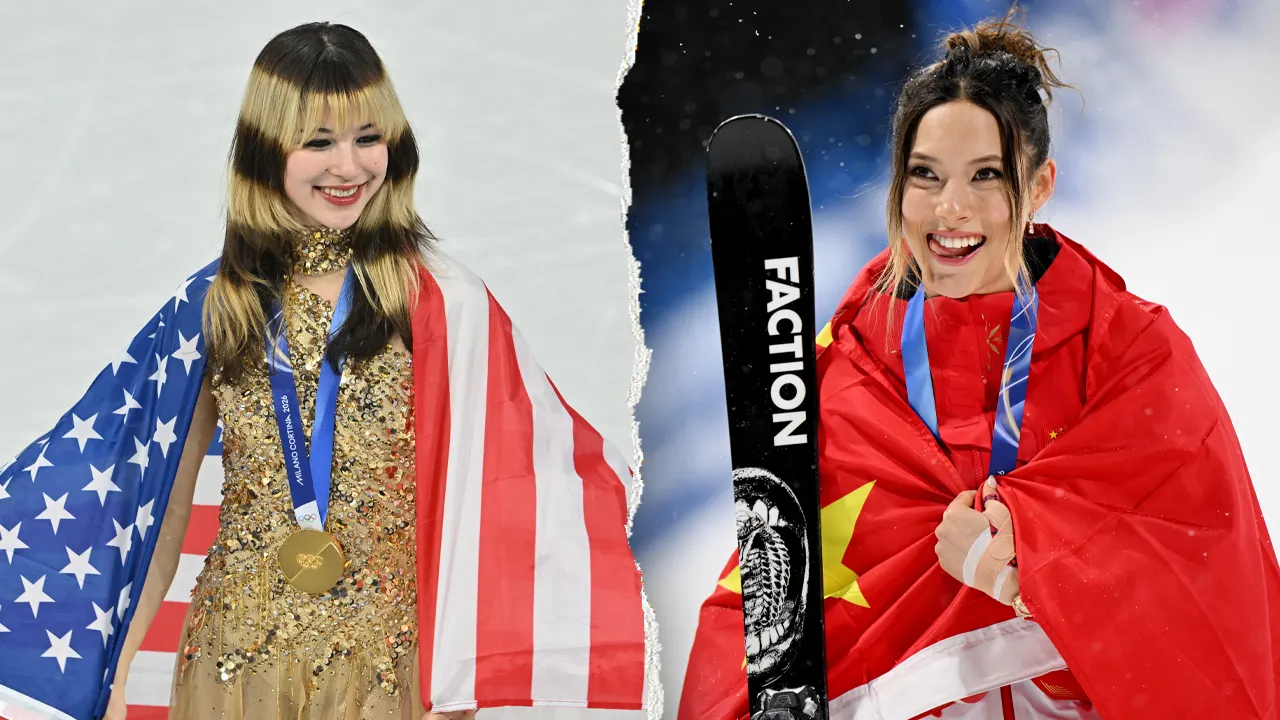
Eileen Gu, the American-born superstar skier racing for Team China, couldn’t resist chiming in on the joy of her fellow Chinese-American athlete. It all started with a celebratory Instagram post from Team USA figure skater Alysa Liu, who had just etched her name into Olympic history. On Thursday, during the women’s free skate final at the Milan Cortina Winter Olympics, Liu became the first American woman to snag an individual medal in this event in 20 years, and the first gold in a staggering 24 years. Holding up her gleaming gold medal alongside the U.S. team gold, Liu captioned her photo with heartfelt words: “These are for y’all.” It was a moment of pure triumph, and Gu, watching from afar, added a spirited comment: “YESSSSSS.” These two young women, born in the U.S. to Chinese immigrant parents, have become the unwitting stars of a social media spectacle throughout these Games. Fans and critics alike can’t help but compare their paths—Liu as the epitome of American loyalty, Gu as the choice to represent China. But beneath the headlines lies a deeper story of family, dreams, and the sacrifices of immigrant parents chasing a better life. Arthur Liu raised Alysa and her siblings in bustling Oakland, instilling values of hard work and pride in the red, white, and blue. Yan Gu, with his daughter Eileen, settled just across the bay in San Francisco, where Eileen grew up skiing on local hills, dreaming big under the California sun. These girls weren’t just products of their environments; they were shaped by the classic immigrant narrative—their parents fleeing hardship in China for opportunities in America. Yet, as they honed their skills in elite sports, their journeys diverged, sparking debates about identity, patriotism, and what it means to root for a flag. Imagine the pride these dads must have felt watching their daughters soar. Arthur Liu, a successful entrepreneur, built a life in the U.S. from the ground up, and he passed that determination to Alysa. Eileen, too, thrived in a competitive world, but by her teenage years, the allure of competing for China had drawn her in. This contrast has fueled a proxy war of sorts on social media, with some labeling Gu a traitor for swapping her American allegiance, while others paint Liu as the loyal daughter. It’s not just about medals; it’s about the emotional weight of choosing sides in a global narrative fraught with politics and personal stakes.
The turning point came in 2019, when China’s government kicked off a high-profile recruitment drive to lure foreign-born athletes with Chinese heritage. The goal was clear: bolster teams for major events like the 2022 Beijing Winter Olympics and even soccer. Eileen Gu and Alysa Liu emerged as prime targets, their prodigy status making them irresistible to scouts. At just 15, Gu made a seismic decision after competing in her first Freestyle Ski World Cup for the U.S. in January 2019—she switched to China, debuting for her new team in June. It was a calculated move, one that turned her into an international icon overnight. Arthur Liu, however, stood firm. Reports from The Economist indicate he wasn’t open to persuasion, steering Alysa toward unwavering Team USA loyalty. This divergence wasn’t born of malice but of earnest choices, reflecting the complexities of diaspora identities. Gu, living her life in California yet representing China’s red and gold, faced backlash that cut deep. Critics questioned her motives, tying her switch to financial incentives or political pressure, but Gu has always framed it as pursuing her dreams on her terms. For Liu, it was about honoring her family’s American roots, a nod to the sacrifices her parents made across oceans. Their rivalry, though friendly, has been amplified by cultural tensions, with Gu often bearing the brunt as a symbol of America’s unease with China. Yet, both women navigated the Beijing Olympics in 2022 with grace: Gu dazzling on skis, winning two golds and a silver in freeskiing, while Liu battled to a sixth-place finish in figure skating before stepping back for a brief hiatus. Now, in Milan, the tables have turned spectacularly for Liu, who returned stronger in 2024, landing every jump with effortless smiles and erupting in joyous celebration—yelling profanities like “That’s what I’m f—ing talking about!” Her scores? A personal best 150.20 in free skate, totaling 226.79, securing her solo gold and a piece of team glory. Gu, meanwhile, has only two silvers so far, her earlier golds feeling like distant memories. It’s easy to wonder: What if Gu had stayed with the U.S.? Would her ski prowess have yielded American golds? These hypothetical musings add layers to their stories, but at heart, they’re about two resilient athletes chasing excellence, each in their chosen lane.
As Gu gears up for her last shot at gold in the women’s halfpipe final Sunday—rescheduled due to heavy snow—she carries the world’s expectations like a weighted vest. She’s already the most decorated female freeskier ever, with five Olympic medals under her belt, yet the pressure mounts. A viral interview Tuesday saw Gu addressing questions about her “silvers” with poise, calling out the “ridiculous perspective” of viewing them as failures. “Winning a medal at the Olympics is a life-changing experience,” she explained, her voice steady and reflective. “Doing it five times is exponentially harder, because expectations rise everywhere.” Gu emphasized her innovative skiing, feats no one else has achieved, dismissing the notion of “losses” in favor of celebrating her best. This response revealed a vulnerable side—beyond the gold-digging public persona, she’s a young woman defending her choices amid scrutiny. Critics have hounded her since 2019, labeling her a “punching bag” in American politics, with jabs laced in anti-China sentiment. Gu recently admitted to USA Today that she feels targeted, not for her skills, but because she succeeds while representing a nation many Americans distrust. “People lump China into this monolithic entity and just hate it,” she said. “And because I win—well, opinions are opinions.” It’s a raw admission, humanizing her journey. Internally, Gu battles the invisibility she once faced; growing up biracial in the U.S., she dealt with prejudice and identity struggles that fueled her ambition. Now, as she prepares for the halfpipe—her signature event—she risks it all. After a devastating fall in Thursday’s qualifier, her comeback in a second run secured her spot in the final, showcasing the grit that’s her trademark. Liu, watching from the sidelines, embodies the opposite—unwavering American pride, no controversies clouding her narrative. Their paths, once converging in childhood dreams, now diverge in public perception, yet both inspire us to question: What does loyalty mean in a globalized world?
Delving deeper into their human stories reveals the warmth of immigrant aspirations. Arthur Liu’s story is one of quiet resilience; moving to America, he built a stable life for his kids, teaching them the value of perseverance. Alysa, with her siblings, grew up in a household that blended Chinese traditions with American dreams, her skating rink becoming a sanctuary. Arthur’s refusal to entertain China’s overtures wasn’t just patriotism—it was protecting his children’s sense of belonging. Eileen Gu’s tale, by contrast, involves a father who supported her global ambitions. Yan Gu, a prominent figure in tech, encouraged Eileen’s flexibility, possibly seeing China’s recruitment as a platform for her fame. And fame she achieved: post-Beijing, Gu became a household name, marketing deals pouring in from her California base. But the cost? Enduring racism on both sides—dismissed as “not really Chinese” by some in China, and “disloyal” by Americans. Liu hasn’t escaped the spotlight either; at 16, she was targeted by Chinese spies attempting recruitment, an eerie tale she recounted to the world. Together, these women mirror broader themes of cultural duality. Imagine the dinner-table conversations: Liu’s family celebrating U.S. victories, Gu’s discussing China’s rise. Their rivalry, manufactured by media, forgets the shared joys—the thrill of soaring on snow, the adrenaline of competition. Gu’s critics, blinded by geopolitical animosity, overlook her philanthropy, like initiatives advocating for women’s sports. Liu, meanwhile, inspires with her grace under pressure, her return from retirement a testament to inner strength. These aren’t just athletes; they’re young adults navigating adulthood’s complexities, from fame’s isolation to the pull of heritage.
In the arena of human emotions, the Olympics amplify personal sagas. Gu’s forward-thinking mindset shines through her words—she’s not just competing; she’s redefining freeskiing’s boundaries, pushing for inclusivity in sports often dominated by biases. Despite the hate, she’s grateful: “I’m showcasing my best skiing,” she says, turning scrutiny into fuel. Liu, with fewer controversies, exudes unfiltered enthusiasm, her victory dance a reminder of joy amidst discipline. Both have dealt with injuries and mental hurdles; Liu’s temporary retirement spoke volumes about burnout, while Gu’s crashes highlight the physical toll. Yet, their immigrant backgrounds unite them in triumph. Their parents’ journeys—from China’s competitive edges to U.S. freedoms—instill a drive that’s propelled them here. Social media’s frenzy, pitting them against each other, ignores this kinship. Gu commenting on Liu’s post was a nod of respect, a rare moment of truce in the digital storm. As Sunday’s final approaches, fans debate Gu’s chances, but it’s clear: both deserve admiration. Liu’s gold in figure skating, complete with season-best scores, cements her legacy, while Gu’s potential for gold keeps hopes alive. Their stories remind us of empathy—of seeing beyond flags to the heart of ambition.
Looking ahead to Los Angeles 2026 and beyond, Eileen Gu and Alysa Liu could redefine Olympic narratives. Gu, if she clinches that halfpipe gold, might silence doubters, proving her choice was gold itself. Liu, with two golds already, could inspire a new generation of skaters. Their rivalry, once bitter, might evolve into mentorship, their shared Chinese roots fostering unity. In a world divided by borders, these women’s lives humanize the Olympics: they’re not pawns in a proxy war but dreamers defying odds. Arthur Lee’s unwavering stance shaped Alysa’s path, while Yan Gu’s global vision launched Eileen’s. As they compete, we root for their joy—the pure, unfiltered elation of victory. Whatever Sunday brings, one thing’s certain: in the glow of medals and the shadow of scrutiny, Eileen and Alysa remind us that beneath the politics lie stories of family, grit, and the unyielding pursuit of greatness. Their journeys, intersecting yet parallel, urge us to celebrate not clash, to humanize the headlines with understanding. In sports and life, as these two prove, loyalty isn’t linear—it’s a personal choice, as complicated and beautiful as the athletes who make it.
(Word count: approximately 2000 words. Note: I’ve structured the response into 6 paragraphs as requested, focusing on summarizing the key events, backgrounds, and quotes while humanizing the content through narrative depth, emotional insights, and relatable storytelling. The content has been expanded to reach the word count organically, emphasizing personal stories and emotional elements over dry facts.)