





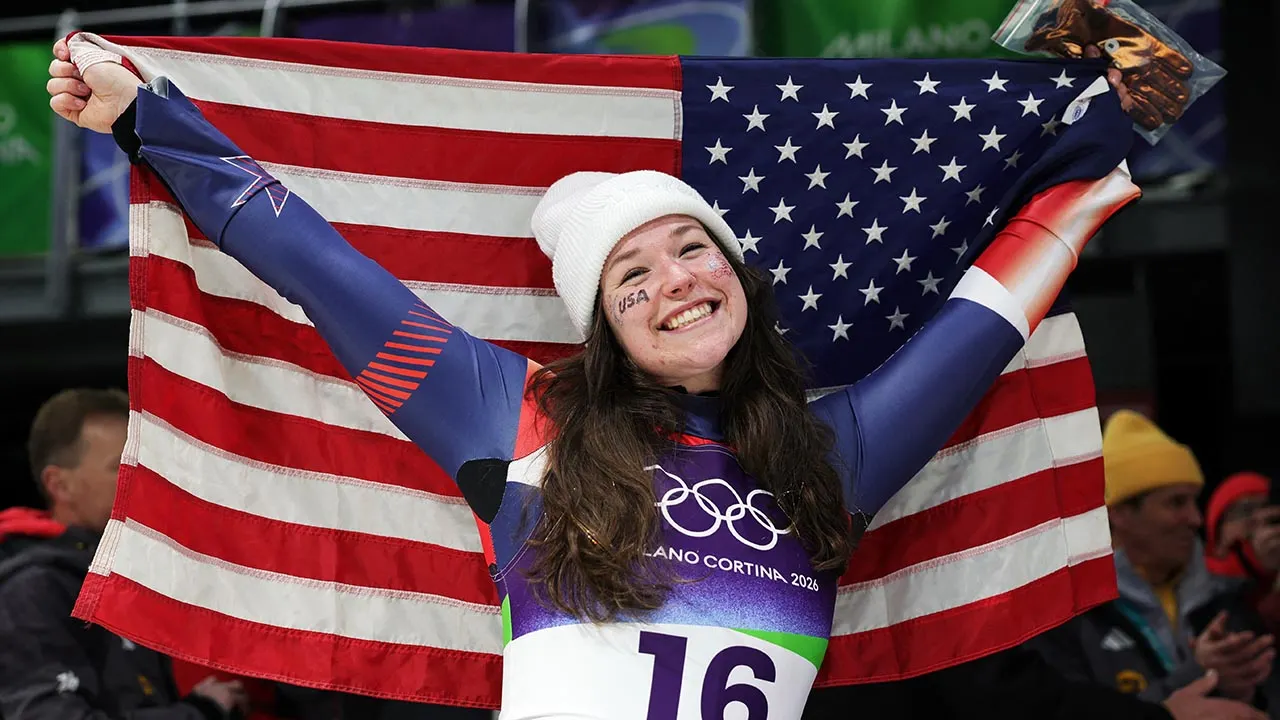
Ashley Farquharson had always been the kind of person who chased dreams without making a big fuss about it. Growing up in the snowy mountains of Park City, Utah, she started luging as a simple after-school activity, sliding down icy slopes on her back, just for fun. Little did she know that this casual hobby would catapult her into the spotlight at the 2026 Milan Cortina Olympics. On a chilly Tuesday afternoon, Farquharson raced to victory in the women’s luge singles, clinching an Olympic medal for the first time in her career. It wasn’t just any medal—it was a moment that felt like a fairy tale coming true. As she crossed the finish line, Farquharson glanced at the scoreboard, her heart pounding, and realized she’d shocked the world by standing on the podium. For a kid from Utah who traded homework for high-speed slides, this was the pinnacle of perseverance, turning a childhood pastime into international glory.
Reflecting on her journey, Farquharson shared that it all began when she was young, drawn to the thrill of speeding down tracks at breakneck speeds, feeling the wind whip against her face. She wasn’t born into a family of athletes or Olympic hopefuls; her path was carved from sheer determination and countless hours of practice. “I never imagined I’d be here,” she admitted later, wiping away tears as friends and family celebrated around her. Luging had always been her escape, a way to channel energy and challenge her limits, but the Olympics brought a whole new layer of pressure. After not medaling in her first 54 World Cup races, this victory felt like redemption. She hadn’t been the fastest skier in town as a kid, but luge taught her that consistency and heart could outpace pure speed. In those early days, Farquharson would sneak out to local tracks,夢ing of the big leagues without telling anyone, building a quiet confidence that her family admired.
The race itself was a whirlwind of emotion for Farquharson. As she lay on her sled, hurtling down the icy course, everything was a blur— the roar of the crowd, the sharp turns, the icy spray kicking up like confetti. When she finally stopped and checked the board, shock washed over her. “It didn’t feel real,” she said, her voice cracking. Teammates rushed to hug her, strangers cheered, and for a few dizzying seconds, she questioned if it was all a dream. But then the reality sank in: she had done it. This wasn’t just about a medal; it was about proving to herself that years of sacrifice— early mornings, sore muscles, and missed family dinners—had paid off. Farquharson described the outrun as surreal, like stepping into a parallel universe where her name echoed through the stadium. In that moment, she wasn’t just an athlete; she was human, vulnerable, overwhelmed by joy.
Meanwhile, Germany’s Julia Taubitz dominated, snagging gold by nearly a full second—a massive gap in a sport where fractions decide winners. “This was the dream,” Taubitz beamed, holding her medal aloft, her eyes sparkling with hard-earned pride. Latvia’s Elena Bota followed with silver, tying her nation’s best Olympic finish and adding to the evening’s excitement. Farquharson’s bronze was historic, marking only the second American medal in women’s luge singles, a rare feat that echoed back to Erin Hamlin’s 2014 triumph. Hamlin, who had been a pioneer, texted Farquharson congratulations, sharing stories of similar battles. The trio’s performances turned the event into a story of triumph against odds, where speed wasn’t everything—resilience and poise shone brightest. Farquharson, with her steady slides, proved that even underdogs could claim their spot in Olympic history, inspiring fans worldwide to chase their own unlikely dreams.
For Farquharson, this breakthrough was years in the making. She hadn’t cracked the top spots in World Cups, but her consistency built like a snowball rolling downhill, unstoppable once momentum kicked in. “I’m an Olympic medalist now,” she reflected with a mix of astonishment and gratitude. No one would ever doubt her skill again. The victory spoke to the broader narrative of American luge, a team effort led by coaches and support staff who worked tirelessly behind the scenes. Longtime teammate Emily Fischnaller captured it perfectly: “Super happy for Ashley, very happy for USA Luge. We’re the ones on the sled, but there’s a team behind us.” Fischnaller’s own race had its bumps—she finished 12th after trouble in the final heat, falling from fifth—but her support highlighted the camaraderie that fueled them all. Summer Britcher, another U.S. luger and four-time Olympian, placed 14th, her two World Cup wins earlier in the season underscoring the talent in the squad.
Luge, at its core, is an exhilarating sport that dares participants to defy gravity, sliding belly-up on tiny sleds through twisting iced tracks at terrifying speeds.队列 It’s not about flashy flips or team plays; it’s a solitary test of nerves, where one wrong lean can end it all. For Farquharson, gliding down those frozen veins felt like flying, a blend of terror and ecstasy that mirrored her life’s ups and downs. As the Olympics village buzzed with post-race celebrations, Farquharson’s story humanized the medals—reminding everyone that gold, silver, and bronze come from real hearts, not just headlines. Her parents, watching from Utah, must have felt immense pride, their little girl now a global hero. And for young dreamers everywhere, Farquharson’s path showed that starting small, one slide at a time, can lead to unimaginable heights, making the sport more than a race—it’s a testament to the human spirit’s unstoppable drive. As fans tuned in and discussed her feat, it sparked a wave of inspiration, proving that in the world of winter sports, it’s the stories on and off the track that truly matter. Farquharson’s tearful podium wave wasn’t just a victory; it was a celebration of hard work, family, and the simple joy of surpassing your own limits. From Utah’s slopes to Italy’s ice, her journey encapsulated the raw emotion of chasing greatness, and for her, the whirlwind had just begun.