






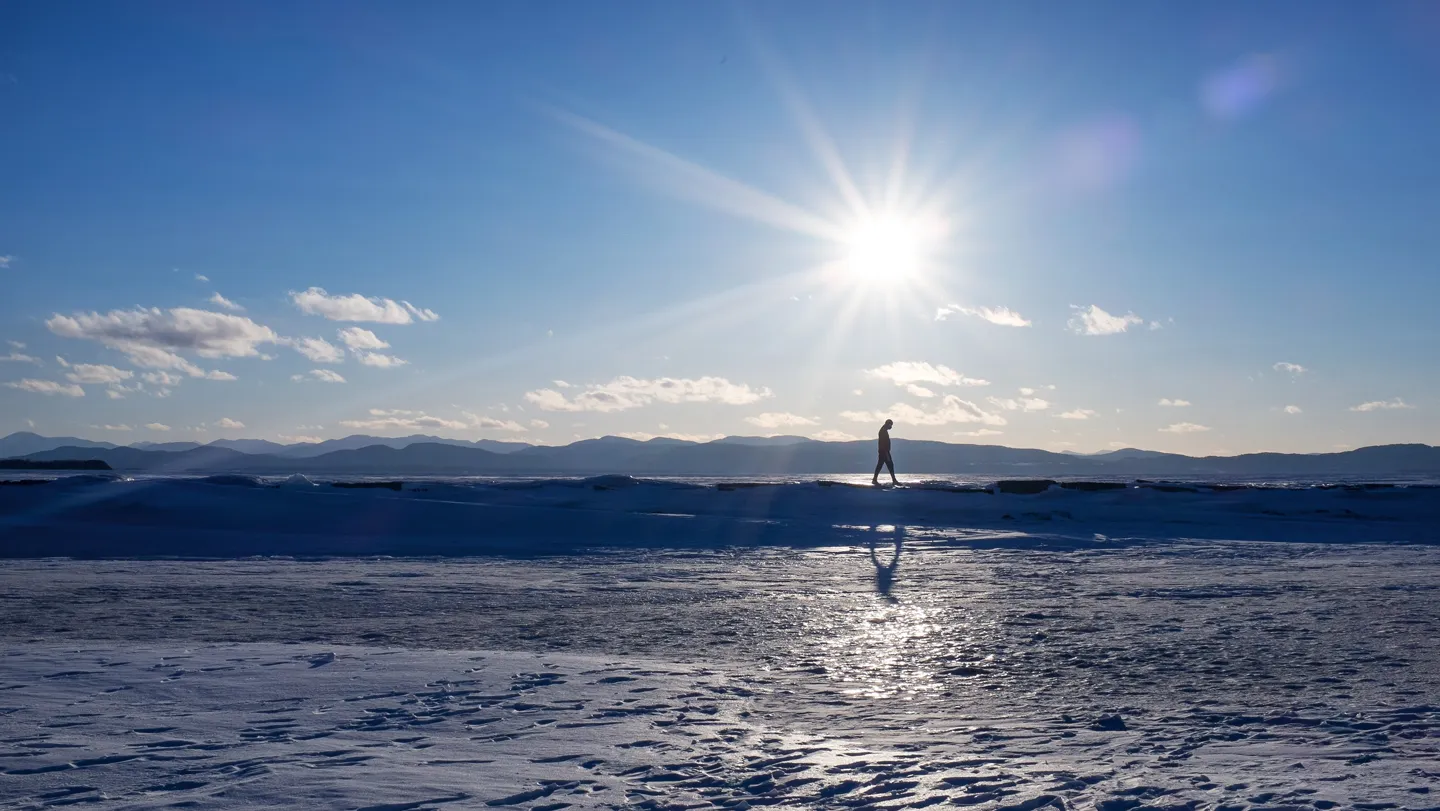
Living in northern Vermont, I’ve always been captivated by the raw beauty of Lake Champlain, especially during those crisp winter months when it transforms into a shimmering ice canvas. Old newspaper clippings in our local library tell tales of a bygone era—pictures of families driving trucks across the lake’s frozen surface, creating ephemeral highways of ice that connected communities and brought a sense of adventure to the cold season. But these days, those icy corridors feel like distant memories, relics of a time when the lake behaved predictably. Roughly half a century ago, my parents would talk about how the lake froze solid every winter, a constant in their lives from the late 1800s through to the mid-1900s. Back then, between 1850 and 1917, it froze without fail, and even up to the late 1940s, freeze years dominated. Now, with temperatures creeping up slowly but steadily, the shift is undeniable—over the past decade, thaw years have outnumbered the freezes, and this February marked the first ice cover in seven long years. As someone who grew up here, I feel the weight of this change personally; my childhood memories of skating parties and snow forts on the lake now seem fragile, like fragile ice cracking underfoot.
This gradual warming snuck up on us imperceptibly at first, like a thief in the night, altering our world without much fanfare. Technically, the difference between a frozen lake and open water boils down to just a degree or two in temperature—a small shift that can turn President’s Day weekend from frozen escapades to spring-like boating. That’s where the intriguing work of Grace Liu, a machine learning expert at Carnegie Mellon University, comes in. She’s been exploring how we perceive climate change, and her research offers a fresh lens. Liu and her team found that people pay far more attention to stark, binary choices—like whether the lake froze versus didn’t freeze—than to the gradual creep of continuous data, such as rising average temperatures over decades. Presenting information in black and white, she says, makes the changes feel immediate and urgent. It’s not just about the data; it’s about human psychology. In their study published in Nature Human Behaviour in 2025, participants who saw binary data were quicker to recognize the trend, rating climate impacts as more severe than those eyeing temperature graphs. For me, living by this lake, it’s eye-opening—seeing the ice disappear feels like losing a part of my heritage, but Liu’s findings remind me that our brains latch onto this simplicity to grasp the bigger picture of environmental shifts.
Yet, this boiling frog effect—where we normalize the abnormal—haunts us in deeper ways. Scientists have long assumed that once disasters pile up—severe hurricanes, raging wildfires, prolonged droughts—people would finally sit up and take notice of climate change. But research paints a sobering reality: we’re not so vigilant. A massive analysis of over 2 billion social media posts from 2014 to 2016 revealed that folks quickly adjust their idea of “normal” temperatures based on the last two to eight years. What felt shocking yesterday fades into routine today, as if the planet’s fever is just a fleeting chill. Published in the Proceedings of the National Academy of Sciences in 2019, this study dubbed it the boiling frog syndrome, likening our complacency to the amphibian that boils to death without leaping out. Even direct exposure to catastrophes doesn’t galvanize us—a survey of nearly 500,000 Americans hit by 15,000 natural disasters between 2006 and 2022 showed scant change in climate beliefs or support for green policies. Toni Rodon, a political scientist at Universitat Pompeu Fabra in Barcelona, puts it bluntly: “Nothing moves the needle.” And Rachit Dubey, a computational cognitive scientist at UCLA, warns of self-gaslighting; we convince ourselves the rapid warming over the past two decades isn’t catastrophic. As a parent, I worry about my daughter—she was just four the last freeze, and now open water in February feels utterly ordinary to her, her fleeting memory of crunching ice dissolving like the seasons themselves.
Humans are cognitive misers, forever seeking shortcuts to conserve mental energy, and binaries offer just that. Therapists and psychologists like Jeremy Shapiro, author of Finding Goldilocks, caution against black-and-white thinking; it’s a trap that oversimplifies life’s nuanced grays. Depression isn’t just present or absent—it’s a spectrum, and forcing it into categories can distort reality. Yet, Shapiro acknowledges the evolutionary appeal: in ancestral times, slicing the world into good versus bad, safe versus perilous, could mean the difference between survival and extinction. Today, we’re still wired that way, processing information lazily. Climate data illustrates this vividly; gradual trends like temperature hikes or snow-loss cliffs—where a tiny warming causes massive snow declines across the Northern Hemisphere, as noted in a 2024 Nature study—blur our perception. New York City’s rare 50-centimeter snowfall storm in February felt extraordinary, but it masked the undercut: the city’s snow drought lasted 701 days before that January 2024 event. Shapiro’s intrigued by flipping the script for climate communication—using our miserly tendencies to our advantage. Instead of battling binaries, perhaps lean into them to jolt awareness.
In their groundbreaking experiments, Liu and Dubey illuminated this binary climate effect through creative studies. As students at Princeton, they examined local histories, noticing how people once marveled or mourned when Lake Carnegie didn’t freeze for skating. Today, with no freeze in years, it registers as normal to newcomers like Liu. To test perceptions, they surveyed almost 800 online participants, showing one group continuous temperature data and another binary freeze/no-freeze graphs for a fictional town. The binary viewers rated climate impacts significantly higher. Replicating with real U.S. lakes and 250 people yielded similar results. In another twist, nearly 400 participants spotted illusory changepoints—sudden shifts—in constant data trends, but mostly when binarized. Those perceiving a “shift” deemed problems graver, suggesting such illusions could awaken us to climate gravity. Liu warns that binarizing loses nuance—it’s an oversimplification—but paired with full context, it might empower action. For instance, in Germany, anthropologist Julian Sommerschuh notes apathy from overwhelming data; people feel paralyzed by global scale. Contrast that with Kenyan farmers, who confront tangible losses like erratic rain yet embrace concrete fixes, planting trees to build resilience across generations. Back home, the lake’s freeze embodies this palpability—touching hanging icicles or sculpting from harvested blocks evokes awe, but also insignificance in the vast, impersonal universe of climate.
As spring blooms, nudging winter’s echoes into memory, I reflect on these insights with a mix of hope and melancholy. Setting the world in binary frames sharpens some stories—like freeze or not—but blurs others, like the interlocking web of weather systems. At Science News, testing this approach highlighted where it clarifies, and where it fails; it’s a tool, not a doctrine. Oversimplified or not, Liu dreams of humans noticing the amiss anew, perhaps igniting action against the crisis. My daughter and I visit the thawing lake shore, where warning signs caution against thinning ice— a binary border between safety and peril. Birds singing herald renewal, yet the melt reminds us of winter’s touchstones slipping away. In northern Vermont, where I call home, the lake’s story urges us to guard what warms our hearts, before it’s lost to the unnoticed thaw. As the earth warms, may we freeze those moments in our minds, turning subtle shifts into calls for change.