





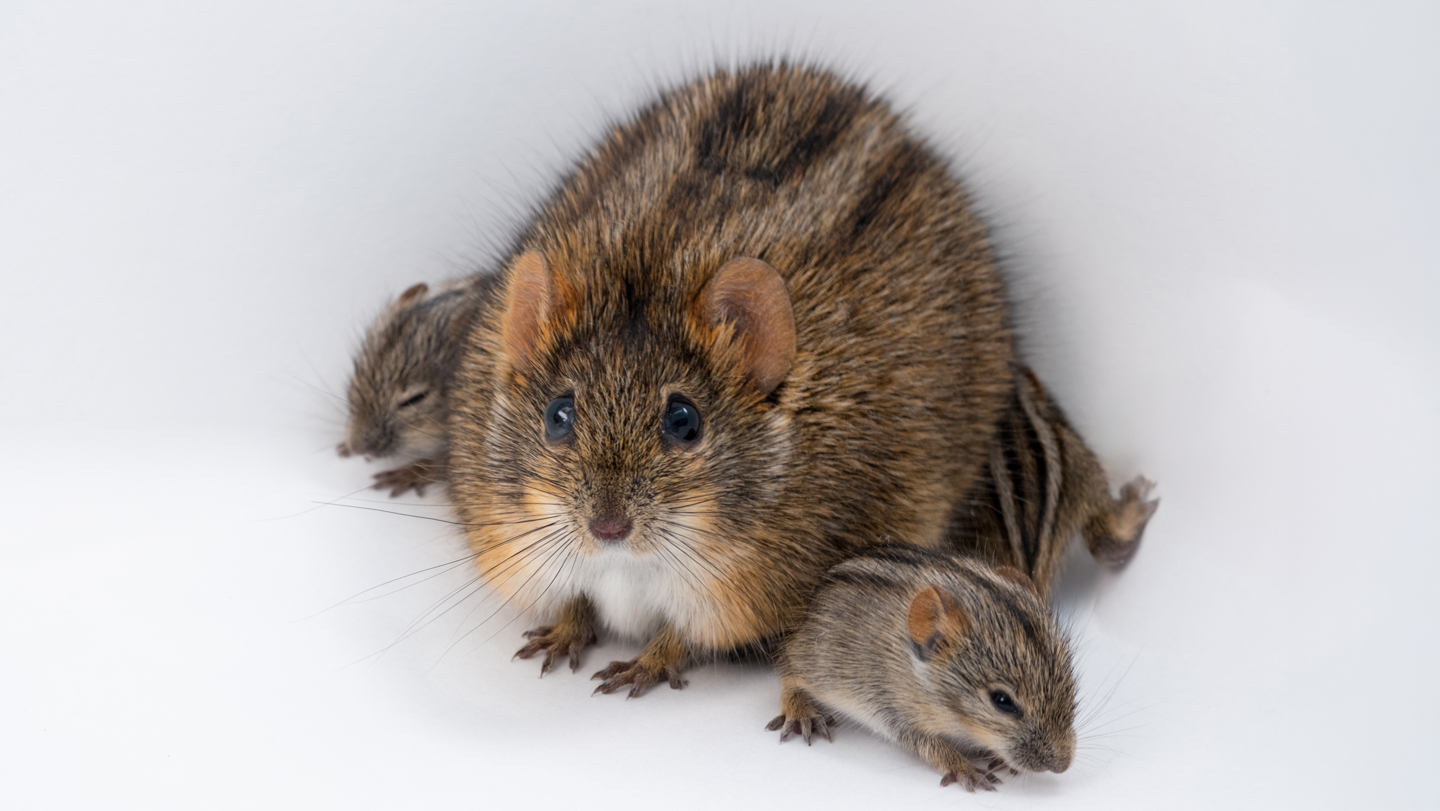
In the cozy corners of family life, we’ve all seen it—the devoted dad who leaps from bed at dawn to bottle-feed the baby, versus the absentee father who barely knows his kid’s middle name. It’s a tale as old as humanity, but what if the roots of this divide aren’t just environmental or psychological, but buried deep in our biology, flipping a switch in the brain? Imagine a world where loving nurture or cold indifference hinges on a simple molecular tweak, echoed in the lives of tiny African striped mice. These small rodents, with their distinctive black-and-white fur patterns, aren’t just cute critters; they’re unlocking secrets about parenting that could resonate across species. Research published in Nature on February 18 reveals that a gene called Agouti plays a pivotal role in determining whether a male mouse becomes a doting protector or a distant aggressor toward his pups. By tweaking this gene’s activity in a key brain region, scientists transformed nurturing dads into standoffish ones, and in extreme cases, even pup killers. It’s a stark reminder that the line between family man and negligent father might not be as wide as we think, shaped by the invisible dance of genes and surroundings.
Picture the African striped mouse—a pint-sized mammal native to southern Africa, thriving in grasslands and rocky terrains. In the wild, these creatures form small family groups, but their domestic lives are a study in contrasts. Unlike the stereotypical mammal where mothers do all the heavy lifting of childcare, male striped mice often step up, grooming the pups, huddling them for warmth, and defending the nest from predators. It’s a rare trait among furry critters; most male mammals bolt after mating, leaving the mom squad to handle the diapers and midnight feedings. But in these mice, fathers vary wildly—some are all-in, others indifferent, and a few downright hostile, nipping at or even abandoning their offspring. This inconsistency makes them perfect lab subjects for dissecting what makes a dad tick. Researchers at Princeton University, led by comparative neurobiologist Forrest Rogers, set out to crack this code. Observing the mice in controlled settings, they noticed social context was everything. Males housed in groups, mimicking the bustle of communal living, turned aggressive when exposed to helpless pups, perhaps viewing them as threats or competitors in the crowded milieu. Yet, when those same males were isolated, living solo like reclusive hermits, they flipped scripts to become devoted parents, gently tending to the little ones. It was counterintuitive at first—typically, social isolation sparks anxiety in rodents, turning them moody and antisocial. But these solitary mice thrived, their paternal instincts awakening as if they’d woken from a long slumber.
Digging deeper, Rogers and his team scanned the mice’s brains during pup interactions, using advanced imaging techniques to map neural activity. The medial preoptic area, or MPOA—a pea-sized knot deep in the brain’s hypothalamus—lit up like a Christmas tree in caring fathers. This region, long associated with nurturing in female rodents, especially new moms, was firing on all cylinders in paternal males. It regulates hormones, emotions, and instincts, acting as the brain’s command center for parental care. Aggressive males, however, showed subdued activity here, their MPOAs barely flickering. It’s fascinating to ponder how this tiny switch might mirror human experiences: a man overwhelmed by family chaos might shut down emotionally, while solitude gives him space to connect. Anthropologist Sarah Hrdy from UC Davis, who cheered from the sidelines, notes that the neural machinery for parenting seems conserved across genders and species. “It’s as if males and females borrow from the same playbook,” she says, challenging old notions that mothering is purely feminine and fatherhood an afterthought. This study blurs those lines, showing how the brain’s wiring, shaped by evolution, enables both sexes to bond deeply with their progeny. In a society obsessed with gender roles, it’s compelling to think of the MPOA as a universal parenting hub, unbiased by chromosomes.
The real intrigue emerged at the molecular level, where science met surprise. The researchers homed in on a gene called Agouti, famed for painting the stripes on these mice’s coats—those bold, eye-catching patterns that help them blend or stand out in their habitats. But Agouti isn’t just a fashionista gene; it’s moonlighting in the brain. In aggressive males, Agouti activity surged in the MPOA, correlating with hostile behaviors like pup biting or neglect. When the team cranked up Agouti artificially, nurturing fathers morphed into ambivalent caretakers, and some even became killers, dispatching their pups to eliminate potential rivals. It’s a chilling demonstration of how one gene can forge or shatter family bonds. Conversely, shifting males from groups to solitary confinement dialed down Agouti, igniting their caregiving flames. This environmental modulation highlights a profound truth: our genes aren’t fixed destinies but responsive instruments, tuning to life’s melodies. Evolutionary biologist Ricardo Mallarino, who first decoded Agouti’s role in stripe formation, was floored by its brain cameo. “It’s like finding your coat-check attendant doubled as a chef,” he quips. This dual role suggests Agouti helps mice weigh competing demands—parenting versus foraging, protecting territory versus bonding. In humans, we see echoes in fathers who sacrifice sleep for night duties yet struggle in high-pressure jobs; the gene acts as a biological thermostat, balancing self-preservation with family devotion.
Zooming out, caregiving in male mice taps into ancient vertebrate roots, stretching back to fish and amphibians where dads guard eggs and fry with fierce loyalty, defying the mammalian norm. Just 5% of mammal species feature involved fathers, making striped mice outliers in a sea of deadbeats. Their flexibility—switching personas based on social cues—echoes real-world adaptability. Think of human dads juggling bachelor life with sudden fatherhood, their instincts fluctuating like the weather. This research amplifies a burgeoning field: social environments rewiring genes via epigenetics, altering brain function without changing DNA itself. It’s empowering, suggesting we can influence nurturing tendencies through context—supportive communities fostering bonding, isolation sparking introspection. Hrdy reflects on human parallels: unlike our chimp cousins, where dads vanish post-mating, human fathers often engage deeply, walking the walk from infancy to adulthood. Yet, we know little about the biological underpinnings. “It’s early days,” she cautions, but studies like this hint at hormonal and neural echoes in men, from testosterone dips during diaper changes to oxytocin surges in play. Perhaps, one day, we’ll map how environments sculpt male involvement, turning deadbeat tendencies into devoted legacies.
Ultimately, this mouse study humanizes parenting’s biology, painting fathers as nuanced beings, not caricatures. Agouti’s tale reminds us that nature versus nurture is a false dichotomy; they’re intertwined, a seamless dance. For families grappling with absentee dads, it offers hope: change the scene, adjust the sliders, and caregiving can bloom. In our fast-paced world, where men juggle careers and culture, the lesson is resonant—environmental cues can rewrite genetic scripts, transforming potential harmers into healers. As science peels back layers, we glimpse a future where understanding brain switches enables better support for nurturing instincts in both sexes. After all, every great dad story starts with a choice, molecular or not, to show up and love unconditionally. This research bridges animals and humans, whispering that deep down, we’re all wired to care—given the right conditions. It’s a beautiful, humbling revelation in the grand tapestry of life, urging us to nurture the nurturers among us. Let it inspire fathers everywhere to tune their inner worlds, fostering homes rich with love and laughter.