





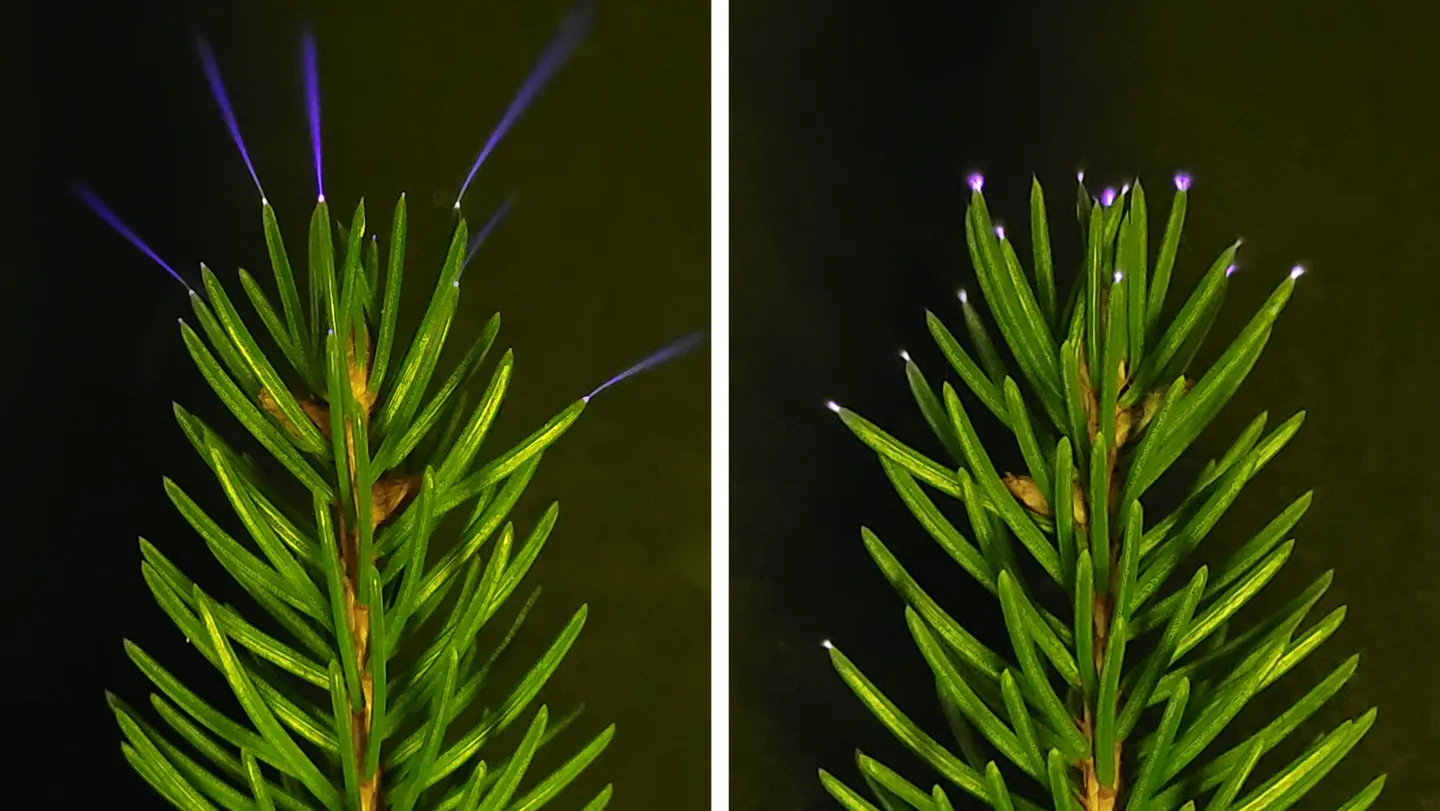
Have you ever stood outside during a thunderstorm, feeling that electric tension in the air, and wondered if the leaves of nearby trees were up to something more than just getting drenched? Turns out, thunderstorms don’t just bring rain and thunder—they can turn the tips of wild trees into twinkling beacons of ultraviolet light, glowing in a way that’s invisible to our human eyes. This isn’t just some poetic fancy; it’s a real scientific phenomenon, where electrical charges in the stormy sky cause trees to shed their own faint blue and UV luminosity. Imagine the tops of those ordinary trees lighting up like Christmas ornaments in the dark, but only detectable with special cameras. For centuries, we’ve known about something similar called Saint Elmo’s fire, those spooky bluish fires that dance on the masts of ships during lightning storms, a sign of charged air interacting with pointed objects. But lately, scientists have been asking: Could trees be doing the same thing right in our forests? And now, thanks to some adventurous researchers, we’ve got proof that they do.
It all started innocently enough over lunch a few years ago, when meteorologist Patrick McFarland was chatting with his advisor, William Brune, at Penn State University. McFarland recalls Brune leaning back, gazing up at the branches overhead, and casually wondering aloud, “Hmm, I wonder if those trees glow under thunderstorms?” It sounded like a quirk of curiosity, but it sparked something real. That very afternoon, they grabbed a fresh branch from a tree, hauled it into the lab, and set up a simple experiment. They placed a high-voltage plate above it to mimic the negative charges in a stormy sky, and connected the branch to a positive plate representing the ground. Sure enough, a faint blue glow emerged—the kind of electrical discharge known as a corona. It was barely visible to the eye but packed with invisible UV rays. This lab success only fueled their intrigue: If branches glow in a controlled setup, what about real trees in the wild during actual storms? “Do we see these glows under thunderstorms as well?” McFarland thought, opening up a whole new chapter of atmospheric science that felt equal parts thrilling and surreal, like discovering a secret life trees lead when we’re not looking.
To chase this wild idea, McFarland and his team didn’t just theorize—they built a mobile lab out of a 2013 Toyota Sienna van, transforming it into a rolling science station packed with weather instruments and a high-tech ultraviolet camera that could spot those corona discharges. Summer 2024 was go time, and they hit the road, heading straight for Florida, the thunderstorm capital of the U.S. With sea breezes from both the Atlantic and Gulf of Mexico colliding daily, Florida offers nearly endless storms, perfect for testing their hunch. “You get thunderstorms almost every single day,” McFarland said with a grin, imagining the van as their trusty steed in this quest. They drove down for a month, navigating humid roads and unpredictable weather, retrofitting the van with a roof-mounted periscope to channel light into the camera. It wasn’t just about driving into storms; it was about setting up elaborate equipment in public spots with tall trees, waiting for the right conditions, and hoping their tech held up. The team felt like intrepid explorers, blending the excitement of a road trip with the precision of fieldwork, all while battling humidity and the constant gamble of Florida’s fickle skies.
Not every attempt was a win, though—these glows are elusive, appearing only under specific storm conditions and not always where expected. The challenges piled up: setting up gear quickly before a storm faded, finding locations with exposed treetops free from interference, and dealing with the van’s limitations in rough terrain. McFarland described it as “really, really challenging,” a mix of logistical headaches and scientific patience. Then, serendipity struck. As they were driving back to Pennsylvania, a storm brewed right in North Carolina, near the coastal plains town of Pembroke. “This storm just so happened to form when we were driving,” McFarland laughed, like the universe was in on the joke. They pulled over, set up near a sweetgum tree and a loblolly pine, and started recording for 90 minutes. It was their golden moment, turning frustration into triumph as the camera captured exactly what they’d hoped for—those tree tops illuminating in the storm’s heart.
Watching the footage back in the lab must have felt like unlocking a treasure chest. The team spotted 41 distinct corona flashes, each one fleeting, lasting no more than three seconds, darting and dancing across leaves and branches like shy fireflies in the wind. They weren’t static points of light; they jumped around, influenced by the breeze rustling the foliage, creating a mesmerizing display that blended science with a touch of natural poetry. No single spot dominated—the glows flickered momentarily and vanished, as if the trees were whispering secrets in light. These observations powered their study, published in the Geophysical Research Letters, where they detailed the UV and blue emissions tied directly to atmospheric charges. It was more than data; it was a confirmation that nature has these hidden performances, where biophysics meets meteorology in a storm-filled ballet, reminding us how much we’re still learning about the quiet, charged conversations between Earth and sky.
What does this mean for the bigger picture? These corona discharges seem far more common than anyone imagined, popping up not just in that North Carolina storm but in others across Florida and Pennsylvania too. “These glows seem to be really, really widespread,” McFarland noted, hinting at a hidden atmospheric effect that might go unnoticed in many storms due to our limited equipment. While their study focused on that one pivotal event, it opens doors to questions about how often this happens worldwide, whether it affects plant health or even contributes to the storm’s energy dynamics. Could trees be playing a tiny role in lightning genesis, or is this just another quirky byproduct of electricity in motion? Future research might involve even more sensitive detectors or global observations, turning this discovery into a gateway for understanding thunderstorms on a deeper level. It’s a humbling reminder that even in the midst of raging weather, the world holds wonders we can’t see with the naked eye—tiny lights signaling that science is an ongoing adventure, full of surprises waiting to be revealed. In the end, these glowing treetops aren’t just a footnote; they’re a call to look closer at the everyday miracles hiding in plain sight, blending the awe of nature with the spark of human curiosity. Who knows what other secrets the skies and trees are keeping? Starting this conversation could lead to breakthroughs far beyond a stormy van ride, inspiring a new wave of exploration into the electric heart of our planet.