





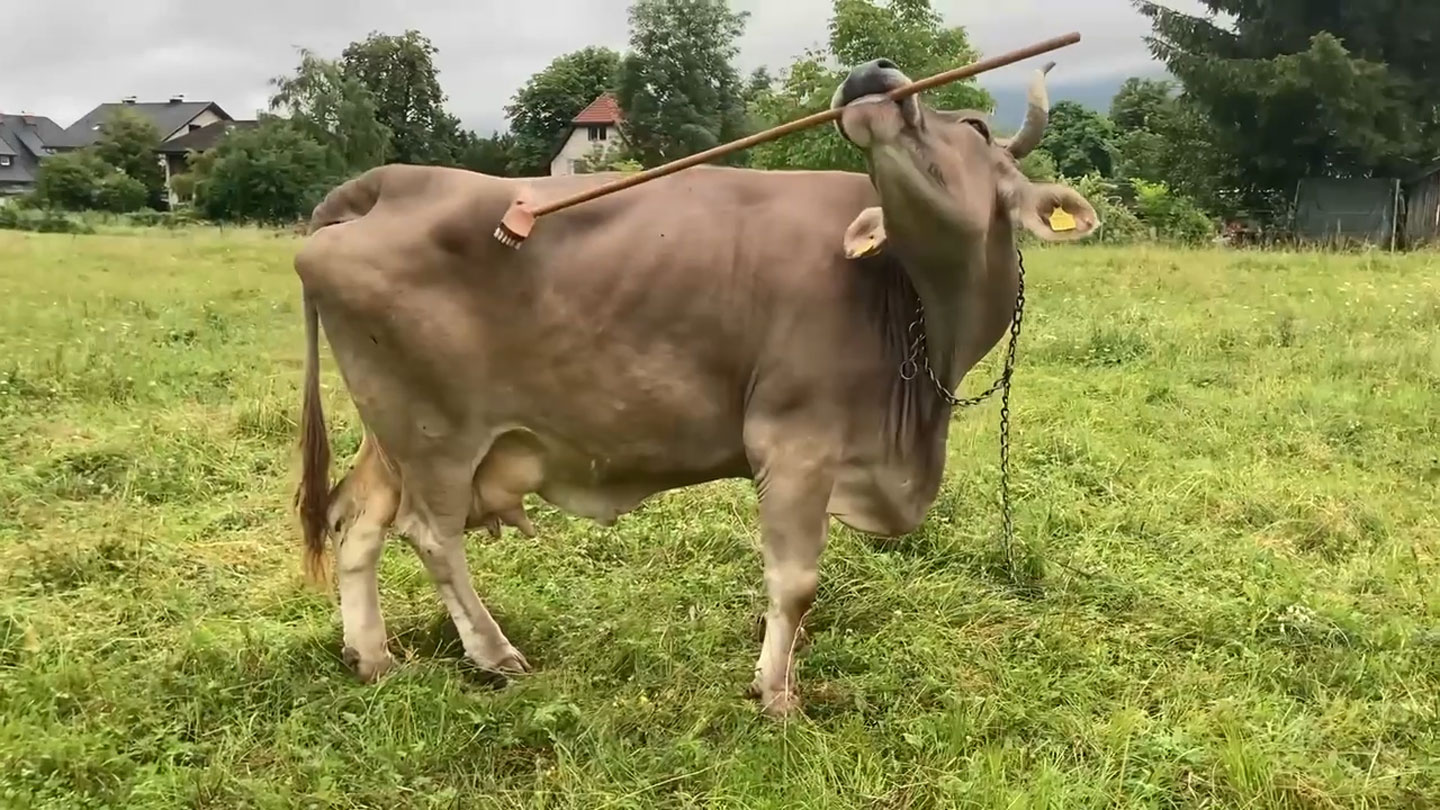
A Brush with Brilliance: Veronika the Cow’s Remarkable Tool Use
In a quiet corner of a farm somewhere, a cow named Veronika made a discovery that would impress scientists and animal behaviorists worldwide. When faced with an itch she couldn’t reach, Veronika didn’t just suffer in silence like many might expect from a cow. Instead, she demonstrated remarkable problem-solving abilities by deliberately picking up a brush with her mouth and using it to scratch those hard-to-reach places on her body. This seemingly simple act represents something extraordinary in our understanding of animal cognition and tool use, challenging long-held assumptions about the intellectual capabilities of farm animals that have often been underestimated or overlooked entirely.
Veronika’s innovative brush technique isn’t just cute or clever—it represents a sophisticated cognitive process. She recognized a problem (the itch), identified a potential solution (the brush), and then physically manipulated this external object to extend her body’s natural capabilities. This sequence demonstrates an understanding of cause and effect, spatial relationships, and even a form of planning that was once thought to be primarily the domain of primates and a few other species like corvids and elephants. The fact that Veronika repeatedly uses the brush, adjusting her technique depending on where the itch occurs, suggests this isn’t accidental but represents true tool use—a behavior that requires mental representation of the problem and its solution before action is taken.
For scientists studying animal cognition, Veronika’s brush use represents an important expansion of our understanding of tool use across species. Historically, the “cognitive elite club” of animal tool users was extremely exclusive, centered around great apes, some birds, and elephants. Cows, generally viewed as simple grazers with limited cognitive complexity, weren’t even considered candidates for such behaviors. Yet Veronika’s actions align perfectly with the scientific definition of tool use: the manipulation of an external object not part of the animal’s body to achieve a goal. This discovery invites us to reconsider how widespread tool use might be among domesticated animals that have constant access to human artifacts but whose behaviors are rarely studied with the same intensity as wild animals or traditional research subjects.
What makes Veronika’s tool use particularly fascinating is the context in which it occurs. Unlike wild animals who might use tools for survival-critical tasks like obtaining food, Veronika’s brush use addresses comfort—suggesting a level of self-awareness and concern for personal wellbeing beyond mere survival. This raises profound questions about animal consciousness, sentience, and the richness of inner lives that farm animals might experience. If a cow can recognize discomfort and actively seek solutions to improve its condition using tools, what other aspects of their experience might we be missing? The implications extend beyond scientific curiosity into ethical considerations about how we treat animals that demonstrate such cognitive capabilities and emotional needs.
Veronika’s story also highlights the potential impact of environment on cognitive development. Living on a farm with access to human tools, she had opportunities that wild bovines would never encounter. This suggests that the expression of intelligence in animals may be partly opportunity-dependent—given the right conditions and materials, many species might demonstrate capabilities we’ve never witnessed simply because they haven’t had the chance. This phenomenon, sometimes called “latent intelligence,” implies that animals may possess cognitive abilities that remain unexpressed until specific environmental conditions or challenges bring them forth. In this light, Veronika’s brush technique may represent not an exceptional cow, but rather an exceptional opportunity for ordinary cow intelligence to express itself in a novel and observable way.
As we continue to learn from animals like Veronika, we’re compelled to expand our understanding of non-human intelligence and reconsider the artificial hierarchies we’ve created that place some species above others based on our limited observations. Each discovery of tool use, problem-solving, or complex cognition in previously underestimated species doesn’t just add a footnote to scientific literature—it fundamentally challenges how we conceptualize intelligence itself. Perhaps intelligence isn’t a single ladder with humans at the top, but rather a diverse forest of cognitive adaptations suited to each species’ particular needs and environment. Veronika the cow and her brush remind us that remarkable discoveries about animal minds await us not just in exotic locations or laboratories, but sometimes in the most ordinary places—if only we take the time to look, observe, and appreciate the complexity that exists in the animals with whom we share our world.