





The Curious Case of a Twisted Sentence and the Wonders It Unlocks
You know how some sentences just grab you by the collar and pull you into a world of mystery? Take this one: “A molecule made of carbon and chlorine is half as twisty as the paper loops common in math classes.” It sounds like the punchline to a riddle or the opening line of a sci-fi novel, doesn’t it? As a curious mind wandering through the corridors of science and math, I couldn’t help but dissect it. We’re talking about a molecule—something at the atomic level, invisible and intricate—being compared to these paper loops we all played with in school. Those loops, often hastily cut from notebooks and twisted before gluing them into infinity symbols, embody a concept that’s as mind-bending as it is simple. And the twisty molecule? It’s made of carbon, that versatile element that forms everything from diamonds to your DNA, paired with chlorine, the halogen that adds a sharp edge to many compounds. But “half as twisty”? What does that even mean in the real world of atoms and paper? I imagine myself in a high school classroom, fidgeting with a strip of paper, realizing this is no ordinary comparison. It’s a bridge between math’s abstract elegance and chemistry’s molecular ballet, inviting us to explore why shape and twist matter so much. Half as twisty suggests a quantitative oddity—like playing a never-ending game of “what if” with a Möbius strip, where the rules bend and everything connects in ways you never expected. This sentence isn’t just factual; it’s a human one, blending the childlike joy of crafting paper art with the adult fascination of molecular secrets. It personifies science, making it relatable, like chatting with a friend over coffee about something mind-expanding yet tangible.
Diving into those paper loops, they’re the heart of Möbius strips, named after the mathematician August Ferdinand Möbius, who introduced the idea back in the 19th century. Picture this: you take a long strip of paper, give it a half-twist, and glue the ends together. Voilà, what you have is a loop with a single surface. That twist makes it topological, which is fancy speak for something defying ordinary geometry. In math classes around the globe, these loops are handed out like party favors—cut one in half, and instead of two equal pieces, you get a longer, intertwined figure-eight. It’s a lesson in continuity, infinity, and the weirdness of topology, the study of shapes that stay the same no matter how you stretch, twist, or bend them (as long as you don’t tear). Teachers use them to spark wonder, showing how a simple twist can create something eternal—infinite paths without ends. But the twist also raises philosophical questions: is it art or math? It feels human, like a metaphor for life’s twists and turns, where paths loop back unexpectedly. We’ve all traced our fingers along these strips, feeling the surprise of endlessly circling without crossing an edge. Extending this to everyday life, Möbius strips inspire designs in tires (for even wear), conveyor belts, and even the recycling symbol. Yet, for all their flatness, they’re twisty at their core, with that essential half-twist defining their essence. It’s no wonder they’re a staple in classrooms; they teach patience and curiosity. Without that twist, it’s just a boring tube, but with it? It’s comic genius, a symbol of the universe’s playful complexity. So, when the sentence compares a molecule to these loops, it’s not hyperbolic—it’s grounding abstruse molecular behavior in something we’ve all touched and wondered about.
Now, zooming into the microscopic realm, the molecule in question is likely something like a chlorinated carbon compound, perhaps carbon tetrachloride or a similar chloroalkane. Carbon and chlorine atoms bond in fascinating ways; carbon, with its four valence electrons, loves to form stable structures, while chlorine, with seven, readily steals one to complete its octet. Together, they can create chains, rings, or tetrahedral formations that twist in three-dimensional space. Take carbon tetrachloride—it’s a classic example, where one carbon atom sits at the center, surrounded by four chlorine atoms like a tetrahedral table. This molecule isn’t inherently “twisty” in the way a ribbon spirals; it’s more symmetrically rigid, like a stable building block in solvents or industrial applications. But twistiness in chemistry often means chirality, where mirror-image molecules differ in their spatial arrangement, affecting how they interact with light or interact with living systems. In enantiomers, one might be left-handed, the other right-handed, like twisted siblings. Chlorine introduces polarity, pulling electrons and forcing bonds to bend or flex unpredictably. We’ve seen in labs and nature how these compounds can mimic biological helices if extended—think synthetic polymers used in plastics or pharmaceuticals. Yet, the sentence pegs it as half as twisty as those Möbius loops. Perhaps this molecule exhibits a quarter-twist conformation, something less than the full DNA-like double helix but more artful than a straight line. It’s humanizing: we’re not just talking formulas; we’re imagining how these invisible entities dance, influencing everything from the paint on your walls to the chemicals in your fridge.
Exploring twistiness takes us deeper into the rabbit hole of molecular structure. Twistiness isn’t just aesthetic; it’s functional. In math, twist is measured in angles—like 180 degrees for a Möbius strip, creating that single surface through continuity. Half as twisty would logically be 90 degrees, a subtle bend that changes everything without going overboard. Applying this to chemistry, twisted molecules can adopt conformers—different shapes from rotating bonds, like a flexible straw. Carbon-carbon bonds in alkenes or alkynes can twist into cis-trans configurations, mimicking the half-compromise. We’ve observed this in NMR spectroscopy, where spins reveal hidden geometries, or in x-ray crystallography, capturing a molecule’s pose like a frozen dancer. Chlorine compounds, often volatile and reactive, can exhibit atropisomerism, where steric hindrance forces slower twists, remaining stable enough to isolate. It’s like baking bread: too much twist, and it tears; just right, and it’s perfectly shaped. Nature’s helices, like alpha-helices in proteins, are twisty at 360 degrees, far twistier than half. But our molecule strikes a middle ground, perhaps in cyclic chlorocarbons where the ring puckers slightly, resembling a partially contorted Möbius echo. This twistiness affects properties—solubility, reactivity, even taste in chiral drugs. Many diseases hinge on handedness, reminding us why enantiomers matter. Twisting also connects to quantum mechanics; electrons in orbitals twist in phases, influencing bonding. It’s all so intricately human, like the way artists twist forms in sculpture for emotional depth.
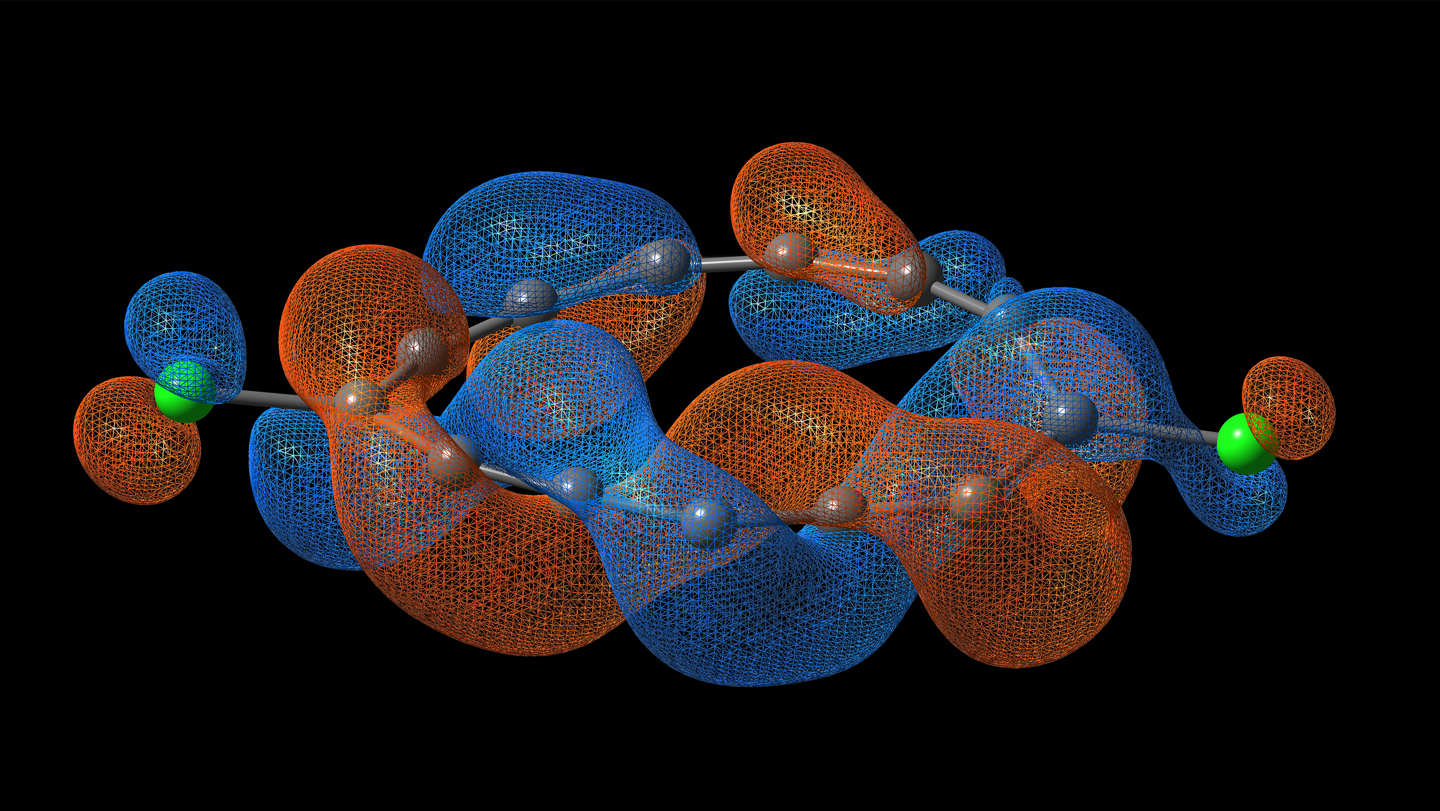
Bridging math and chemistry, topology emerges as the common thread. While math deals in pure shapes, chemistry embodies them in matter. Those paper loops teach topology’s invariants—properties that survive deformation. A ball can be squished into a donut topologically, but a twisted Möbius can’t. Molecules borrow this: graphene sheets can form fullerene buckyballs through local twists, but global twists create Möbius-like carbon tubes discovered in labs. Chlorine-doped analogs might exhibit similar quirks, like Möbius aromatics where electrons delocalize along a twisted path. Imagine researchers like Gerhard Schröder or others in the 1960s, experimenting with such loops in chemistry, realizing synthetic Möbius molecules. These aren’t mere copies; they’re hybrids, where half the twist alters reactivity—perhaps stabilizing radicals or enabling novel reactions. In quantum chemistry, knots and links from topology model rodlike molecules or DNA supercoiling. DNA itself, a full helical twist, is twistier than our molecule, aligning with the sentence. Human stories abound: chemists publish papers like thrilling adventures, racing to prove theoretical Möbius carbon rings exist. It’s collaborative, with twists of surprise—like accidental discoveries in pollution or pharmaceuticals. Kids seeing paper loops might grow up fascinated, linking classroom demos to lab breakthroughs. This fusion humanizes science, turning abstract into experiential. We cycle between math’s eternal loops and chemistry’s tangible forms, each twist unveiling deeper realities.
Reflecting on that enigmatic sentence, it’s clear it captures more than facts—it’s a poetic nudge toward unity. The molecule, half as twisty, embodies balance: not overwhelming like a DNA coil, but curiously inviting like a Möbius loop. We’ve journeyed from scribbled paper to atomic dances, seeing how twists shape worlds. In our human quest, curiosity drives us—gambling on the unknown, like adventurers charting unexplored territories. It reminds me of Einstein’s thought experiments, blending imagination with precision. This “half-twisty” molecule could inspire future innovations: biodegradable plastics with controlled torsions or drugs targeting twisted receptors. Ultimately, the sentence humanizes the esoteric, inviting everyone to ponder the loops in our lives. Science isn’t cold data; it’s connective tissue, woven with wonder. As we fold and twist our understanding, we create new infinities, just like those classroom paper chains—endless, ever-twisty, and profoundly human. What other secrets hide in the folds? The pursuit keeps going, one twist at a time.