



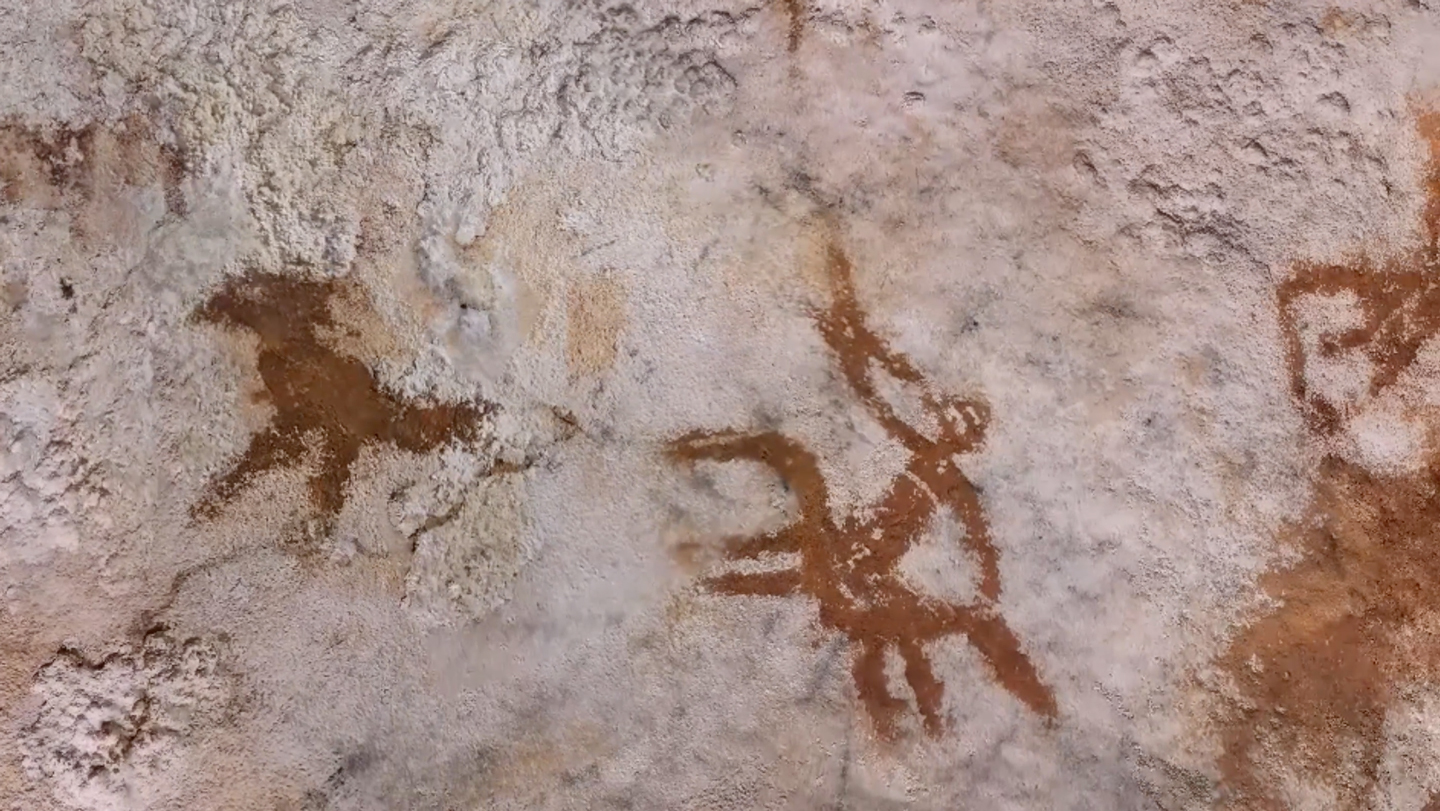
Ancient Hand Stencil Reveals Earliest Rock Art Ever Discovered
In a remarkable archaeological discovery, a hand stencil created approximately 67,800 years ago on a cave wall in Indonesia has been identified as the oldest known rock art in the world. This ancient artistic expression provides a fascinating glimpse into humanity’s earliest creative impulses and rewrites our understanding of prehistoric art.
The hand stencil was discovered among hundreds of other paintings on Muna Island, near the larger Indonesian island of Sulawesi. According to archaeologist Adam Brumm from Griffith University in Brisbane, Australia, the image was created by someone placing their hand against the cave wall and spraying paint from their mouth around it – a technique that would become common in prehistoric art across the globe. This ancient artist was likely part of the same population of modern humans who eventually colonized Australia around 65,000 years ago, suggesting these early people were island-hopping in dugout canoes as they made their way toward what was then the ancient continent of Sahul (which connected New Guinea and Australia).
Prior to this discovery, the earliest known cave art was attributed to Neanderthals in Europe, dating back approximately 65,000 years. The new finding shifts our understanding of art’s origins and raises intriguing questions about the artistic capacities of different human species. Interestingly, the ancient hand stencil appears to have been created with a slight rotation of the hand during painting, resulting in narrowed or claw-like fingers – a distinctive motif that continued to appear in cave paintings across Sulawesi until about 20,000 years ago, suggesting a long-standing artistic tradition.
The research team, led by Brumm who previously discovered a 44,000-year-old narrative cave painting and a 45,000-year-old animal depiction on Sulawesi, dated this new finding by analyzing uranium isotopes in the calcium carbonate layers that formed over the paintings throughout millennia. This meticulous process allowed them to establish a precise timeline for the prehistoric artwork in the Metanduno Cave on Muna Island. The discovery may also highlight differences between Neanderthal and early modern human artistic capabilities. While Neanderthals created hand stencils over 66,000 years ago in Spain, early Homo sapiens progressed from simple hand stencils to creating complex, intricate cave paintings like those found in France’s Chauvet Cave (dated between 37,000-32,000 years ago).
Many experts view this discovery as further evidence that early Homo sapiens were navigating between islands in this region thousands of years ago. Helen Farr, an archaeologist from the University of Southampton who specializes in prehistoric seafaring, notes that these people were clearly crossing water channels using boats or rafts. However, not all experts agree with this interpretation. James O’Connell, an anthropologist from the University of Utah, suggests the possibility that this earliest Sulawesi rock art could have been created by a different human group than those who migrated to Sahul, and questions whether purposeful marine travel was necessary, suggesting humans might have swum or drifted on natural debris.
This groundbreaking discovery not only pushes back the timeline of human artistic expression but also provides valuable insights into the migration patterns, technological capabilities, and cultural practices of our early human ancestors. As archaeologists continue to explore these ancient cave systems across Indonesia, each new finding helps piece together the rich mosaic of humanity’s earliest creative endeavors and their journey across the prehistoric world.