


The Curious Case of the Rockhead Poacher’s Head Drum
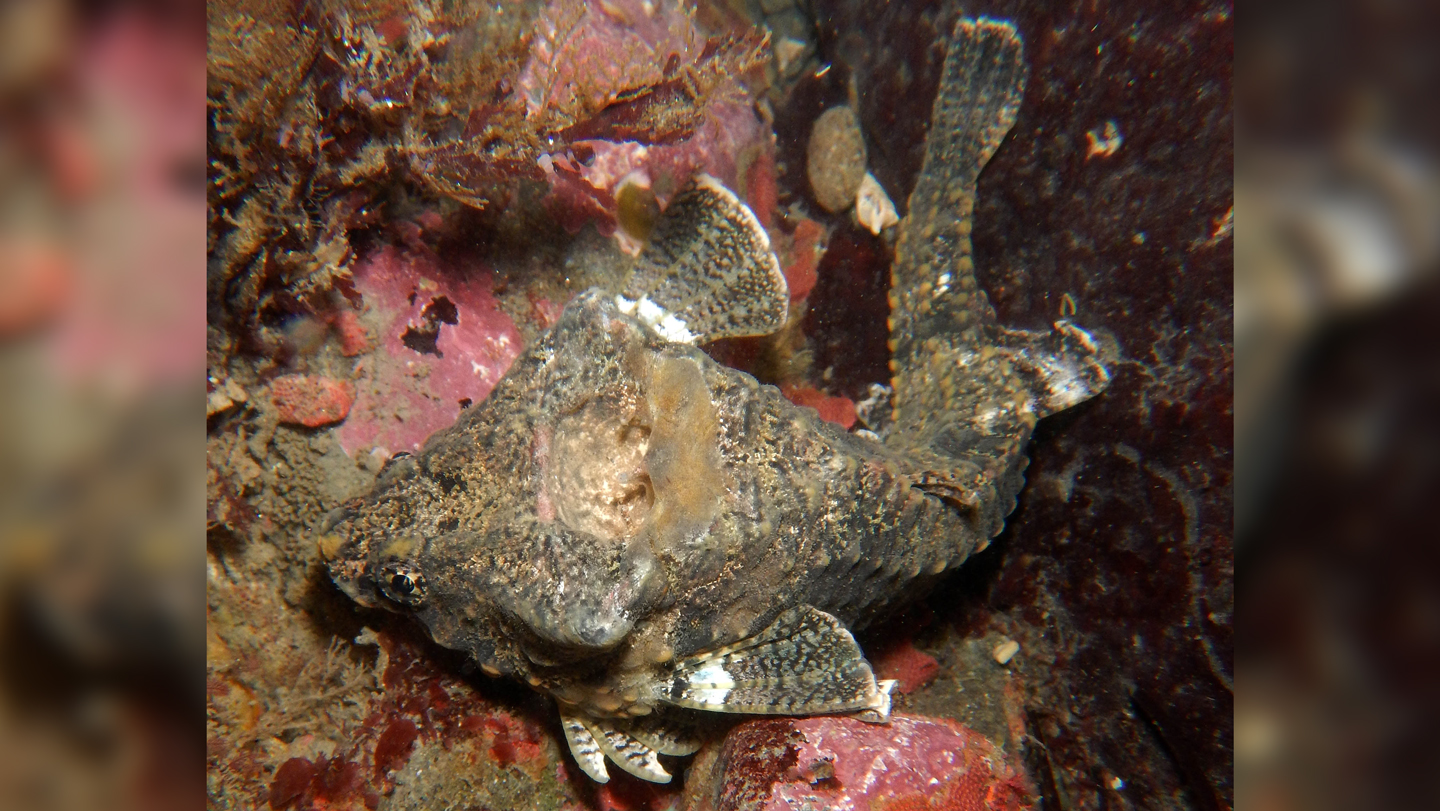
In the shallow coastal waters from Alaska to California lives an unassuming fish with a remarkable secret. The rockhead poacher (Bothragonus swanii), a small, armored, teardrop-shaped creature that spends most of its time camouflaged on the sea floor, possesses one of the most unusual anatomical features in the fish world: a conspicuous divot in the top of its skull that scientists now believe functions as a built-in drum. This extraordinary adaptation may allow these modest fish to communicate with one another in their noisy underwater environment, representing a fascinating example of how evolution can produce unexpected solutions to environmental challenges.
For years, scientists had noted the peculiar depression atop the rockhead poacher’s head—a pit so large it could contain the fish’s entire brain—but its purpose remained elusive. Was it some kind of sound collection device like a satellite dish? Did it enhance some other sensory capability? To solve this mystery, functional morphologist Daniel Geldof and his colleagues at Louisiana State University employed advanced imaging technology, using high-powered X-rays to create detailed three-dimensional models of the fish’s internal structure. What they discovered was nothing short of remarkable: an apparent percussion instrument built into the animal’s skull.
The breakthrough came when researchers identified unusual rib bones beneath the head cavity. These ribs are uniquely adapted—larger, denser, and flatter than typical fish ribs—and connected to powerful muscles that allow them considerable mobility. Geldof’s hypothesis is that these specialized ribs act as drumsticks, striking against the underside of the skull pit to produce vibrations and sounds. “This fish basically has a tiny drum kit or maraca in its head,” Geldof explains. He notes that the sensation of a rockhead poacher vocalizing feels similar to holding a vibrating cell phone, suggesting that these fish can generate significant mechanical energy through this internal percussion system.
This method of sound production, known as stridulation, involves the striking or scraping of body elements together and is found in various animals, including some fish species. However, the rockhead poacher appears to take this mechanism to an extreme. The adaptation seems particularly well-suited to the fish’s challenging acoustic environment. Living in wave-pounded intertidal shallows creates a noisy backdrop that would typically make communication difficult. Rockhead poachers may have evolved their unique sound-producing capability to overcome this challenge, potentially transmitting vibrations through the rocky surfaces they rest upon rather than solely through the turbulent water.
The evolutionary purpose behind this unusual adaptation remains subject to debate. While startling predators might be one function, Geldof believes it’s more likely that the fish use their built-in percussion instruments for communication with other members of their species, particularly for mating purposes. Just as birds use songs to attract mates and establish territories, these fish may be using their head drums to communicate important information in their underwater world. “They have to work around all these crazy challenges if they want to hear and be heard in this din,” Geldof notes, highlighting the ingenuity of this evolutionary solution.
Not all scientists are convinced by this interpretation, however. Eric Parmentier, an ecomorphologist at the University of Liège in Belgium, questions whether the ribs actually strike the pit to create sound, suggesting that bone-on-bone contact would produce frequencies much higher than those predicted by Geldof’s team. The debate underscores the need for further research, including direct recordings of the fish making sounds underwater and laboratory experiments to observe the proposed mechanism in action. These additional studies would help confirm how this peculiar percussion system functions and shed light on why such an unusual anatomical feature evolved in the first place. Whatever the ultimate answer, the rockhead poacher’s head drum stands as a testament to nature’s endless capacity for innovation and the remarkable diversity of adaptations found in our oceans.