


Echoes from the Past: Paleontological Discoveries of 2025 Reveal Earth’s Ancient Stories
In the world of paleontology, 2025 has become a landmark year where discoveries from our planet’s distant past are challenging long-held scientific assumptions and opening new windows into Earth’s ancient history. From tiny dinosaurs asserting their independence to singing cicadas that predate our earliest estimates, these findings remind us that our understanding of life’s evolution continues to evolve itself. Each fossil, preserved in rock, amber, or even sidewalk cement, tells a story that connects us to a world both strange and familiar.
Perhaps the most contentious debate in dinosaur paleontology has finally reached resolution with the confirmation that Nanotyrannus lancensis was indeed its own species, not simply a juvenile Tyrannosaurus rex as many had argued. Two separate research teams approached this decades-old question from different angles – one examining limb structures in the famous “Dueling Dinosaurs” fossil, while the other analyzed growth patterns in throat bones associated with the original 1940s skull discovery. Both teams converged on the same conclusion: these specimens represented fully-grown adult Nanotyrannus that lived alongside T. rex approximately 67 million years ago. This revelation transforms our understanding of the late Cretaceous ecosystem, suggesting a more diverse tyrannosaur population than previously thought and demonstrating how even seemingly well-established paleontological classifications remain open to revision with new evidence and analytical techniques.
The timeline of Earth’s ancient sounds received a dramatic adjustment when researchers reexamined a fossil housed for decades in Germany’s Senckenberg Museum. What they discovered were two female specimens of Eoplatypelura messelensis, a newly identified species of cicada dating back 47 million years to the Eocene Epoch. This pushes back the known history of cicadas by 17 million years, suggesting their distinctive songs have been part of Earth’s acoustic landscape far longer than previously understood. Particularly intriguing is what this tells us about the evolution of insect communication, since in modern cicadas only males produce their characteristic songs. Similarly ancient acoustic revelations came from the Grand Canyon, where scientists identified a sophisticated new species of “penis worm” (Kraytdraco spectatus) from the Cambrian Period around 540 million years ago. The complexity of its feeding structures – featuring intricate teeth and finely branching projections – suggests it inhabited a resource-rich environment that allowed for evolutionary experimentation with advanced adaptations.
Horror-film scenarios from nature’s playbook were confirmed with the discovery of a 100-million-year-old amber specimen capturing the precise moment when a zombifying fungus erupted from an ant pupa’s body. This finding, unearthed in a laboratory basement at China’s Yunnan University, doubles the known age of these brain-hijacking fungi that inspired fictional apocalyptic scenarios in popular entertainment. The exceptional preservation in amber provides rare documentation of fungal biology from deep time, as the soft tissues of fungi rarely fossilize. In a different but equally dramatic preservation, a nearly complete Archaeopteryx fossil with wings outstretched offers new insights into how flight evolved in birds. This 150-million-year-old specimen, preserved with remarkable detail including impressions of feathers and skin, revealed the presence of specialized inner wing feathers called tertials – a feature found in modern flying birds but not in non-avian feathered dinosaurs. The fossil also showed evidence of mobile digits on the hands, supporting theories that Archaeopteryx wasn’t merely capable of flight but may have been an adept tree-climber as well.
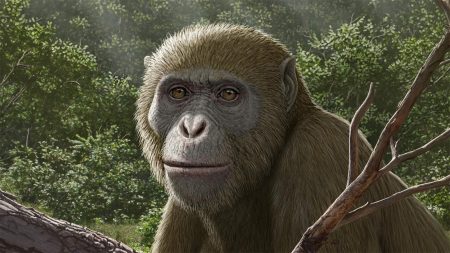
Our understanding of human evolution continues to grow more nuanced with evidence that multiple early human species coexisted in East Africa around 3.4 million years ago. New fossil discoveries in Ethiopia, including foot bones and fragments of pelvis, skull, jaw and teeth, have been attributed to Australopithecus deyiremeda, challenging the long-held view that Lucy’s species (Australopithecus afarensis) was the sole early human relative in the region between 3.8 and 3 million years ago. A. deyiremeda appears to have retained more primitive features than Lucy’s kind, including a grasping big toe better suited for climbing trees, and chemical analyses suggest it had a less diverse diet. Meanwhile, debate continues over the identity of the 146,000-year-old “Dragon Man” skull from Harbin, China. While two studies suggest it represents the first known skull of the mysterious Denisovans based on protein and DNA analyses, other scientists remain skeptical due to concerns about identification methods and possible contamination. Similarly thought-provoking is a 126,000-year-old fossil trace from South Africa that appears to record not just footprints but also the distinctive “butt-drag” marks of ancient rock hyraxes, representing the first fossil of this behavior ever discovered.
Even modern impressions can become subjects of paleontological inquiry, as demonstrated by the scientific examination of Chicago’s viral “Rat Hole” – an animal impression preserved in sidewalk cement that captured public imagination. Careful measurement and analysis determined it was likely made by a squirrel rather than a rat, having fallen from an overhanging tree. While seemingly trivial, this investigation highlights the fundamental challenges of paleontological identification: if correctly identifying a modern species from a recent impression proves difficult, imagine the complexity of naming creatures that lived hundreds of millions of years ago. These discoveries of 2025, from tiny tyrannosaurs to singing insects and climbing birds to ancient human neighbors, remind us that paleontology isn’t just about collecting old bones – it’s about reconstructing lost worlds, behaviors, and evolutionary pathways. Each finding adds another piece to our understanding of Earth’s magnificent and continuing story, where the past informs our perspective on life’s diversity and resilience through deep time.