

Imagine stumbling upon a scene straight out of a fairy tale: tiny, orange blobs clinging to tall grasses in a sun-dappled meadow, pretending to be delicate flowers while secretly plotting a parasitic takeover. That’s the world of the European blister beetle, or Meloe proscarabaeus, whose larvae have mastered the art of deception in ways that would make even the cleverest con artist blush. These clever critters don’t just look the part; they chemically mimic blossoms to lure unsuspecting bees, turning the tables on nature’s usual order. It’s a rare twist where an animal impersonates a plant, not the other way around, revealing just how wild and inventive evolution can get. Picture it as a beetle’s version of undercover work: camouflaged as something harmless and inviting, all to hitch a ride to a bee’s nest and feast on the resident eggs. This discovery, shared on biorXiv.org, shines a light on a behaviour that’s both fascinating and unsettling, much like finding out your friendly neighbourhood gardener has a darker side.
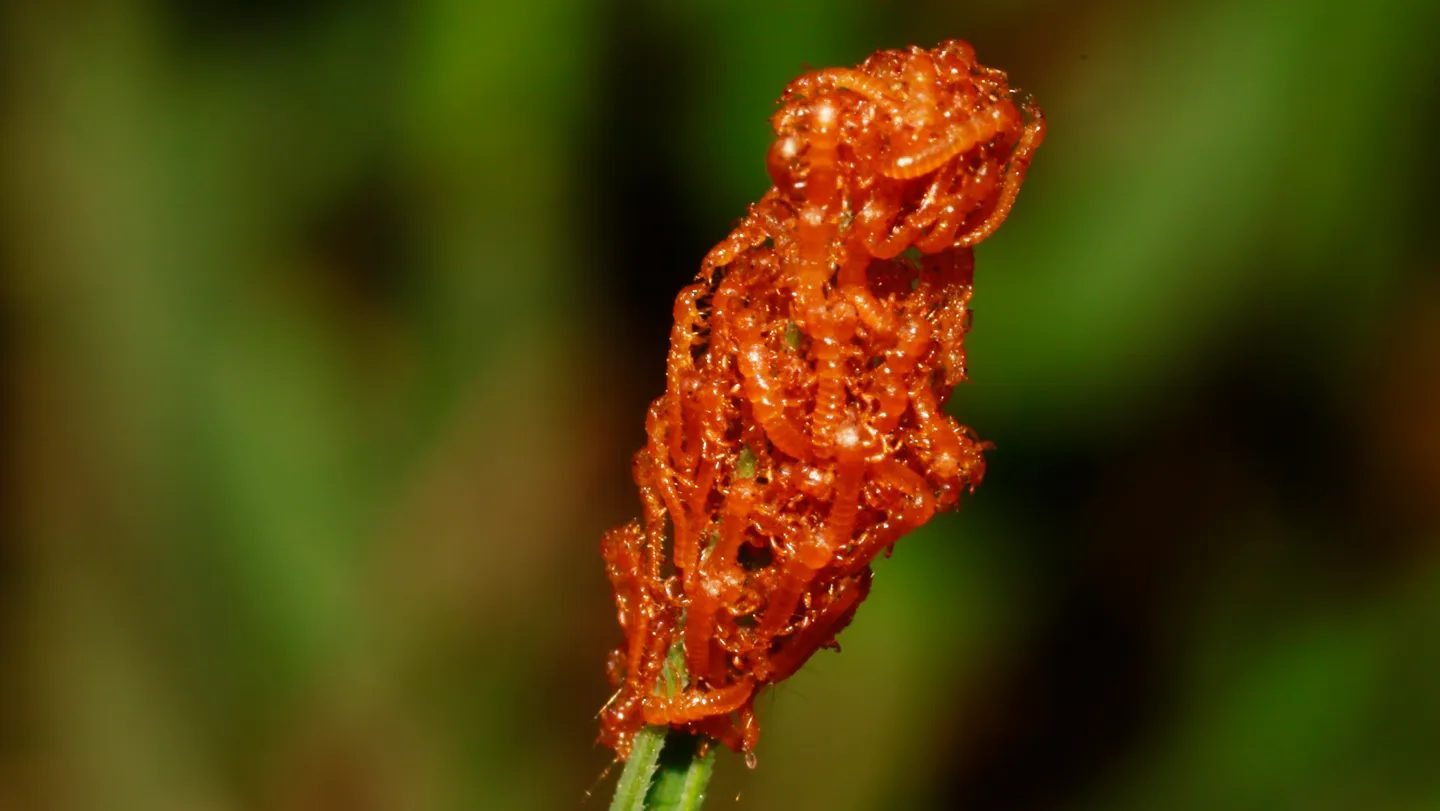
In the spring, when the ground softens and new life stirs, these beetle larvae burst forth from underground. They scramble up blades of grass, clustering together in bright orange masses that gleam like artificial sunshine against the green foliage. To the casual observer, they resemble nothing so much as vibrant flower heads, a floral impersonation that’s as convincing as it is bizarre. Bees, always on the lookout for nectar-rich blooms, are drawn in, mistaking these gatherings for a promising source of pollen. Once close, the larvae latch on with surprising speed, clinging to the bee’s furry body like determined hitchhikers. They ride the insect back to its nest, where they unleash their true parasitic intent: devouring the bee’s eggs and pupae, ensuring their own survival at the host’s expense. It’s a cycle as dramatic as any thriller, with the larvae as the pint-sized villains who start as helpless newborns but quickly become ruthless opportunists.
Yet, for years, scientists scratched their heads over exactly how these larvae pulled off such an elaborate ruse. Sure, their orange clusters looked flower-like, but what was the irresistible hook keeping bees buzzing back? Was it pure visual trickery, or something more olfactory? Enter Ryan Alam, a synthetic chemist at Germany’s Max Planck Institute for Chemical Ecology, who decided to dive deep into this beetle mystery. With a team of researchers, he set up a greenhouse sanctuary for the beetles, nurturing male and female adults on a diet of wheatgrass, broad bean, and clover. After allowing them to mate and lay eggs, he watched as the larvae emerged and instinctively climbed skyward. Carefully brushing them from their grassy perches with a gentle paintbrush, he prepared to unravel their secrets through a battery of chemical analyses. It was detective work on a microscopic scale, piecing together clues that could explain this parasitic perfume party.
What they uncovered was nothing short of astonishing: the larvae weren’t just faking it; they were full-blown perfumers, churning out a sophisticated blend of 17 aromatic compounds typically found in plants. At the heart of their bouquet was linalool, that spicy, lavender-like essence you might recognize from high-end perfumes or essential oils. But it didn’t stop there—these tiny alchemists synthesized the scents from scratch, wielding two specialized enzymes to tweak linalool into a diverse medley. Think of it as a beetle laboratory, where raw ingredients are transformed into an alluring cocktail designed to seduce pollinators. It wasn’t a sloppy imitation; it was a meticulously crafted aroma, proving that these larvae had evolved their own “personal larval perfume,” as Alam aptly called it. This chemical mimicry turns the beetles into living lures, bridging the gap between the plant and animal kingdoms in a way that’s both perverse and poetic.
To test their findings, the researchers enlisted real bees—wild red mason bees, or Osmia bicornis—as unwitting participants in choice experiments. By releasing different synthetic versions of the beetle’s aromas into controlled environments, they observed how the insects responded. The results were telling: certain blends, especially those attracting female bees, heightened the larvae’s chances of landing a free ride straight to a nest. It’s as if the scents acted like an invisible beacon, whispering promises of floral rewards that bees couldn’t resist. Intriguingly, the compounds didn’t just fool the adults; they also drew the larvae themselves into clusters, suggesting a built-in signaling mechanism. Perhaps, in their evolutionary backstory, the larvae once followed natural flower scents to congregate and await bees. Over time, they began producing the odours themselves, amplifying the deception until plants became obsolete in their survival strategy. It’s a survival hack that feels almost empathetic—these little beings learning to communalize and thrive in a world that’s often harsh and scarce.
This adaptation may have evolved to give the larvae an edge in early spring, when true flowers are scarce and bees are desperate for sustenance. By posing as the season’s first feast, the beetle crowds become evolutionary pioneers, priming pollinators for the tasks ahead while securing their own passage. And the bees? They seem blissfully unaware, duped by a disguise that’s chemically spot-on. It poses bigger questions about mimicry in nature: how far might animals go to blur lines with their environment, turning symbiosis into subterfuge? For the beetles, this perfume ploy isn’t just clever chemistry—it’s a lifeline, ensuring their lineage continues in the face of adversity. It’s a reminder that in the grand theatre of evolution, even the smallest actors can wield outsize charm, weaving aromas into narratives of deception and delight. One can’t help but admire the ingenuity, even as it creeps you out just a bit, proof that life finds the most unexpected ways to endure. As we uncover these hidden strategies, we’re invited to rethink our own perceptions of who’s pulling the strings in nature’s complex web, where roles can flip in the blink of an evolutionary eye.