





The Dreamy Solution to Stubborn Puzzles
Ever find yourself staring at a Rubik’s Cube or a crossword clue that just won’t give, only to wake up the next morning with the answer popping into your head like magic? It’s the kind of “aha!” moment that makes you wonder if your brain did the heavy lifting while you snoozed. Well, scientists have been scratching their heads (literally, sometimes) over this phenomenon for years, and now a new study shines a light on how dreams might actually be key to solving real-life enigmas. Imagine unlocking the mysteries of your mind not through sheer willpower, but by cozying up to something as elusive as REM sleep. In a fascinating exploration published on February 5 in Neuroscience of Consciousness, researchers discovered that playing specific sounds during sleep could nudge lucid dreamers toward cracking those tough puzzles. It’s the first solid, experimental proof of dreams influencing problem-solving, offering a peek into the wild world where our unconscious minds wander freely.
Karen Konkoly, a cognitive neuroscientist at Northwestern University, teamed up with colleagues to dive deep into this dream-fueled detective work. They’ve long known dreams are a cornerstone of our mental lives—whether we remember them or not, they’re always happening, bubbling with fragments of our daily experiences and inner thoughts. The team was intrigued by something called targeted memory reactivation, or TMR, a clever trick where a subtle cue, like a gentle sound or even a whiff of scent, reminds the sleeping brain of a specific memory. While past work showed this works best in deep sleep stages, Konkoly wondered: What if it could spark creativity during rapid eye movement (REM) sleep, that vivid phase where dreams get wild and lucid dreaming—realizing you’re in a dream and maybe even steering it—becomes possible? The idea isn’t to control every dream like a remote control, but to gently prompt the brain to mull over pressing problems. It’s like planting a seed in the fertile soil of your subconscious, hoping it sprouts into something useful come morning.
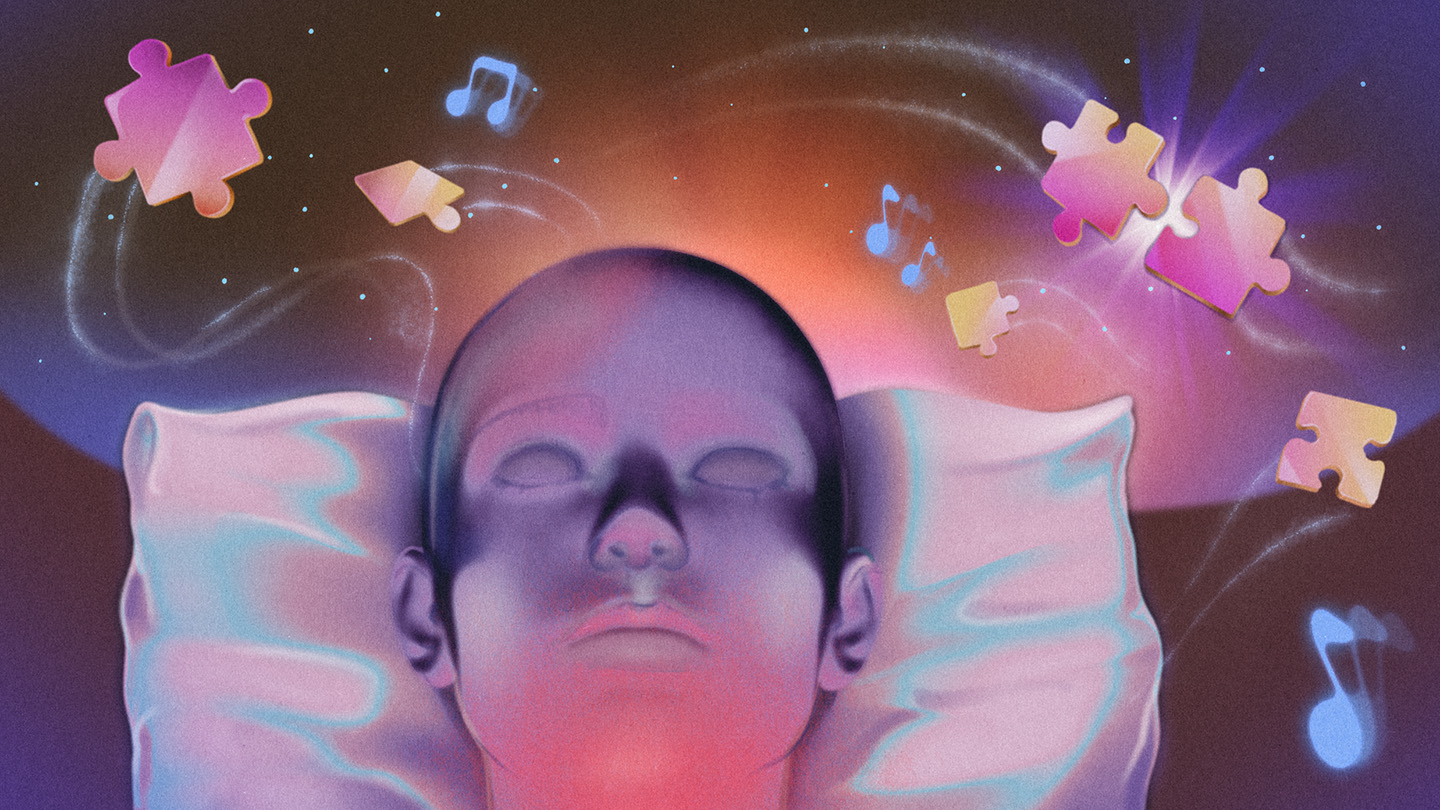
To test this, they recruited 20 people skilled in lucid dreaming—those rare folks who can become aware inside their dreams and sometimes direct them, turning what might be a confusing nightmare into an intentional adventure. Each participant got a set of puzzles: some solvable, some not. Nothing too harrowing, just brain-teasers paired with quirky, unrelated soundtracks—like snippets of soothing instrumental music. Imagine listening to a mellow jazz loop while squinting at a logic puzzle; the sounds weren’t meant to help solve it directly, but to link the puzzle to that audio in the mind. Then, wired up with electrodes to track their sleep stages, the participants hit the sack. Around 4 a.m., they were gently roused and coaxed back into dreamland with tips to focus on lucid dreaming—think deep breathing and mental cues like “I’m in a dream.” As they drifted into REM, the researchers played those puzzle-linked sounds softly, turning sleep into a potential brainstorming session.
The results were intriguing, if not earth-shattering. Out of the bunch, nine instances led to actual lucid dreams about the unsolved puzzles. What’s more, 75% of the participants reported dreaming about these cued problems, even if not fully lucid. On the morning-after quiz, those who had dreamed—even vaguely—about the puzzles solved 42% of them. Compare that to just 17% for those who skipped the dreamy detour: a clear edge from having the brain chew on the problem while unconscious. It’s not a guaranteed fix—dreams can be fickle, after all—but it hints at a real connection. Giulio Bernardi, a cognitive neuroscientist from Italy’s IMT School for Advanced Studies Lucca, not involved in the study, calls it a groundbreaking step. For too long, tales of naps leading to breakthroughs felt like urban legends, unsupported by rigorous tests. This study bridges that gap, showing dreams aren’t just random fluff; they can actively reshape how we approach challenges.
Of course, this isn’t about turning your pillow into a productivity hack station. Konkoly stresses she’s not advocating for “corrupting” every dream with work woes; instead, she wants us to cherish dreams for what they are—messy, disjointed mirrors of our inner worlds. Stories of geniuses like Einstein or Edison getting insights from dozing abound, but the science has been murky. Some experts say sleeping on a problem boosts chances of solving it, while others shrug it off as coincidence. Here, the twist is in the dreaming: it’s not just rest that helps, but actively engaging the subconscious with cues. In an age of constant wakefulness, this reminds us sleep isn’t wasted time—it’s a superpower. Imagine harnessing it to tackle not just puzzles, but bigger life quandaries, all while catching Z’s.
In the end, this research nudges us to reframe dreams as collaborative partners in the human experience. We’re not passive victims of our slumber; with the right setup, we can invite our dreams to join the problem-solving party. Sure, not everyone’s a natural lucid dreamer—it takes practice to gain control in the dream world—but the potential is thrilling. What if tomorrow’s big idea isn’t born from a caffeine-fueled grind, but from a midnight reverie? As Konkoly puts it, dreams are a “big part of your inner life,” and valuing them might unlock more than we ever imagined. It’s a call to embrace the chaos of our minds, one puzzle—and one dream—at a time. So next time you’re stuck on a crossword, try whispering your woes into the night: who knows, inspiration might just visit while you dream.