



Ancient Fire-Starters: Groundbreaking Discovery Reveals Earliest Evidence of Intentional Fire Making
In a remarkable archaeological finding that reshapes our understanding of early human technological advancement, researchers have uncovered the oldest clear evidence of intentional fire making at a site in southern England. Dating back 400,000 years, this discovery reveals that Neandertals near what is now Barnham, England, used iron pyrite and flint to create sparks for lighting campfires—pushing back the earliest known date of this practice by approximately 350,000 years.
The groundbreaking research, published in Nature on December 10, chronicles how these ancient relatives of modern humans gathered around water holes on grasslands bordering forests and deliberately created fire. “You get a tingle down your spine,” describes Nick Ashton of the British Museum, one of the researchers. “This is a major change in how human societies begin to operate.” The significance cannot be overstated, as Marie Soressi from Leiden University notes, “For the first time, we actually have excellent evidence at a site of that age of fire making and not only fire using. Being able to have it at will is really a game changer.”
The ability to create fire at will represents one of the most transformative developments in human evolution. Fire provided early humans with protection from predators, created a social gathering space during nighttime hours, and revolutionized food preparation. Cooking removed toxins from food, extended preservation, and significantly reduced the calories needed for digestion—potentially contributing to further brain development. While evidence suggests that humans and their relatives have been using fire for more than a million years—with sites in Kenya and South Africa showing signs of fire use by Homo erectus, and a site in northern Israel preserving hearths from about 780,000 years ago—what makes the Barnham discovery unique is the presence of fire-making tools.
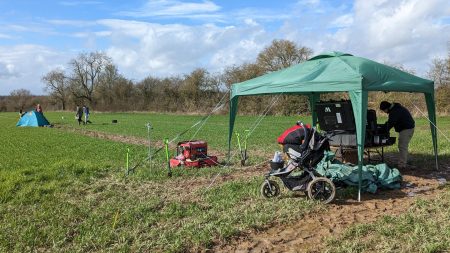
The journey to this discovery was methodical and years in the making. The Barnham site has long been known for its Paleolithic stone tools, but it wasn’t until 2014 that Ashton and his colleagues discovered heat-shattered flint, though they couldn’t definitively rule out natural causes. In 2017, they found bits of iron pyrite—a material that can be used to create sparks—but again faced uncertainty about whether it had been naturally deposited. The breakthrough came in 2021 when Ashton spotted reddened clay in a previously overlooked area. “I thought, ‘I’m sure that looks like heated or burnt sediment,'” he recalls. Subsequent geochemical analysis confirmed the sediment had been heated multiple times to temperatures exceeding 700 degrees Celsius, and a geological survey revealed that iron pyrite is extremely rare in the local area, suggesting it was deliberately transported there.
Even skeptics find the evidence compelling. Dennis Sandgathe, a Paleolithic archaeologist who has generally questioned fire-making claims, acknowledges that “finding a couple of chunks of iron pyrite in what appears to be pretty close association with fire residues—that’s a pretty compelling argument that they’re making fire.” The ancient campfires date to an interglacial period of warmer temperatures, and although few human remains have been preserved at Barnham, researchers believe the fire makers were early Neandertals or a closely related group based on the age of the deposits and the tools discovered.
Many questions about early fire use remain unanswered, including whether fire-making knowledge spread rapidly among populations or developed independently multiple times. Soressi suggests it’s possible that “it was invented and then lost because the density of the population at that time was extremely low.” However, Ashton believes that future discoveries may reveal fire making was more common than previously thought, reflecting that “we always underestimate the ability of our early ancestors.” This remarkable discovery not only illuminates a crucial chapter in human technological development but also reminds us of the ingenuity and resourcefulness that has characterized our species and close relatives throughout evolutionary history.