




The Homesick Rover: A Cosmic Dilemma
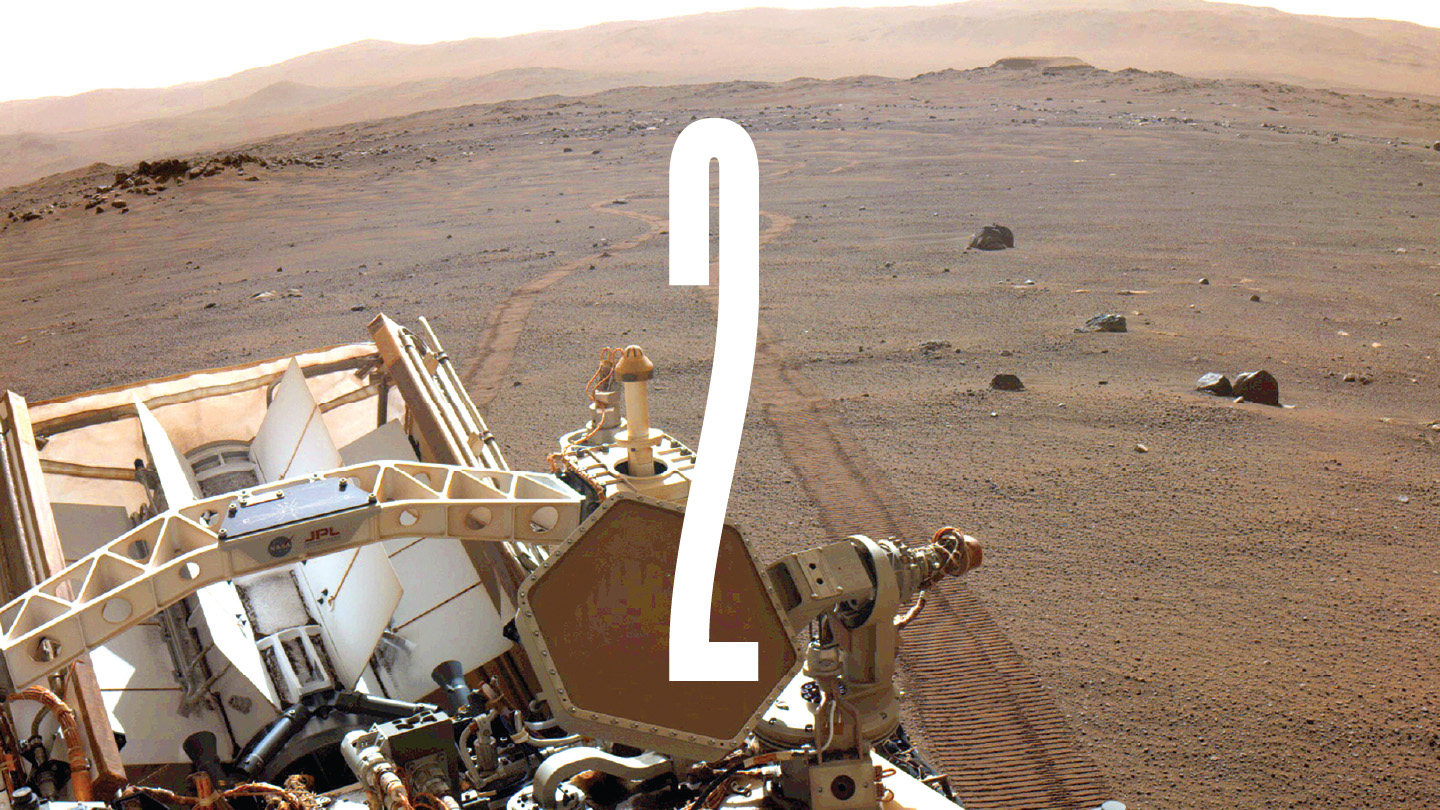
In the vast expanse of space, on a distant rocky exoplanet, a small Earth-built rover finds itself in quite the predicament. Unlike its adventurous human creators who dream of exploring the unknown, this particular rover experiences something akin to homesickness. From the moment its wheels begin turning on alien soil, it yearns to return to its landing site—the closest thing to “home” it has on this foreign world. The rover’s dilemma stems from a strict set of movement instructions programmed into its core: on the first day, travel one kilometer straight ahead, then make a 90-degree turn; on the second day, two kilometers followed by another 90-degree turn; on the third day, three kilometers and a turn; continuing this pattern of increasing distances until completing its eight-day mission. Within these constraints, the rover has only one choice to make each day—whether to turn left or right after completing its designated distance.
This seemingly simple puzzle reveals something profound about mathematical patterns and spatial reasoning. The rover’s path, if drawn on a coordinate grid, creates what mathematicians might recognize as a variation of a spiral pattern. With each day’s journey, the rover moves further from its origin in increasing increments, creating a pattern that could potentially lead it far away from home. However, the 90-degree turns create an interesting possibility: with the right sequence of left and right turns, the rover might just find its way back to where it began. This problem challenges us to discover that perfect sequence—the exact pattern of lefts and rights that would complete a journey covering dozens of kilometers while ultimately returning to the precise point of origin.
The solution requires careful consideration of how movement in perpendicular directions affects the rover’s final position. When the rover turns right, then right again, it essentially moves in the opposite direction from its original path but offset by some distance. Similarly, a series of four 90-degree turns in the same direction would create a spiral that moves the rover continuously outward. What makes this puzzle particularly elegant is that there exists a specific combination of left and right turns that creates a closed loop, allowing our homesick rover to return exactly to its starting point after eight days. This speaks to the beautiful symmetry often found in mathematical problems, where seemingly complex paths can resolve themselves perfectly with the right pattern of choices.
Beyond the initial eight-day mission, the puzzle expands to consider a hundred rovers on different planets, each with mission durations ranging from one to one hundred days. This extension transforms the problem from a specific case to a general one, asking us to determine how many of these rovers could potentially return home using the same movement constraints. The answer lies in recognizing which mission lengths create patterns that can geometrically close back on themselves. For some mission lengths, no combination of turns will ever lead back to the starting point—the mathematics simply doesn’t allow it. For others, a perfect sequence exists. Determining exactly how many of the hundred rovers can successfully return home requires identifying a pattern in which mission durations permit a closed path.
The homesick rover puzzle illustrates a fundamental concept in mathematics and physics: conservation of displacement. In any journey consisting of movements in perpendicular directions (north, east, south, west), the final position relative to the starting point can be calculated by summing all movements in each direction. For our rover to return home, the sum of all eastward movements must equal the sum of all westward movements, and likewise for north and south. The increasing distances each day create a sequence (1, 2, 3, 4, 5, 6, 7, 8) that sums to 36 kilometers of total travel. The challenge becomes determining if these 36 kilometers can be distributed among the four cardinal directions in a way that creates a net displacement of zero—bringing the rover back to its starting coordinates.
At its heart, this puzzle reminds us of the beauty of mathematical thinking in solving practical problems. While described in terms of a homesick rover on an alien planet, the puzzle represents challenges we face in many fields—from efficient routing in delivery services to planning return trajectories for space missions. The rover’s journey, with its strict constraints and limited choices, mirrors how we often must find creative solutions within rigid systems. And perhaps there’s something poetically human about a machine programmed to explore but longing to return home—a sentiment that resonates with anyone who has ventured far from familiar ground. Whether all hundred rovers find their way back or only a select few, the elegant mathematical patterns underlying their journeys reveal the hidden order in what initially appears to be a complex problem of distance, direction, and desire.