





The Dangerous Embrace: Colibactin’s Role in Colon Cancer
In a remarkable scientific breakthrough, researchers have finally unraveled the mysterious structure of colibactin, a microbial toxin produced by certain gut bacteria that has been strongly linked to colon cancer. The discovery, published in Science on December 4, reveals how this molecule’s unique shape allows it to target and damage DNA with frightening precision. Like a wolf in sheep’s clothing, colibactin’s structure grants it the perfect configuration to snuggle up to our genetic material—but this embrace is far from benign, as it creates mutations that can eventually lead to cancer.
Colon cancer affects approximately one in 25 Americans during their lifetime, making it one of the most common cancer diagnoses. While most gut bacteria are beneficial or harmless, certain strains of Escherichia coli (E. coli) produce destructive toxins like colibactin. Since its initial discovery in 2006, evidence has steadily accumulated suggesting colibactin’s role in colon cancer development. One of the strongest connections comes from the unique “fingerprints” of mutations found in 5-20% of human colon cancers—specific patterns of genetic damage that match colibactin’s handiwork. Additionally, E. coli strains carrying colibactin-producing genes appear more frequently in colon cancer patients than in healthy individuals. Laboratory experiments have further demonstrated that colibactin exposure causes DNA damage, accelerates cellular aging in human cells, and promotes tumor formation in mice.
Despite compelling evidence of colibactin’s cancer-causing potential, scientists have struggled for nearly two decades to determine its complete structure. The molecule’s extreme instability caused it to break down too quickly for traditional analysis methods. Researchers had previously only managed to study fragments or imperfect analogs of the real molecule. This challenge was finally overcome by chemist Emily Balskus and her team at Harvard University through an unconventional approach—using living gut microbes to produce the chemical and then capturing it bound to its preferred DNA sequences. “This is very unconventional because chemists prefer to use individual, purified molecules,” explains Balskus. Their innovative method allowed them to examine colibactin in its natural state using techniques like mass spectroscopy and nuclear magnetic resonance spectroscopy.
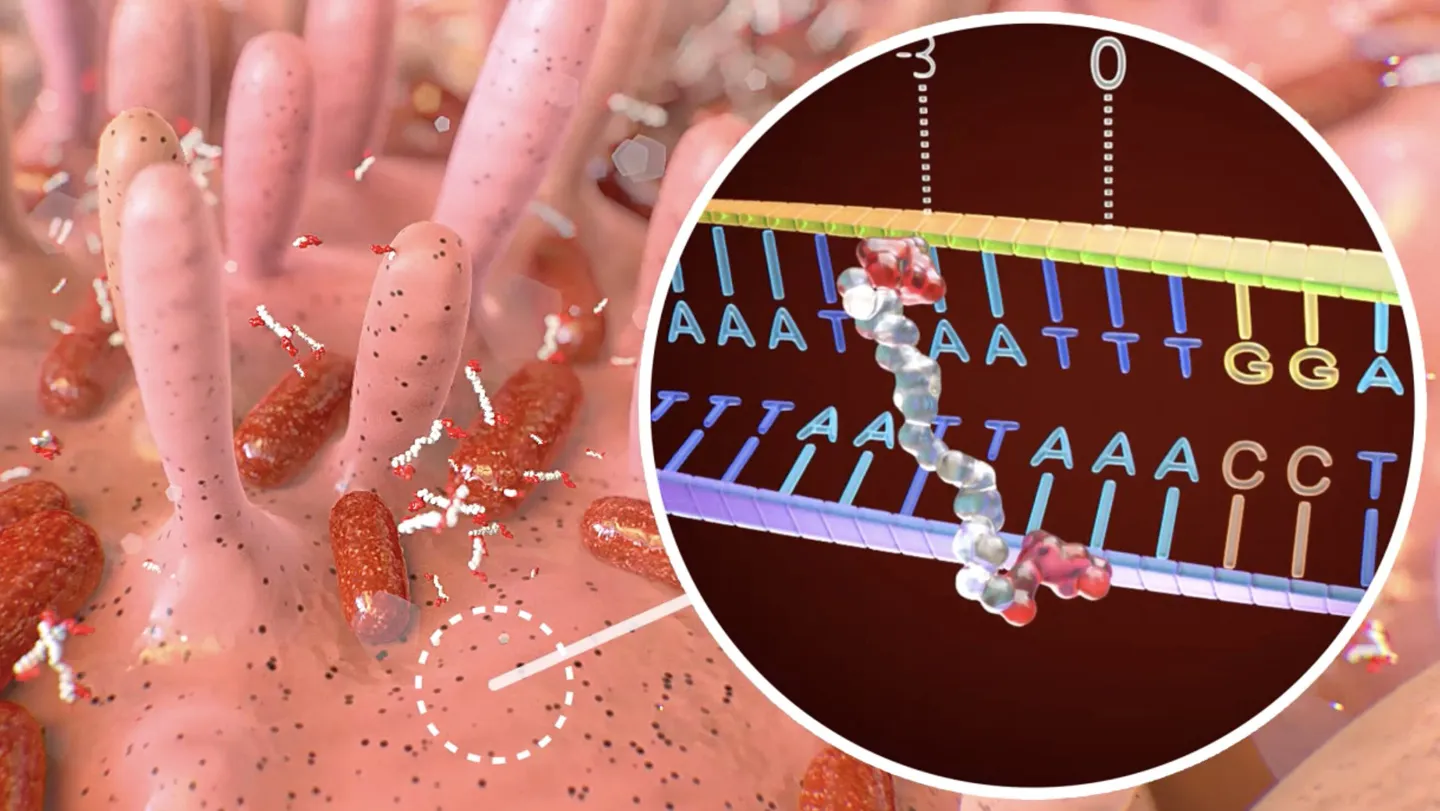
The structural analysis revealed why colibactin is particularly dangerous. At its core lies an unstable group loaded with positively charged protons that helps the molecule recognize and attach to specific DNA sequences. Extending from this core are two long arms decorated with additional sticky nitrogen groups and tipped with what scientists call “warheads”—triangular structures made of three carbon atoms that can attack and form chemical bonds with DNA. This arrangement allows colibactin to slip between the double helix strands and create chemical bridges that prevent DNA from unzipping properly during replication or transcription. While cells can repair such damage, the repair process is often imperfect and leaves behind mutations that can eventually lead to cancer development.
The significance of this discovery extends beyond understanding colibactin’s structure. By identifying exactly how this bacterial toxin targets specific DNA sequences, scientists now have a clearer picture of the link between gut bacteria and cancer development. This knowledge opens new avenues for potential screening tests that could detect colibactin exposure before cancer develops. As Orlando Schärer, a chemist and biologist at the University of Pittsburgh who wasn’t involved in the research, noted in an accompanying perspective piece, “What they did is really quite special.” Balskus herself expressed excitement about the breakthrough: “This is the closest we have come to solving [colibactin’s] structure, a journey that has taken the field almost 20 years. As a chemist, I find this very exciting!”
The research represents a critical advancement in our understanding of how environmental factors like our gut microbiome can influence cancer development. With colon cancer rates continuing to rise, particularly among younger populations, this discovery provides valuable insights that could eventually lead to better prevention strategies, improved diagnostic tools, and potentially new treatments aimed at neutralizing colibactin’s dangerous embrace before it can damage our DNA. The journey from this structural discovery to clinical applications may be long, but it represents a significant step toward addressing one of the underlying causes of a prevalent and devastating disease.