

The Barefoot Virologist and His Vaccine Beer: A Revolutionary Approach to Immunization
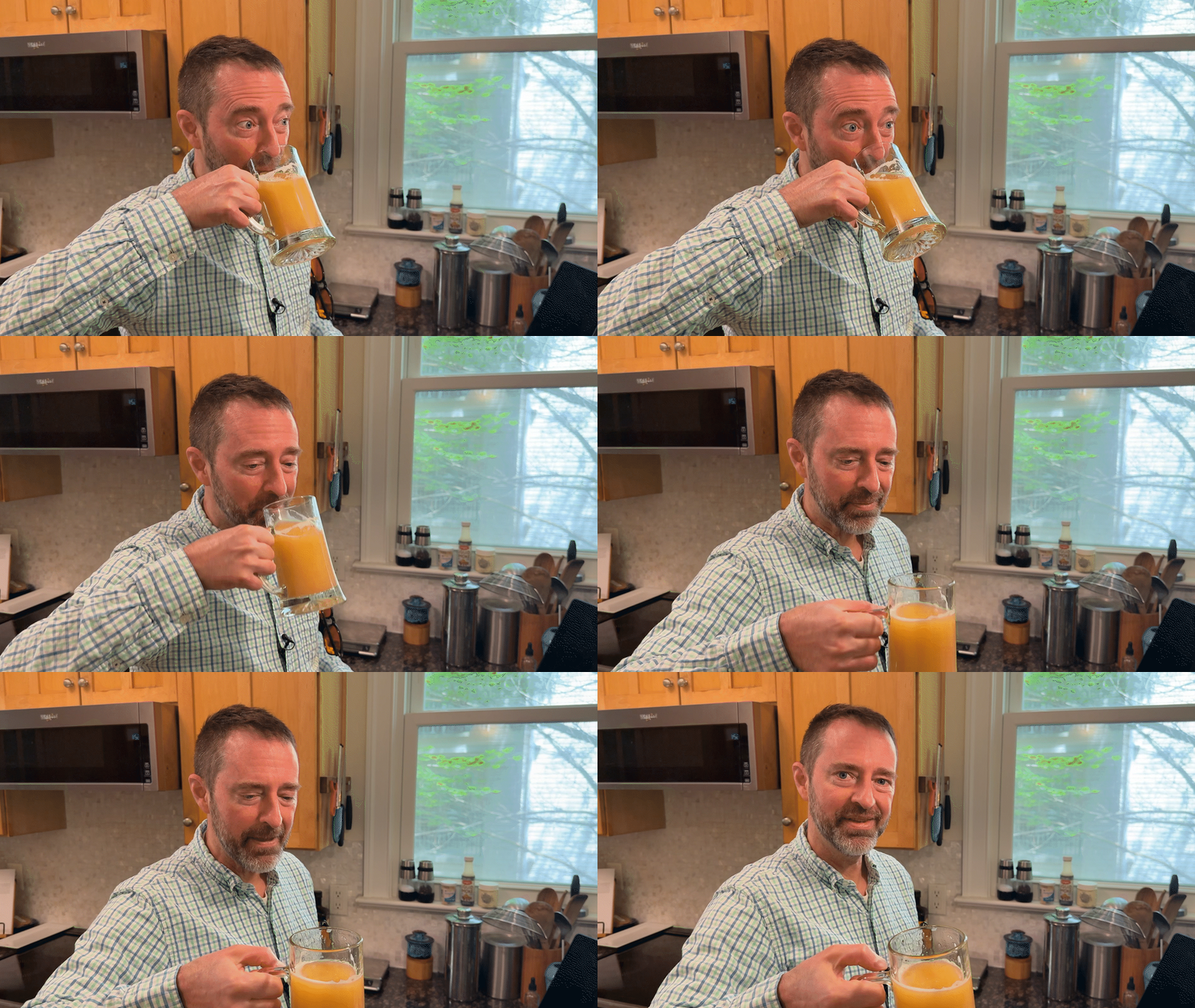
In his kitchen, virologist Chris Buck stands barefoot, gently swirling a bottle of unfiltered Lithuanian farmhouse ale before taking a sip. “Cloudy beer. Delightful!” he exclaims. But this is no ordinary beer – it may be the world’s first vaccine delivered through a beloved beverage. Buck’s unconventional approach to immunization represents either a breakthrough in making vaccines more accessible or a concerning deviation from established scientific protocols. His story illuminates the complex challenges surrounding vaccine development, from legal and ethical considerations to scientific validation and public acceptance.
Buck is no amateur experimenter but a respected virologist at the National Cancer Institute in Bethesda, Maryland. His professional focus on polyomaviruses – linked to various cancers and serious health problems in immunocompromised individuals – led him to discover four of the thirteen polyomaviruses known to infect humans. While his day job involves developing traditional injectable vaccines against these viruses, the beer experiment evolved from his desire to create more accessible immunization methods. When an NIH research ethics committee prohibited him from experimenting on himself by drinking the vaccine beer, Buck found a creative workaround. He established Gusteau Research Corporation, a nonprofit organization named after the chef from Ratatouille whose motto is “Anyone can cook,” allowing him to conduct his experiments as a private citizen beyond the constraints of his employer’s oversight.
The results of Buck’s self-experimentation appear promising. After consuming the beer, his body produced antibodies against several types of polyomavirus without any adverse effects. His brother Andrew and other family members have also consumed the brew without complications. The Buck brothers have shared their method for making vaccine beer on Zenodo.org and Chris announced the publications on his blog “Viruses Must Die.” However, neither publication has undergone peer review, as an NIH ethics committee objected to Buck posting the manuscripts to the traditional preprint server bioRxiv.org. Buck’s frustration with institutional bureaucracy is evident in his statement: “One week of people dying from not knowing about this is not trivial.” Yet his approach has raised concerns among experts about safety and efficacy. Michael Imperiale, a virologist and emeritus professor at the University of Michigan Medical School, questions drawing conclusions based on testing with just two people, while Arthur Caplan, former head of medical ethics at NYU Grossman School of Medicine, believes the current political climate is “maybe the worst imaginable time to roll out something that you put on a Substack about how to get vaccinated.”
The potential benefits of Buck’s polyomavirus vaccine are significant. Polyomaviruses are ubiquitous, with up to 91 percent of people infected with BK polyomaviruses by age nine. While dormant in most humans, these viruses cause serious problems for some, particularly organ transplant recipients who take immune-suppressing drugs. Kidney transplant recipients risk losing their donated organs when dormant BK polyomaviruses reawaken due to weakened immune systems. Other transplant patients can develop brain disease from JC polyomavirus, a cousin to BK. Buck’s personal motivations are powerful – he often recounts how a friend was denied the HPV vaccine because he was an adult man at a time when access was limited to adolescent girls. That friend later died of head and neck cancer caused by the virus. Buck equates withholding vaccines from people who want them to the ethical failings of the Tuskegee experiment, viewing it as a moral imperative to make his vaccine accessible to everyone.
Buck’s scientific breakthrough came unexpectedly. His team had been working with a vaccine maker in India on a traditional, injectable polyomavirus vaccine using empty viruslike particles made in insect cells. When they experimented with alternative delivery methods, they discovered something remarkable – feeding mice whole, live yeast carrying polyomavirus-like particles produced antibodies in the animals. This was a shock even to Buck, who had previously believed oral vaccines worked only with live, weakened viruses or bacteria that could infect intestinal cells. The implications extend beyond polyomavirus – Buck believes that with modification, yeast could deliver vaccines against a wide variety of diseases, including COVID-19, H5N1 bird flu, and cancers caused by HPV. Bryce Chackerian, a virologist at the University of New Mexico Health Sciences Center, calls this “a very exciting possibility” that could potentially extend beyond this specific vaccine.
The regulatory pathway for Buck’s innovation presents both challenges and opportunities. Traditional vaccine development involves multiple rounds of clinical trials testing safety and efficacy in progressively larger groups. However, Buck envisions his product as primarily a food, which follows different regulatory requirements. Food and dietary supplements don’t require the extensive testing that drugs do – manufacturers must establish safety but aren’t required to prove efficacy to the FDA. Buck maintains that his vaccine beer contains ingredients already considered “generally regarded as safe,” and since polyomaviruses are commonly shed in urine and present throughout our environment, people likely encounter them regularly. He’s navigating this regulatory gray area carefully, acknowledging that “vaccines are drugs” but arguing that something can be both a drug and a food. While his brother has established a corporation to sell the yeast strains, they cannot legally claim it treats or prevents specific diseases without FDA approval as a vaccine.
The debate surrounding Buck’s approach centers on scientific validation, regulatory compliance, and public perception of vaccines. Critics worry that his unconventional methods could undermine trust in traditional vaccines, particularly in the current political climate where vaccine hesitancy is growing. A recent Pew Research Center poll showed an erosion of trust in vaccine safety, especially among Republicans. However, supporters like Preston Estep, who created his own DIY COVID-19 nasal spray vaccine, believe Buck’s approach could actually build public trust by allowing people to experience vaccines through a “comfort food or comfort beverage approach.” Buck himself feels morally obligated to proceed, describing this as “the most important work of my whole career” and worth risking his professional standing. “I’m not a radical who’s trying to subvert the system,” he insists. “I’m obeying the system, and I’m using the only thing that is left available to me.” In a world where vaccine access may become more restricted, Buck’s kitchen experiment could represent either a dangerous deviation from scientific norms or a revolutionary pathway to democratizing immunization.