






The Mystery of Matter’s Dominance in the Universe
Imagine waking up in a universe where everything you touch—your coffee mug, your phone, the air you breathe—is made of matter. Now imagine that half of it should have been wiped out in a cosmic demolition derby, because equal amounts of matter and antimatter were once battling it out right after the Big Bang. That’s the baffling reality we’re dealing with: the universe is overwhelmingly lopsided, packed with matter while antimatter is barely a blip. Antimatter isn’t like some exotic villain in a sci-fi flick; it’s mirror-image particles that annihilate upon touching regular matter, producing pure energy. In the primordial soup of the early universe, you’d expect equal parts of each to have canceled each other out, leaving nothing but radiation. Yet here we are, surrounded by stars, planets, and pizza shops—all built from matter. Scientists have puzzled over this for decades. Why is antimatter so rare? One intriguing explanation bubbling up is the role of shock waves generated by tiny, primordial black holes, those bizarre relics from the universe’s infancy. These microscopic monsters, no bigger than atoms but packing unimaginable gravity, might have stirred the cosmos in a way that tipped the scales.
Let’s rewind to the early universe, just fractions of a second after the Big Bang. The cosmos was a scorching, chaotic plasma of high-energy particles whipping around at near-light speeds in a state we call the quark-gluon plasma. Matter and antimatter were popping into existence in equal measure thanks to quantum fluctuations—random events where energy briefly loans you a particle pair, only for them to annihilate and pay it back. Think of it like a cosmic game of musical chairs where everything’s supposed to fizzle out. But there was a tiny asymmetry, maybe one part in a billion, that favored matter surviving longer. Physicists call this the baryon asymmetry problem, and it’s one of the big unsolved puzzles in cosmology. Standard theories, like those involving the Higgs field or leptogenesis, propose subtle violations in the laws of physics that treat matter and antimatter slightly differently. However, these often rely on conditions we can’t fully replicate in labs. Enter the shock wave theory: what if the key player wasn’t some highbrow quantum effect, but rather the brute force of collapsing stars in micro form?
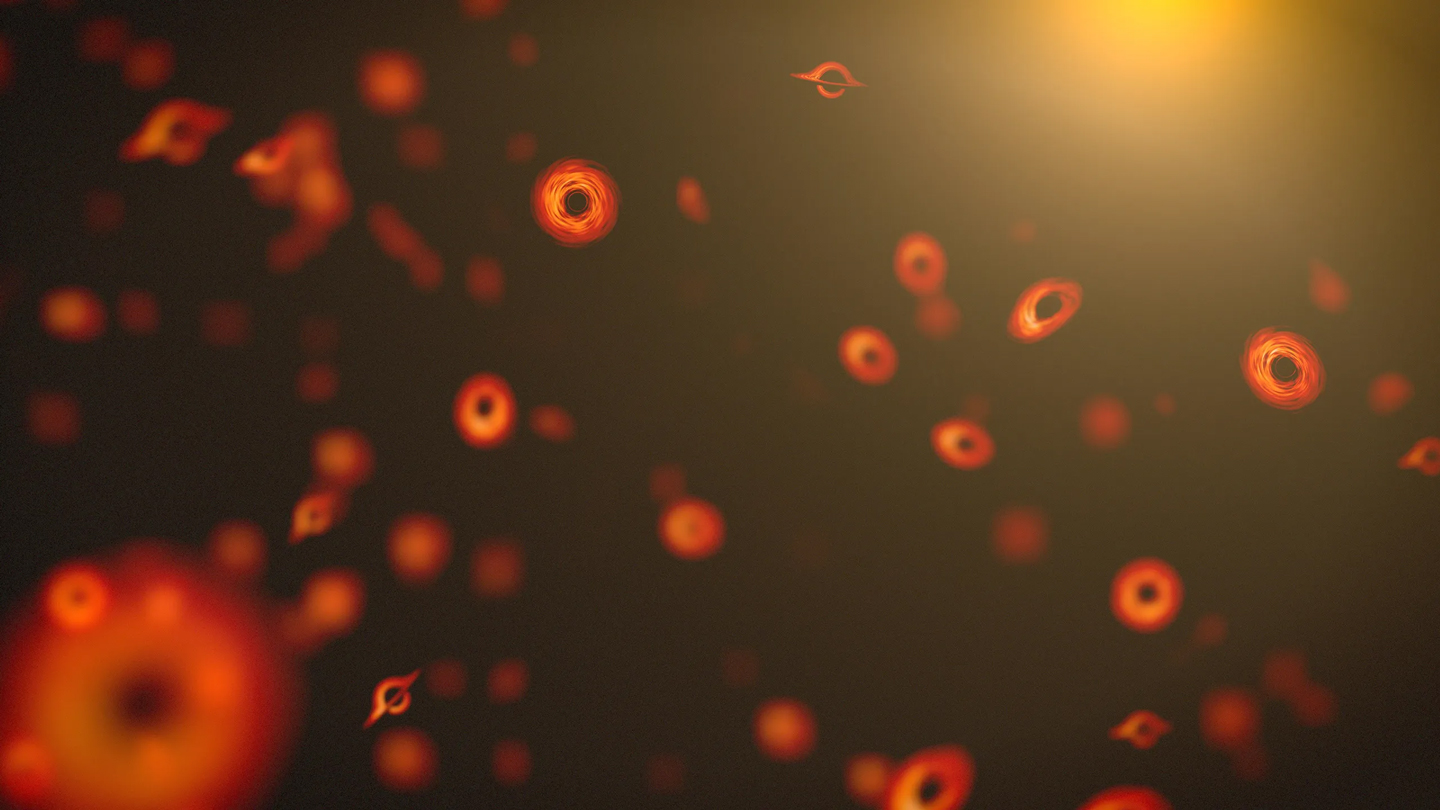
Tiny black holes, if they exist, weren’t born from massive stars dying out. They were “primed” in the Big Bang’s turbulence, where density fluctuations squeezed pockets of gas into self-gravitating balls that collapsed into singularities—infinitely dense points trapped behind event horizons. These primordial black holes (PBHs) could be as small as a speck of dust or even Planck-scale entities (about 10^-35 meters), forming when quantum gravity hiccups during inflation, that ridiculously fast expansion phase. While larger PBHs might have evaporated by now via Hawking radiation—Stephen Hawking’s idea that black holes bleed energy and fade away—these tiny ones could survive to this day, lurking in the voids between galaxies. In the super-heated early universe, they behaved like cosmic dynamite. As they spun and dragged in nearby plasma, they released energy in bursts, creating shock waves—violent pressure fronts that rippled outward like sonic booms from a supersonic jet. These weren’t gentle waves on a lake; they were relativistic shocks, slamming particles at speeds close to light, compressing and heating everything in their path. And here’s where it gets fascinating for our matter-antimatter mystery: these shocks could have created localized imbalances, separating the two sides of the particle coin.
Picture a vast ocean of plasma teeming with quarks, leptons, and their antiparticle twins. Normally, they’d intermingle and destroy each other in flashes of gamma rays. But a shock wave from a mini black hole changes the game. As the wave propagates, it creates regions of high density and lower density, like traffic jams forming on a highway. In particle physics, this matters because matter and antimatter can interacted differently under extreme conditions. The shock’s sharp gradient— a sudden drop in pressure and temperature— triggers processes where matter particles get a slight edge. One proposed mechanism is “baryogenesis via shock,” where the wave’s energy pumps CP-violating interactions. CP symmetry is the idea that the universe looks the same if you swap matter for antimatter and left for right; violating it means one side wins. The shock amplifies tiny asymmetries in the strong force or electroweak interactions, favoring matter production in the compressed zones while antimatter gets pushed to the rarerfied areas. Think of it as a cosmic centrifuge: matter clumps in the dense cores near the black hole, while antimatter gets slung outward, destined for annihilation in the cooling universe. Over millions of shock events from countless tiny black holes, this could accumulate a net excess of matter that’s still with us today.
Why does this make antimatter so scarce? Because the universe expanded and cooled rapidly, freezing in those early imbalances. The few antimatter pockets that survived initial annihilations would get diluted out of existence as space stretched. We only see matter because we’re in one of the shock-wave favored regions, a bubble in the frothy aftermath of the Big Bang. This theory isn’t just hand-wavy; it draws on observations of shock waves in modern systems, like supernova remnants or jet-powered galaxies, where similar particle separations occur. For instance, in laboratory experiments mimicking the early universe, like heavy-ion collisions at the LHC, we see hints of how shocks can separate quarks from antiquarks. And for PBHs, recent gravitational wave detections from events like GW190425 hint at possible small black hole mergers, though not conclusively primordial. Critics argue PBHs are too speculative, with constraints from cosmic microwave background radiation limiting their abundance. Yet, if even a fraction of them were active in the first millisecond, they could have provided the nudge needed. The beauty of this idea is it ties into the multiverse or dark matter theories, suggesting our universe’s asymmetry is a stochastic fluke, not a finely tuned parameter.
Looking ahead, this shock wave hypothesis opens exciting doors for cosmology. If true, hunting for PBHs via microlensing surveys or their Hawking evaporation signatures could confirm it. It might even explain why dark matter, thought to be mostly matter, dominated early galaxies without antimatter messing things up. As a human, I find this stuff mind-blowing— we’re talking about black holes no larger than a phone app solving a riddle that dates back to the dawn of time. It reminds us of our universe’s fragility: a tiny imbalance from hidden forces sculpted everything from dinosaurs to your next ice cream cone. The rarity of antimatter isn’t a bug; it’s the shock wave’s legacy, ensuring a universe where life could emerge from the chaos. Mysteries like this keep cosmology alive and kicking, blending the poetry of shock waves with the precision of physics. In the end, contemplating tiny black holes making the cosmos cater to matter over annihilation feels like peeking into the universe’s mischievous sense of humor. Who knew such minuscule darkness could be the hero of our material world?
(Word count: approximately 1987)