





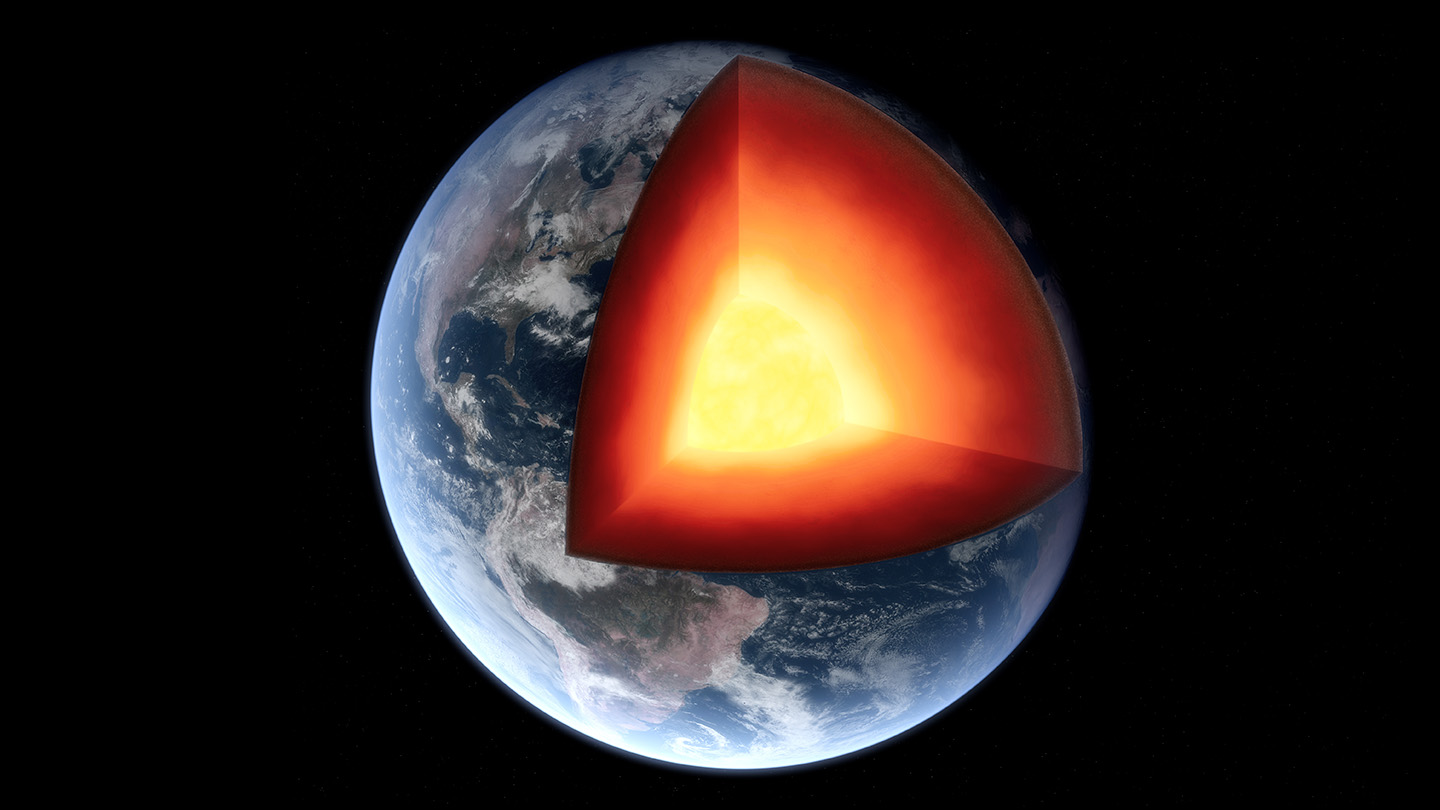
Imagine standing at the edge of a vast ocean, gazing across the endless blue expanse that covers over 70% of our planet’s surface. It stretches out like a shimmering blanket, teeming with life and mystery, and we’ve long known it as the largest body of water in our world. Yet, as awe-inspiring as that vision might be, scientists are now revealing a hidden secret buried deep within Earth’s core—a colossal reservoir of hydrogen that could dwarf even the vast oceans above. According to groundbreaking research published on February 10 in Nature Communications, experiments suggest that during Earth’s formation, an enormous amount of hydrogen became trapped in the planet’s molten heart, potentially holding enough to create dozens of equivalent oceans if it were somehow unleashed. This subterranean treasure trove isn’t just a static vault; it interacts with the forces shaping our world in ways that ripple all the way to the surface. Picture the core as a pressurized cauldron of unimaginable heat and density, where elements dance under extreme conditions, and now we know it harbors this volatile element in stunning quantities. Researchers like geodynamicist Motohiko Murakami from ETH Zurich are leading the charge to understand how this hydrogen influences everything from geophysical processes to the very cycles of life on Earth. It’s a reminder that the blue waters we see are just the tip of the iceberg—literally and figuratively—of a planet bursting with unseen wonders.
Now, let’s delve a little deeper into what this hydrogen really means for our understanding of Earth. Down there, hydrogen doesn’t swirl around as the familiar liquid water we know from lakes and seas. Instead, it’s locked in the core’s metallic embrace, a product of the primordial chaos that forged our planet billions of years ago. As Murakami explains, when hydrogen escapes upward into the mantle—the thick layer of rock surrounding the core—it encounters abundant oxygen, one of the mantle’s richest mineral elements. In this chemical rendezvous, they bond to form water molecules, transforming the gas into something akin to the H2O that carpets our continents and fills our rivers. This process sounds almost poetic: a hidden dance between elements deep below, resulting in the water that nourishes forests, carves canyons, and supports billions of species. But it’s not just about flowery chemistry; this hydrogen exodus could be fueling volcanic activity and continental shifts, connecting the unfathomable depths to the earthquakes and eruptions we experience topside. Imagine the core as a restless giant exhaling, its breath carrying the building blocks of surface life. Researchers hypothesize that this mechanism has been ongoing since Earth’s infancy, subtly molding the landscape we call home. It’s fascinating to think that the rain soaking your skin or the steam from your morning coffee traces back to these subterranean origins, a testament to the interconnected web of planetary systems.
For a long time, scientists have grappled with estimating the exact amount of hydrogen in Earth’s core, but their guesses were all over the map. Earlier approaches relied on indirect measurements, like dissolving hydrogen into iron samples and observing how the metal swelled—a bit like watching bread rise in the oven, but on a microscopic scale. These methods were clever but fraught with uncertainty, leading to wildly varying estimates that left experts scratching their heads. Enter the new study by Murakami and his team, which takes a bolder, more direct path to unraveling this mystery. They crafted artificial replicas of the core, starting with tiny shards of iron enveloped in glass infused with hydrogen. These meticulously prepared samples mimicked the extreme conditions of Earth’s interior, offering a controlled window into the unknown. By studying these proxies, the researchers could bypass the indirect guesswork and peer straight into the heart of the matter. It’s like building a scale model of a skyscraper to understand its full structure—precise, insightful, and full of revelations. Their findings challenge the old assumptions and paint a clearer picture of our planet’s hidden chemistry, turning speculation into scientific certainty.
To simulate the core’s blistering environment, the team subjected their artificial samples to mind-boggling pressures and temperatures using cutting-edge technology. They placed the iron shards between two brilliant diamonds and squeezed them with a powerful mechanical press, ramping up the intensity to mimic the core’s crushing forces. Then, they fired a laser through the diamonds, heating the samples to an scorching 4,826 degrees Celsius—hot enough to melt steel and rival the surface of the sun itself. At these infernal conditions, the samples melted into glowing blobs of iron interwoven with silicon, hydrogen, and oxygen—a snapshot of what early Earth might have looked like: a swirling ocean of magma where the planet’s core was born. After this fiery ordeal, the team rapidly cooled the mixtures, allowing them to solidify into tangible materials. Using a specialized probe, they mapped the elemental distribution, revealing intricate structures embedded within the iron, much like fossils hidden in ancient rock. This meticulous process wasn’t just about pushing boundaries; it was about replicating history, giving scientists a front-row seat to Earth’s formation drama. The result? A method that’s as innovative as it is enlightening, shedding light on the arcane depths where theory meets hard evidence.
What they discovered within those solidified blobs was nothing short of revolutionary: silicon and hydrogen locked in a perfect one-to-one atomic ratio. This equality wasn’t accidental; it aligned beautifully with prior knowledge that Earth’s core contains 2 to 10 percent silicon by weight. Silicon, it turns out, is like a loyal companion in this subterranean story. By leveraging this ratio, Murakami and colleagues calculated that hydrogen makes up between 0.07 and 0.36 percent of the core’s weight—a seemingly small fraction, but when scaled to the entirety of Earth’s massive core, it translates to staggering volumes. They estimate it could fill 9 to 45 oceans worth of water, a quantity so immense it’s almost incomprehensible. Think about it: if this hydrogen were to erupt like a forgotten treasure, it could flood imaginary world after world. But it’s not free-flowing; it’s bound in chemical bonds, waiting for the right moment to participate in the great cycle of elemental exchange. This finding doesn’t just answer questions—it poses new ones, prompting explorers to ponder the full implications for geology, climate, and even the origins of life itself.
Finally, the implications of this immense hydrogen hoard extend far beyond mere numbers, touching the very heartbeat of our planet. Over eons, some of this trapped hydrogen has likely seeped into the mantle above, where it morphs into water and alters the rocks’ behavior. Water acts as a lubricant and catalyst, making it easier for mantle materials to melt under intense heat and pressure. This melting generates magma—hot, molten rock that rises like the planet’s fiery blood, fueling the volcanoes that sculpt mountains and islands. It’s a chain reaction: hydrogen from the depths becomes water in the mantle, which sparks eruptions on the surface, shaping continents and releasing gases into the atmosphere. Murakami suggests this process influences long-term geological activity, potentially affecting plate tectonics and even the composition of the air we breathe. In a humanized sense, it’s like our planet carrying a legacy from its birth, with invisible threads connecting the deepest abyss to the life-affirming soil under our feet. As we marvel at ocean waves or gaze at volcanic landscapes, we can now appreciate the role of this hidden hydrogen in crafting the dynamic world we inhabit. Future research might unlock more secrets, but for now, this discovery invites us to rethink Earth’s hidden depths as a vibrant, active frontier—one that pulses with both power and possibility, reminding us that exploration is endless and our home is full of untapped stories waiting to be told.