


The Multiverse: From Science Fiction to Scientific Theory
In the realm of pop culture, the concept of a multiverse has become a beloved storytelling device. From the interdimensional adventures in “Rick and Morty” to the web-slinging heroics of Spider-Man meeting his variants, the idea of parallel realities has captured our imagination. One particularly memorable example comes from the sitcom “Community,” where a simple roll of a die splits the characters into seven alternate timelines—including the infamous “darkest timeline” where the characters don fake goatees to signal their villainous turn.
While these fictional portrayals might seem like pure fantasy, the multiverse concept has serious scientific proponents. Physicists have developed multiple theories suggesting our universe might be just one among countless others, potentially answering fundamental questions about our cosmos. Two of the most compelling multiverse theories emerge from different branches of physics: cosmology and quantum mechanics. These theories aren’t just abstract musings—they address profound puzzles about the nature of reality and why our universe appears precisely tuned for life to exist.
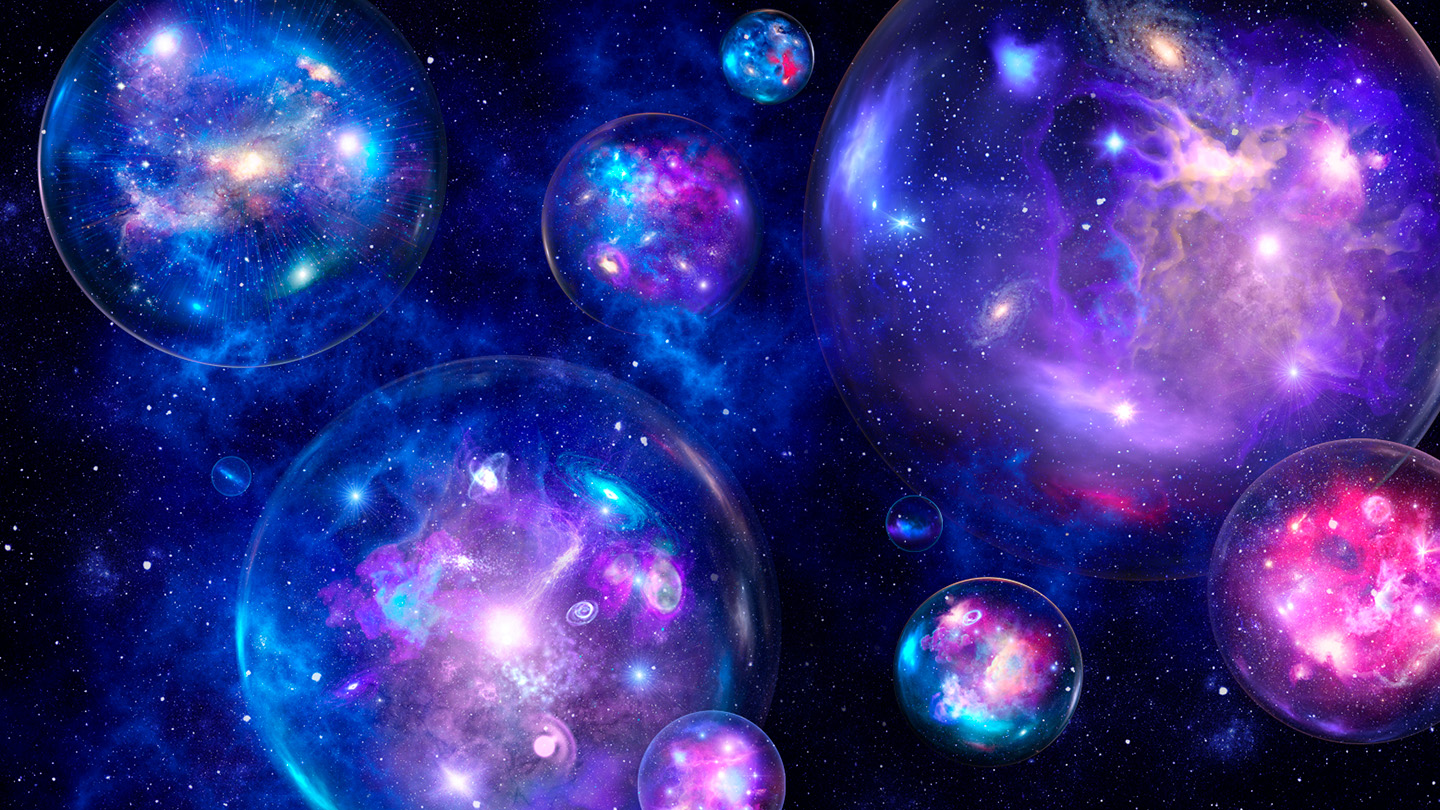
The cosmological multiverse theory is rooted in the concept of cosmic inflation. Shortly after the Big Bang, our universe experienced an extraordinarily rapid expansion period. During this inflation, quantum fluctuations in the universe’s fabric were stretched to massive proportions, eventually creating the density variations that would lead to galaxy formation. According to Andrei Linde, a retired Stanford University physicist and inflation theory pioneer, regions beyond our observable universe might have dramatically different physical properties. These distant cosmic domains could operate under different laws of physics—with varying particle masses and force strengths—potentially creating environments where life as we know it couldn’t possibly exist. More intriguingly, while inflation has ceased in our observable universe, it may continue eternally elsewhere, generating new “bubble universes” with unique properties.
This cosmological multiverse offers a potential solution to one of science’s most perplexing questions: why does our universe seem so perfectly calibrated for life? The physical constants that govern our reality—from the strength of gravity to the mass of the electron—fall within an extraordinarily narrow range that permits complex structures like stars, planets, and ultimately living organisms to form. If countless bubble universes exist with different physical parameters, then naturally some would develop conditions conducive to life. Our existence in such a universe isn’t miraculous but statistically inevitable. Testing this theory might be possible; if our universe has collided with another, it could leave detectable patterns in the cosmic microwave background radiation—the afterglow of the Big Bang. However, as physicist Paul Halpern of Saint Joseph’s University notes, researchers have yet to find evidence of such cosmic “scars.”
The quantum mechanical approach to the multiverse stems from a different puzzle. Quantum physics describes particles existing in multiple possible states simultaneously until observed or measured—at which point they “collapse” into a single state. This measurement problem raises questions: What constitutes a measurement? Why should human observation be special? And how did the universe function before humans existed? In 1957, physicist Hugh Everett III proposed a radical solution known as the “many-worlds interpretation.” Instead of possibilities collapsing into one outcome, perhaps every quantum possibility manifests in its own reality, creating parallel universes with every measurement.
In this quantum multiverse, when an observer measures a particle that could exist in multiple states, the observer themselves splits into different versions—each experiencing a different measurement outcome in separate realities. These parallel versions would have no awareness of each other, existing in completely separate universes. This interpretation resembles the “Community” scenario, though without the dramatic crossover episodes that make for good television. The many-worlds interpretation presents significant testing challenges, as the theory itself suggests we couldn’t detect or communicate with our alternate selves.
Despite the theoretical possibility of multiple universes, the prospects for actual interdimensional travel remain firmly in the realm of science fiction. Hypothetical structures called wormholes might theoretically connect different regions of spacetime, but as Halpern explains, creating them would require astronomical amounts of energy far beyond current technological capabilities. We won’t be stepping through portals to meet our alternate selves anytime soon, which means both good and bad news: no epic team-ups with your variants to save the multiverse, but also no confrontations with your evil, goatee-wearing doppelgänger.
Whether or not the multiverse exists beyond mathematical equations and theoretical physics, the concept continues to fascinate scientists and storytellers alike. It pushes us to question our understanding of reality and consider the possibility that our universe, vast as it appears, might be just one bubble in an infinite cosmic ocean. As researchers develop new ways to test these theories, we may someday determine if the multiverse is simply an elegant solution to complex physics problems or the most profound revelation about the nature of existence.