





Mysterious Ultraviolet Glow Across the Milky Way Might Be Dark Matter in Action
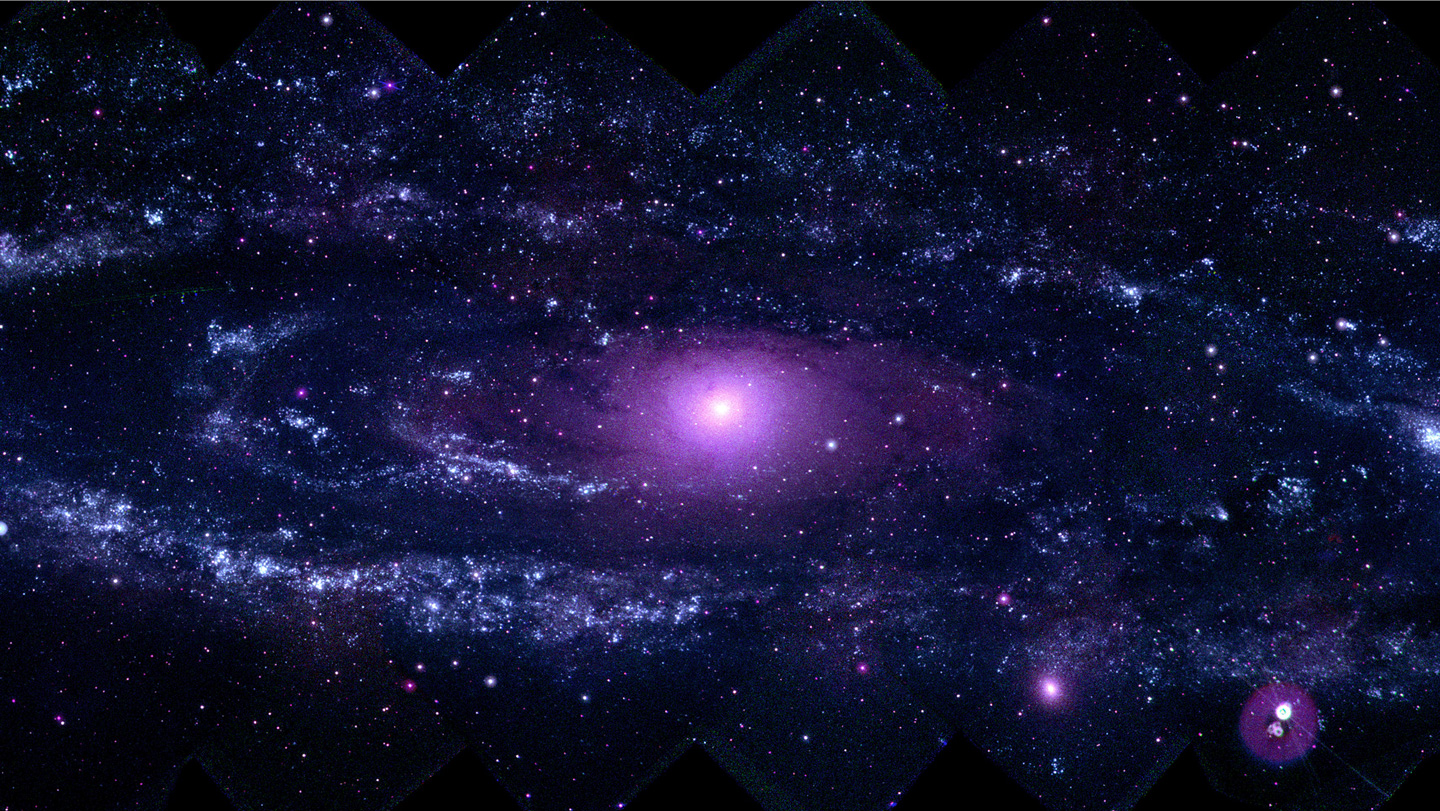
In the vast expanse of our galaxy, a puzzling ultraviolet light has been captivating astronomers for the past decade. This mysterious glow, which appears as an excess of far-ultraviolet radiation across the Milky Way, may finally have a compelling explanation: the destruction of exotic dark matter particles called “axion quark nuggets.” This groundbreaking theory, recently outlined in a paper submitted to arXiv.org, could provide valuable insights into one of the universe’s greatest mysteries.
Dark matter constitutes approximately 25% of all matter and energy in the universe, yet its exact nature has eluded scientists for decades. Unlike ordinary matter that makes up stars, planets, and everything we can see, dark matter doesn’t interact with light, making it incredibly difficult to detect and study. The proposed axion quark nuggets represent a fascinating theoretical form of dark matter that combines ordinary particles with hypothetical particles called axions. What makes these nuggets particularly special is their incredible density – they could pack the mass of a golf ball into a space smaller than a human hair, just micrometers across.
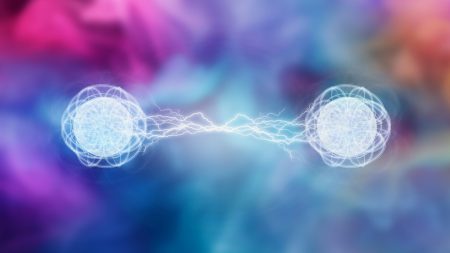
The most intriguing aspect of this theory is that axion quark nuggets could exist in both matter and antimatter varieties. This dual nature provides a unique mechanism for creating the observed ultraviolet glow. When ordinary matter from our galaxy collides with these “antinuggets” of dark matter, they annihilate each other in a process similar to what happens when regular matter meets antimatter. This mutual destruction converts their energy into light – specifically, the far-ultraviolet radiation that astronomers have been observing. “If you have regular matter colliding with these antinuggets, they can annihilate and radiate away some energy,” explains study co-author Michael Sekatchev, an astrophysicist now at the University of California, Berkeley. “And that’s the glow.”
The mysterious excess of far-ultraviolet light was first detected in the 2010s, and scientists quickly determined that it originated from beyond our solar system but within our galaxy. The wavelengths observed are among the shortest in the ultraviolet part of the electromagnetic spectrum. Despite years of research, conventional sources like stars, gas, and dust couldn’t account for this surplus of radiation. Various theoretical types of dark matter particles have been proposed as explanations, but none have fully aligned with the observational evidence until now.
To test their theory, Sekatchev and his colleagues used existing computer simulations of the Milky Way to calculate how much far-ultraviolet light would be produced if axion quark nuggets were colliding with ordinary matter throughout the galaxy. They examined the distribution of gas and dark matter in various regions of the simulated galaxy and applied the theoretical properties of the nuggets to predict light emission. The results were striking – the calculated amounts matched the mysterious excess of far-ultraviolet light detected by spacecraft like the Galaxy Evolution Explorer and New Horizons. This correlation provides compelling evidence for their hypothesis, though the researchers emphasize that their findings are preliminary and require further verification.
James Overduin, a theoretical astrophysicist from Towson University not involved in the study, notes the significance of this work: “I believe the authors have shown convincingly that axion quark nuggets can explain an otherwise inexplicable part of the diffuse galactic background. I am not aware of any other dark matter candidate for which that can be said.” If confirmed through additional observations and tests, this discovery could revolutionize our understanding of dark matter and potentially address other fundamental questions in physics, such as why our universe contains far more matter than antimatter. The humble glow across our galaxy might just be illuminating some of the deepest secrets of the cosmos, bringing us one step closer to understanding the mysterious substance that shapes the structure of our universe.