



The Mystery of Betelgeuse’s Stellar Companion Finally Confirmed
In the vast expanse of our night sky, the red supergiant Betelgeuse has long captivated astronomers and stargazers alike. Marking the shoulder of the constellation Orion, this massive star has been observed for centuries, displaying fascinating cycles of brightness variations. While scientists had understood that Betelgeuse’s shorter 400-day brightening and dimming cycle stems from the star’s natural pulsations, the longer 2,100-day cycle remained a cosmic enigma—until now. Exciting new evidence presented by astrophysicist Andrea Dupree at the American Astronomical Society meeting confirms what some astronomers have suspected: Betelgeuse has a stellar companion that orbits through its atmosphere, creating a detectable wake in the giant star’s gaseous outer layers.
The story of Betelgeuse’s companion began to take shape in 2024 when a group of astronomers proposed that the star’s mysterious longer period could be explained by the presence of a smaller companion star with roughly the mass of our Sun. This theory gained momentum in 2025 when other researchers captured a fuzzy photograph of the proposed companion. However, these findings alone weren’t enough to convince the scientific community completely. The debate persisted, with many astronomers remaining skeptical about the existence of this stellar partner. What made the scenario particularly intriguing is the companion’s peculiar orbit—it travels at a distance from Betelgeuse that’s just four times the Earth-Sun distance, placing it well within the supergiant’s outer atmosphere. To put this in perspective, Betelgeuse is so enormous that if it replaced our Sun, its surface would extend beyond Jupiter’s orbit.
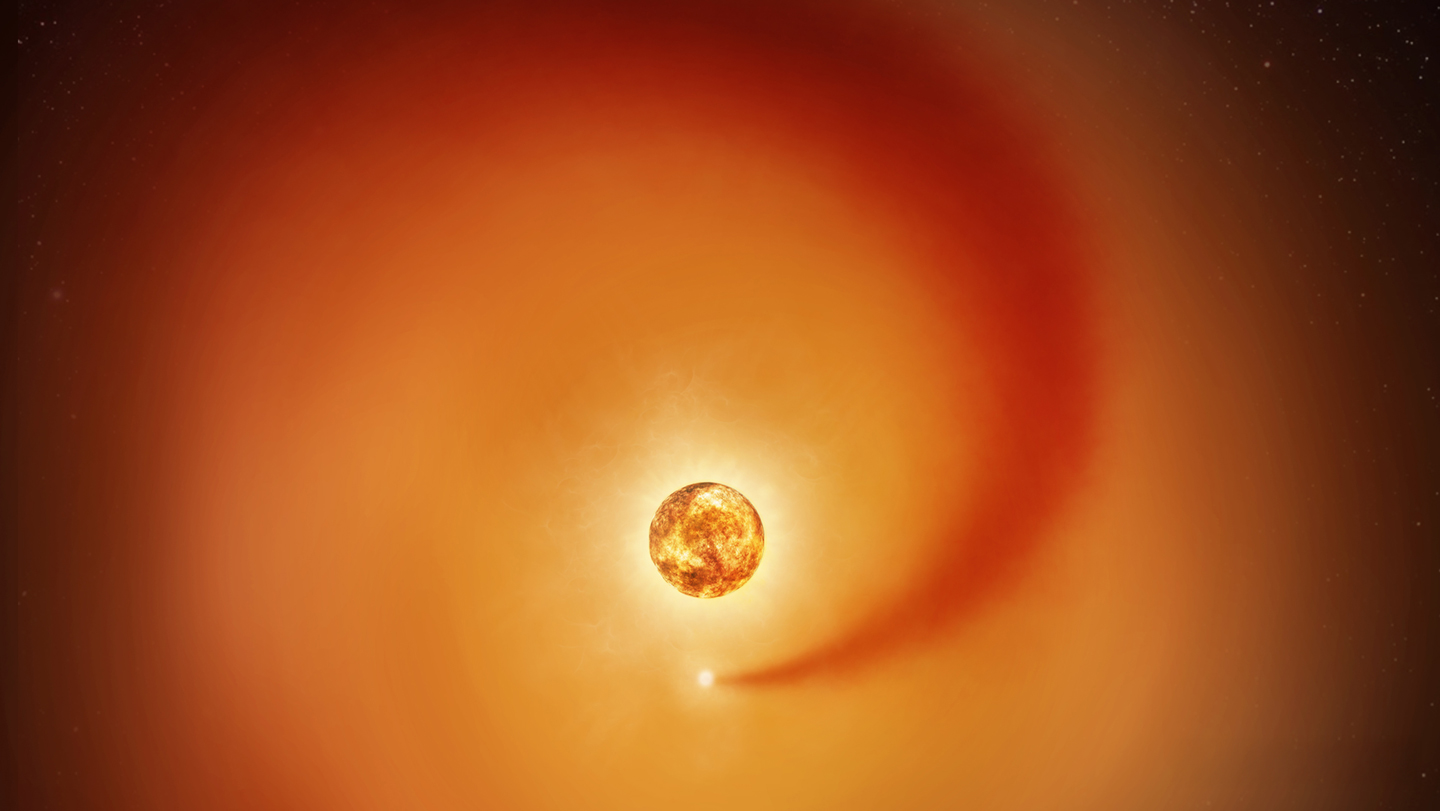
This unusual positioning led Dupree and her colleagues from the Harvard-Smithsonian Center for Astrophysics to a clever realization: if the companion star truly exists and is moving through Betelgeuse’s atmosphere, it should create a wake in the surrounding gas, much like a motorboat circling in a lake. To investigate this hypothesis, the team analyzed eight years of observational data collected by the Hubble Space Telescope and ground-based telescopes, searching for any telltale signs of the companion’s influence on Betelgeuse’s extended atmosphere. Their persistence paid off with a remarkable discovery that provides the most compelling evidence yet for the companion’s existence.
The researchers found that certain wavelengths of light from Betelgeuse exhibited a pattern of brightening and dimming that corresponds perfectly with the theoretical orbit of the companion star. Specifically, these wavelengths grew brighter after the companion passed in front of Betelgeuse’s face and gradually dimmed as it moved behind the star. This pattern is consistent with a slowly expanding outflow of gas trailing behind the companion—the wake that Dupree’s team had been searching for. The finding was presented both at the astronomical meeting and in a paper posted on arXiv.org, adding substantial weight to the argument that Betelgeuse’s long-suspected companion is indeed real.
Stellar astrophysicist Anna O’Grady of Carnegie Mellon University finds these results highly convincing, describing them as another “brick in the wall” of evidence for the companion’s existence. The case for Betelgeuse’s stellar companion has been building through theoretical papers, the fuzzy image, and O’Grady’s own research showing that the object doesn’t emit X-rays—which rules out more exotic possibilities like a black hole or neutron star. With this latest discovery of the wake pattern, O’Grady states she is now “extremely convinced” that the companion star is real, representing a significant advancement in our understanding of this famous red supergiant.
The cosmic dance between Betelgeuse and its smaller partner continues to unfold, with the companion currently being eclipsed by the supergiant. However, astronomers won’t have to wait too long for the next opportunity to observe this stellar relationship. Dupree and her team are eagerly anticipating 2027, when the companion will emerge from behind Betelgeuse, providing another chance to study this fascinating binary system. Beyond Betelgeuse, Dupree plans to investigate other supergiant stars that display similar long and short brightness periods, to determine whether they too might harbor unseen companions. This groundbreaking research not only solves a long-standing astronomical mystery but also opens new avenues for understanding the complex lives of massive stars throughout our galaxy.