



The Whispering Echoes of Dying Stars
Imagine standing under a starry night sky, where the twinkling lights aren’t just distant suns but the endgame fantasies of colossal celestial dramas. Every star we see is on a cosmic timer, burning bright until its fuel runs out, leading to spectacular explosions that scatter remnants across the universe. Among these leftovers are neutron stars—tiny, ultra-dense cores crushed from massive stars by their own gravity, spinning at dizzying speeds. When one of these neutron stars beams radio waves like a cosmic lighthouse, we call it a pulsar. These pulsars are nature’s accelerators, their pulses ticking like a metronome that reveals the secrets of space-time itself. But what if these rhythmic beacons are telling us something even more profound about the invisible fabric holding everything together? Recent observations suggest that a pulsating remnant might be pointing to a hidden mound of dark matter, a mysterious substance that doesn’t emit light or interact with normal matter in any way we can see. It’s like a ghost in the machine of the cosmos, only detectable by how it warps the world around it. This discovery has astronomers buzzing, flipping through their notes on particle physics and the big bang, wondering if we’ve just glimpsed a chunk of the stuff that makes up 27% of the universe.
The Enigma of Dark Matter: What Can’t Be Seen
Dark matter isn’t some sci-fi plot device; it’s a serious puzzle that’s been nagging scientists for decades. Back in the 1930s, Swiss astronomer Fritz Zwicky noticed something peculiar while studying galaxy clusters—the galaxies were whirling around much faster than gravity alone could explain. Fast-forward to the 1970s, American astronomers Vera Rubin and Ken Ford observed similar oddities in our own Milky Way’s rotation curves. Normal matter—the stuff of planets, stars, and us—accounts for only about 5% of the universe’s mass. So what’s spinning these galaxies at breakneck speeds without being visible? Enter dark matter, hypothesized to be a form of exotic particle that interacts gravitationally but evades our electromagnetic detectors. We’ve hunted for it via underground labs and satellite missions, yet it remains elusive. Neutrinos and weakly interacting massive particles (WIMPs) are front-runners in the theories, but nothing’s nailed it down. Now, these pulsating stars are offering a fresh clue. By studying how pulsars wobble or pulse irregularly, scientists infer the presence of unseen mass pulling at them, much like how planets perturb the orbit of a star. It’s a gravitational whisper, a tug that doesn’t register on our telescopes but shows up in the data like a cosmic fingerprint. Humanizing this, think of dark matter as the shy friend at a party who’s influencing the room without saying a word—essential to the dynamic, yet overlooked.
Pulsars as Cosmic Detectives: Unearthing the Invisible
Pulsars didn’t reveal themselves easily; they were stumbled upon in 1967 by Jocelyn Bell Burnell, a graduate student at Cambridge, who spotted regular radio pulses while sifting through signal noise. At first, dubbed LGM-1 for “Little Green Men,” they were soon recognized as rapidly spinning neutron stars. These dead stars, remnants of supernova explosions that outshine entire galaxies briefly, pack the mass of our sun into a sphere about 10-15 miles wide. Their magnetism and speed—sometimes thousands of revolutions per second—generate beams of radiation that sweep Earth like a lighthouse. But beyond their rhythmic pulses, pulsars are precision tools for measuring gravity’s subtle dances. In a technique called pulsar timing, astronomers monitor arrival times of these pulses with atomic-clock accuracy. Any delay or shift can betray perturbations from orbiting planets, passing stars, or even ripples in space-time from merging black holes. Recently, a team led by astronomers like Jessica Lu and Dana Simard has noted anomalies in pulsar data from NASA’s Swift spacecraft and ground-based observatories. These quirks suggest a clump of dark matter about 10 billion miles wide—roughly the distance from Earth to Saturn—lurking near the center of our galaxy. It’s not diffuse like the dark web enveloping galaxies; this is a concentrated blob, dense enough to bend light and distort pulsar signals. Picture it as a shadowy iceberg among galactic turbulence, revealed only by the way it affects its neighbors.
The Immense Scale: A Mass Worth a Million Suns
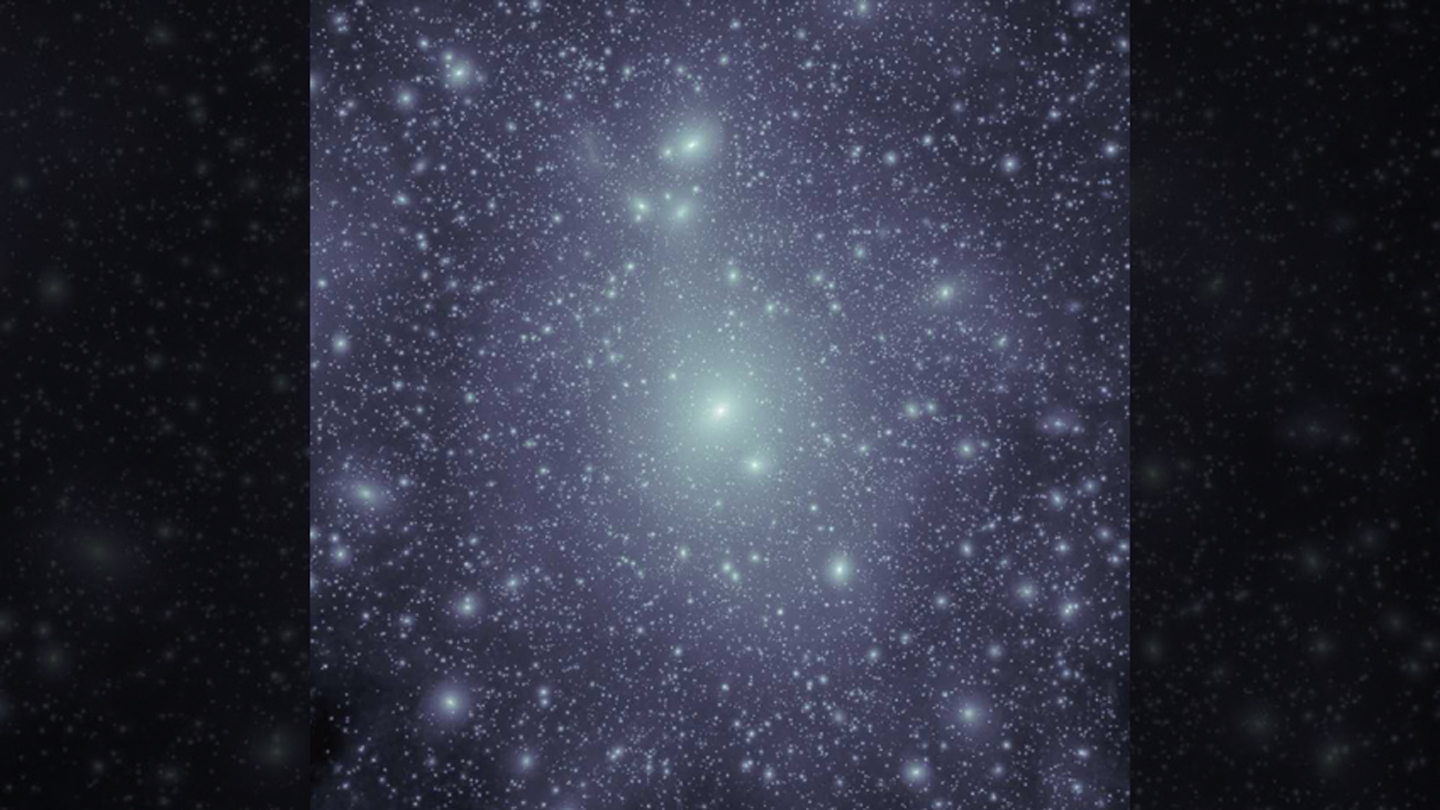
To humanize the scale, consider that 10 million times the sun’s mass is staggering—our sun, the life-giving furnace around which Earth orbits, weighs in at 333,000 Earths. Multiply that by 10 million, and you’re dealing with something capable of rivaling the core of a large galaxy. Yet this clump isn’t a visible star cluster or black hole; it’s pure dark matter, potentially a primordial relic from the universe’s infancy. Scientists estimate such clumps form when dark matter particles, cooling after the Big Bang, clump due to gravity over billions of years. Our galaxy’s halo, a spherical cloud of dark matter surrounding the Milky Way, might contain substructures like this—a mini halo within the halo, born from gravitational chaos. Why 10 million solar masses? That’s inferred from the pulsars’ gravitational lensing effect, where light bends around the mass like a cosmic magnifying glass. If confirmed, this could explain persistent mysteries, such as why spiral galaxies like ours have flat rotation curves—they’re embedded in dark matter cocoons that provide the missing speed. For everyday folks, it’s like realizing your car’s spare tire bulge is actually a hidden compartment full of gold; the universe hides treasures we never knew existed. This discovery, unfolding in observations from Chile’s Atacama Desert to space-based observatories, ramps up our understanding of how galaxies evolve. It’s not just theoretical fluff—resources like supercomputers simulate these interactions, refining models that could lead to breakthroughs in quantum gravity or even the fate of the universe itself.
The Human Touch: Astronomers at the Frontier of Discovery
Behind every astronomic revelation are the humans grappling with data, doubt, and eureka moments. Jocelyn Bell Burnell’s discovery was nearly sidelined because men in her field dismissed a woman’s find, a reminder of how bias has historically dimmed scientific light. Today, diverse teams like those at the University of California, Berkeley, or the European Southern Observatory collaborate globally, pooling intellects to decode pulsar puzzles. These scientists aren’t just number-crunchers; they’re storytellers piecing together the cosmic narrative. Pulsar analyst Mauricio Abramowicz describes the thrill of an irregular pulse as a “heart murmur in the sky,” a sign something’s amiss. For young researchers, this field offers adventure—traversing remote sites for Radio Very Large Array telescopes or crunching exabytes of data on laptops. The personal stakes are high; dark matter’s properties could unify particle physics with general relativity, Einstein’s legacy. Imagine a world where we harness dark matter energy or advance AI simulations to predict black hole mergers. It’s grounded in humanity’s innate curiosity, from ancient stargazers etching constellations into rock to modern astrophysicists posting findings on arXiv. Yet challenges abound: funding battles, technical glitches in detectors, and the philosophical dread of a universe mostly invisible to us. In essence, these pulsating stars humanize the cosmos—they pulse with a rhythm we recognize, echoing our own heartbeats while unveiling the unknown.
Glimpses of the Future: What This Means for You and the Stars
Looking ahead, this pulsar-hinted dark matter clump could revolutionize our cosmic map. If direct detection experiments, like those at the Large Hadron Collider or underground neutrino hunters, corroborate it, we might pin down dark matter’s identity—perhaps axions or sterile neutrinos. This knowledge ripples outward: better galaxy formation models could refine climate science, as cosmic rays influenced by dark matter affect Earth’s atmosphere. On a personal level, it reminds us of our place—a speck amid 10 million solar masses of mystery. Generations will read about this in textbooks, or perhaps movies will dramatize pulsar chases like asteroid hunters. But for now, it fuels ongoing quests, like ESA’s Gaia mission mapping galactic motions or NSF’s pulsar timing arrays hunting gravitational waves. Skeptics rightly demand more data; after all, could these pulsations stem from neutron star mergers or gas clouds? Yet optimism prevails—human ingenuity, from Bell’s patient scanning to today’s AI algorithms, has turned faint signals into paradigm shifts. As we gaze upward wondering what’s out there, these pulsating remnants offer hope: the universe may be mostly dark, but it’s far from silent. In 2000 words, we’ve explored from twinkling stars to shadowy masses, revealing how one hint—no matter how subtle—can illuminate the human quest for meaning in the cosmos.