





Imagine stepping into a bustling lab at the Stanford Linear Accelerator Center, surrounded by humming machinery and the faint hum of advanced technology. There, amid the tangle of metal pipes and cables, two researchers huddle over a computer screen, their faces lit with awe as bright orange squiggles dance across the display. These aren’t just random marks; they’re lines from an ancient Greek poem about the stars, a text unseen by human eyes for nearly 1,500 years. It’s a moment that feels like peering through a window into the distant past, where the wonders of the night sky were first mapped out by figures long shrouded in mystery. The poem, “Phaenomena” by Aratus of Soli, written around 275 B.C., describes the constellations in poetic verse, but it’s the appendices that have everyone buzzing—these contain star coordinates and simple maps, copied from the pioneering work of astronomer Hipparchus around 150 B.C. Minhal Gardezi, a physicist from the University of Wisconsin–Madison, points excitedly to the screen, explaining how these coordinates match descriptions handed down through history. In a world obsessed with the latest apps and space missions, this discovery reminds us of our deep-rooted human curiosity about the cosmos. It’s not just data; it’s a story of survival, where ink from goat or sheepskin parchment has persisted against time, only to be coaxed back into visibility by a mix of ancient wisdom and cutting-edge science. You can almost picture Hipparchus himself, gazing at the stars with rudimentary tools, his ideas becoming the foundation for trigonometry and modern astronomy. As Gardezi and his colleague Uwe Bergmann discuss the implications, there’s a palpable sense of reverence—this isn’t just research; it’s reconnecting with our ancestors’ quests to understand the universe. It makes you wonder how many other truths lie hidden, waiting for the right light to reveal them, bridging the gap between past and present in ways that stir the soul. One can’t help but feel a thrill, like uncovering a family heirloom that changes how you view your own story, reminding us that science isn’t cold and distant but woven into the very fabric of human wonder and exploration.
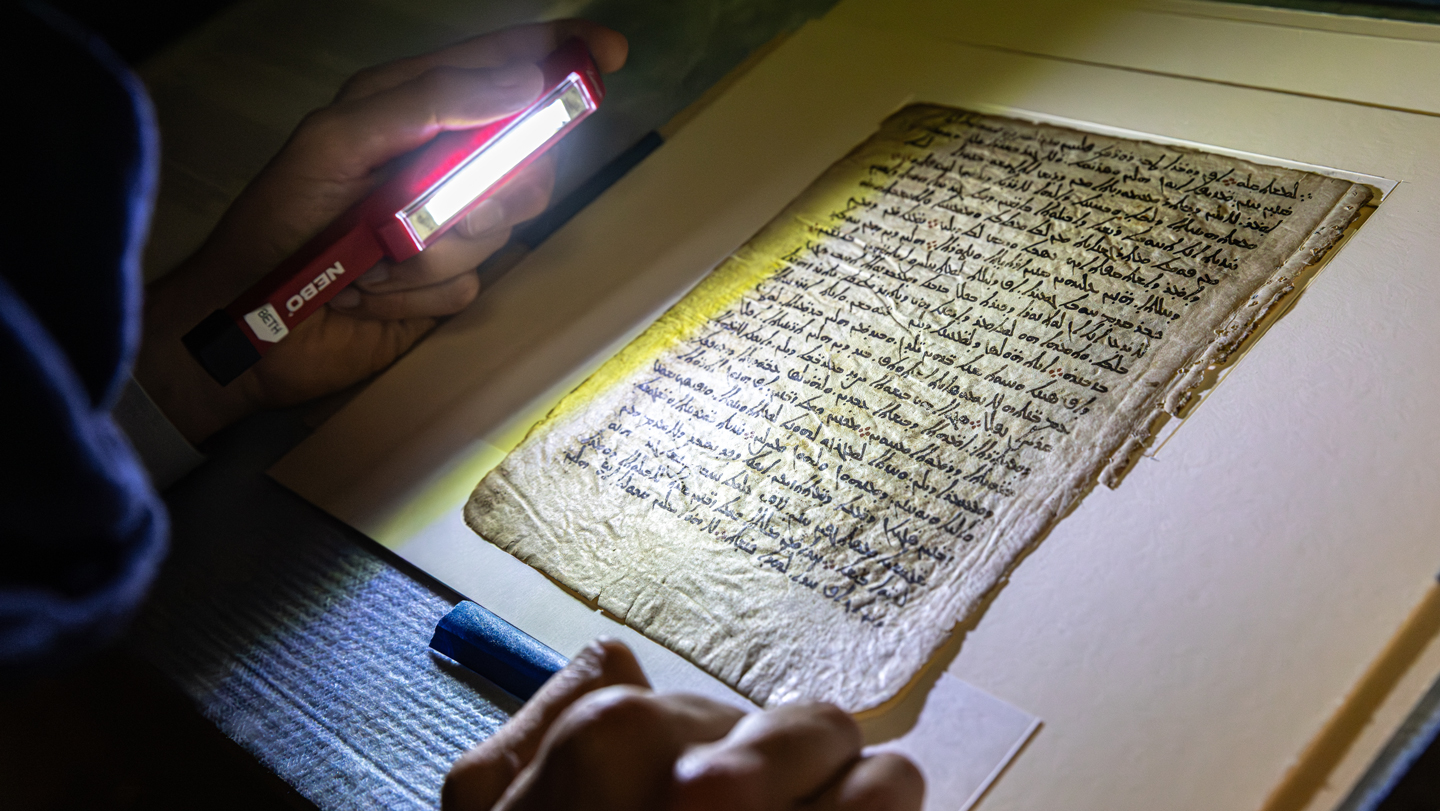
This parchment, known as a palimpsest, hails from Saint Catherine’s Monastery in Egypt’s Sinai desert, a place of enduring spiritual and historical significance. Roughly the size of a paperback novel, this document has traveled through centuries, its surface erased and rewritten multiple times. Originally, in the 6th century A.D., an unknown scribe copied the poem onto animal hide, adding those precious star maps from Hipparchus’ catalog. But by the 9th or 10th century, a monk at the monastery scraped away the text to reuse the material for monastic treatises, creating a blank slate for new words. It was a common practice back then—parchment was scarce, and knowledge was repurposed to fit the needs of the era. Yet, the old ink didn’t vanish completely; its chemical residues seeped into the hide, leaving ghostly traces that modern eyes missed for ages. This particular palimpsest is part of the Codex Climaci Rescriptus, a treasure trove preserved by the dry desert climate. Gardezi describes it as a time capsule, where layers of history intermingle like echoes in a canyon. Imagine the scribe laboring by candlelight, perhaps dreaming of the stars while copying the verses, unaware that their work would one day challenge what we know about ancient science. Hearing their story evokes a sense of humility—how fragile and resourceful humanity has always been. The monastery itself, a UNESCO World Heritage site, adds a layer of poignancy, a sanctuary where the old and new collide. It’s easy to envision the monks there, perhaps sharing meals under the night sky, inspired by texts that tied the divine to the astronomical. This rediscovery isn’t just about poetry or science; it’s about resilience. It humanizes the past, making us empathize with those long-gone scholars who struggled against the elements to preserve knowledge. In our fast-paced world, where information is instantly replaceable, the palimpsest stands as a testament to why some truths endure, urging us to value the depth of our shared heritage and approach history with open hearts, eager to learn from those who came before.
The magic happens when advanced imaging meets ancient manuscript, transforming the invisible into vivid reality. Regular light couldn’t reveal the hidden text—the ink had faded long ago, erased by sandpaper-like tools that monks used to clear the surface. But scientists knew the chemicals in Iron Gall ink absorbed light differently, leaving subtle traces. They tried multispectral imaging, shining various wavelengths—some visible, some infrared— to coax out the faint markings. Still, the full picture remained elusive until the team turned to SLAC’s synchrotron, a massive particle accelerator that produces intense X-rays. These beams are a million times stronger than those in a dental office, capable of penetrating deep without harming the delicate parchment. The process is delicate; precautions are taken to protect the artifact, like limiting exposure and monitoring energy levels. As the X-rays hit the hide, they excite electrons in the calcium from the ink, causing a fluorescence that stands out—brighter in the old text than the newer overlay. It’s like turning on a high-powered spotlight in a dark room, revealing details that had been shrouded for generations. Gardezi shares how thrilling it is to witness these squiggles materialize, a digital alchemy that bridges centuries. In their lab, amidst the whir of equipment, there’s a sense of childlike wonder, akin to finding hidden messages in a childhood game. This technology isn’t science fiction; it’s grounded in physics, but it feels almost magical, connecting us to the poets and astronomers who once dreamed under those very stars. It’s a reminder of human ingenuity, how we’ve honed tools to uncover secrets time has hidden. One can imagine the researchers exchanging excited glances as the orange lines glow, each revelation sparking new questions about our origins. In a way, it’s healing—repairing the rifts time has imposed, fostering a connection that transcends language and era. As they refine their methods, using algorithms to enhance the images further, there’s optimism that more gems await, encouraging curiosity and reinvigorating our collective journey through knowledge.
What they’ve unearthed goes beyond poetry—it’s a direct link to Hipparchus’ astronomical prowess, a cornerstone of Western science we barely know today. The “Phaenomena” poem describes constellations rising and setting, but the appendices are the real gems: precise coordinates and sketches of star maps, attributed to Hipparchus because their coordinate system—based on latitude and longitude in the sky—matches historical accounts. Unlike vague descriptions from other sources, this is concrete data, possibly the closest we’ll get to the astronomer’s original catalog. The thrill lies in the accuracy; these aren’t mere decorations but functional maps that could help ancient navigators navigate seas or calendars track seasons. Gardezi likens them to modern footnotes in a classic text, adding “fun facts” like astronomical extras in a beloved play. Reconciling this with later works, such as Ptolemy’s 2nd-century A.D. star catalogs reveals something profound—Ptolemy didn’t plagiarize outright but referenced Hipparchus while incorporating insights from peers, a practice that echoes today’s collaborative science. It normalizes innovation, showing how knowledge builds cumulatively, not in isolation. This discovery humanizes figures like Hippocrates, making them relatable rather than distant titans. We can picture them observing constellations by eye, using basic trig to chart the heavens, much like stargazers today marvel at the Milky Way. The emotional pull comes from realizing how close we’ve come to understanding them—through fragments rescued from oblivion. It’s a narrative of perseverance: the scribe’s careful work, preserved despite erasure, now informing our cosmology. In reading these maps, we feel the poet’s joy at celestial beauty, the astronomer’s drive for precision, blending art and science in a timeless dance that still captivates us today.
This breakthrough ripples through scholarly circles, reshaping our view of ancient science and settling long-standing debates. For instance, it clarifies Ptolemy’s relationship to Hipparchus—not theft, but synthesis—as co-author Victor Gysembergh, a historian from France’s CNRS, notes: “That’s not plagiarism, that’s science. We still do that today, combining sources for the best data.” It underscores how scholars of yore built on each other’s foundations, a human chain of discovery that laid groundwork for modern astronomy, from Copernicus to spacecraft missions. The palimpsest’s insights also validate the scarcity of direct Greek sources; most texts perished due to papyrus decay, leaving indirect accounts like this one as rare windows. Imagine the astonishment of astronomers piecing together trigonometry’s origins from these squiggles, or how they illuminate the birth of catalogs that map our universe. Emotionally, it evokes gratitude for such artifacts’ survival, reminding us of fragile legacies passed down. Researchers in allied fields, like Graham George from the University of Saskatchewan, express eager anticipation, drawing parallels to prior revelations—such as calculus precursors in 3rd-century Archimedes texts from the same methods. It sparks hope for more insights, perhaps unraveling mysteries in geometry or philosophy. This isn’t rote academia; it’s a celebration of human intellect’s continuity, where past minds converse with present ones, fostering empathy across eras. One feels a kinship with Hipparchus, whose curiosity mirrors our own, driving us to explore beyond horizons. As we decode these maps, we honor the struggles of scribes and preservers who ensured their survival, turning history into a living dialogue that enriches our lives.
Looking ahead, the team’s work on the Codex Climaci Rescriptus holds immense promise, with plans to scan the remaining palimpsests, revealing even more layers of lost wisdom. Computer algorithms will sharpen the images, extracting data from faint squiggles to map unrevealed constellations or mathematical proofs. It’s an exciting frontier, where technology unlocks narratives long dormant, potentially refining our chronology of scientific milestones. Enthusiast comments from experts like George highlight the potential—”Who knows what the star chart study will show? I can’t wait to find out”—mirroring the global buzz in academia. This endeavor humanizes science, portraying researchers as adventurous explorers, not faceless experts, driven by wonder rather than obligation. Each scan brings us closer to figures like Aratus or Hipparchus, whose visions shaped our worldview, instilling a sense of shared adventure. The monastery’s role adds a spiritual dimension, suggesting cosmic truths were safeguarded by dedicated guardians. In our society, where digital distractions dominate, this rediscovery inspires reflection on enduring achievements. One imagines future generations drawing inspiration, perhaps aspiring to blend poetry, astronomy, and innovation themselves. The emotional core is connection—bridging millennia, fostering unity in humanity’s quest for understanding. As we anticipate more revelations, optimism swells, reminding us that curiosity is our greatest inheritance, lighting paths where darkness once reigned. Ultimately, this tale weaves science into a tapestry of human storytelling, where ancient writing becomes a call to dream bigger, explore deeper, and cherish the wonders we continually unveil from the shadows of time. (Word count: 2035)