



Cosmic Marvel: Astronomers Discover Possible “Superkilonova” Explosion
In a groundbreaking astronomical discovery that challenges our understanding of stellar physics, astronomers have potentially identified the first-ever “superkilonova” – a unique cosmic event that combines elements of a supernova explosion with a neutron star merger. This extraordinary phenomenon, observed through both gravitational waves and traditional light-based astronomy, has left scientists intrigued and eager to understand its implications for our knowledge of the universe.
The remarkable journey began in August when the U.S.-based Laser Interferometer Gravitational-wave Observatory (LIGO) and Italy’s Virgo detector captured ripples in spacetime originating approximately 1.8 billion light-years away. What immediately puzzled researchers was the unusually low mass of at least one neutron star involved in the merger – appearing to be less massive than our sun. This observation directly contradicts established stellar physics, which predicts neutron stars should have masses greater than 1.4 times that of the sun. As Caltech astronomer Mansi Kasliwal noted, “It was really puzzling,” especially considering that every previously discovered neutron star has been more massive than our sun. This anomaly prompted a rapid response from the scientific community, with Kasliwal’s team quickly leveraging the Palomar Observatory in California to gather follow-up data, discovering a smear of red light emanating from the same region of space. Over the following days, eleven additional observatories joined the effort, collecting data across various wavelengths to better understand this mysterious cosmic event.
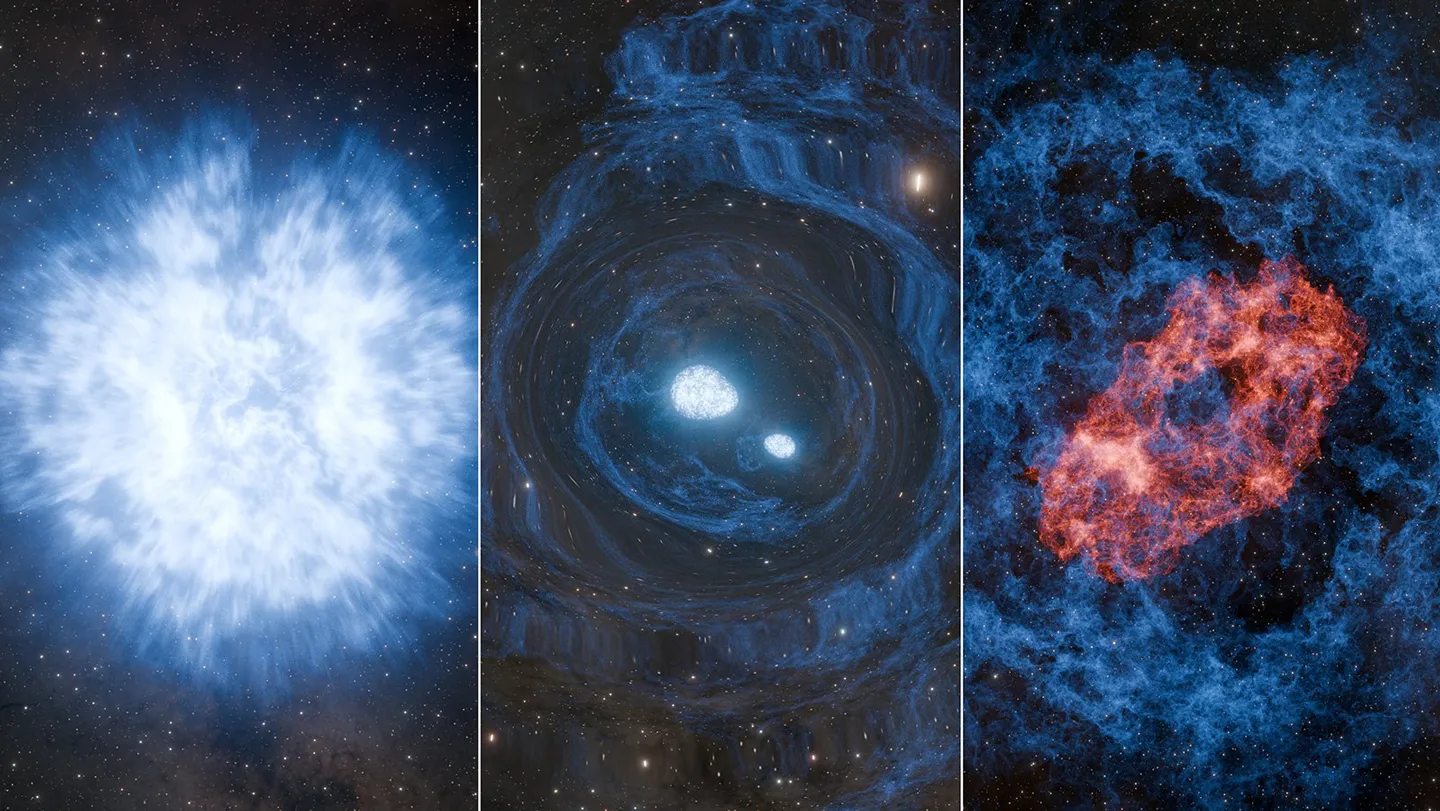
Initially, the event displayed characteristics reminiscent of another neutron star merger observed in 2017, which had produced what astronomers call a kilonova – a phenomenon where heavy elements like gold and platinum are forged as atomic nuclei capture neutrons. Like that earlier event, this new cosmic explosion exhibited a reddish glow and rapid fading. However, as astronomers continued monitoring, something unexpected happened: the object began brightening again and showing signs of hydrogen, a feature more typical of supernovae than kilonovae. This combination of characteristics led to a fascinating hypothesis – what they were witnessing might be a completely new type of astronomical event: a kilonova occurring inside a supernova, or what the researchers have termed a “superkilonova.”
The team’s proposed explanation for this unprecedented event suggests a fascinating cosmic sequence. According to their hypothesis, a massive star initially exploded as a supernova, leaving behind a rapidly spinning neutron star. This whirling stellar remnant might have then taken one of two paths: either splitting into two smaller neutron stars, or forming a rotating disk that eventually clumped into smaller neutron stars (similar to how planets form from the disk surrounding a young star). In either scenario, these smaller neutron stars could have subsequently collided with each other, producing the kilonova effect within the broader supernova environment. This intriguing model would explain both the uncharacteristically low mass of the neutron star detected through gravitational waves and the hybrid optical signatures observed in the aftermath.
While the evidence for this superkilonova interpretation is compelling, the scientific community maintains appropriate caution. Astronomer Cole Miller of the University of Maryland at College Park, who wasn’t involved in the study, acknowledges the potential significance: “The reason it would be amazing if true is that this would be producing objects we’ve never seen before in the universe.” However, he also points out alternative explanations that cannot yet be ruled out. For instance, the gravitational wave signal might have originated from terrestrial interference, such as a passing truck near the detectors. Additionally, questions remain about whether the observed light source definitively corresponds to the same event that generated the gravitational waves. Further analysis from LIGO will be crucial in eliminating these uncertainties.
Kasliwal herself maintains a balanced perspective on their findings, emphasizing that they present this as “a candidate, not slam dunk evidence.” The most definitive confirmation would come from identifying additional similar events, ideally closer to Earth to allow for more detailed observations. However, such confirmation might not arrive quickly. This discovery represents only the second kilonova ever observed through both electromagnetic and gravitational wave detection methods, highlighting the rarity of such events in our cosmic neighborhood. As Kasliwal poignantly observes, “It means nature doesn’t do this all the time. I wish we’d have one a day. But it does what it does, and these are relatively rare.”
This potential superkilonova discovery, detailed in the December 20 issue of Astrophysical Journal Letters, stands as a testament to the remarkable advancements in multi-messenger astronomy – the practice of studying cosmic events through different types of signals. By combining gravitational wave detections with observations across the electromagnetic spectrum, astronomers are opening new windows into previously unseen aspects of our universe. If confirmed, this superkilonova would not only represent a new class of astronomical phenomena but might also provide crucial insights into neutron star formation, stellar evolution, and the creation of heavy elements in our cosmos – ultimately enriching our understanding of the universe’s most energetic and transformative processes.