

When you think about imagination, it’s easy to picture a child lost in a fantasy world, building castles from clouds or sailing ships on imaginary seas. But what if that spark of creativity wasn’t solely the domain of humans? A groundbreaking study has challenged this long-held belief, revealing that a bonobo named Kanzi could engage in pretend play just like a toddler. In a lively make-believe tea party, Kanzi managed to keep track of invisible juice and phantom grapes, suggesting that apes might possess a rudimentary ability to visualize things beyond the here and now. This discovery, published in the journal Science on February 5, 2024, wasn’t just another cute animal story—it was a window into the minds of our primate cousins, echoing the playful antics of human children who start pretending as early as 12 months old and fully master imaginative worlds by age three. As a species, humans rely on imagination for everything from solving complex problems to dreaming up new inventions, yet the idea that other animals might share this trait had only been hinted at in prior studies. Kanzi’s performances add weight to a growing body of research showing that ape cognition isn’t limited to basic survival instincts but can leap into the abstract. Imagine the implications: if a bonobo can track pretend beverages, what else might they be capable of conjuring in their minds? This isn’t mere coincidence; it’s a testament to the evolutionary threads weaving human and ape intelligence together. Scientists have long debated the boundaries of animal thought, and Kanzi’s tea-time escapades invite us to redraw those lines.
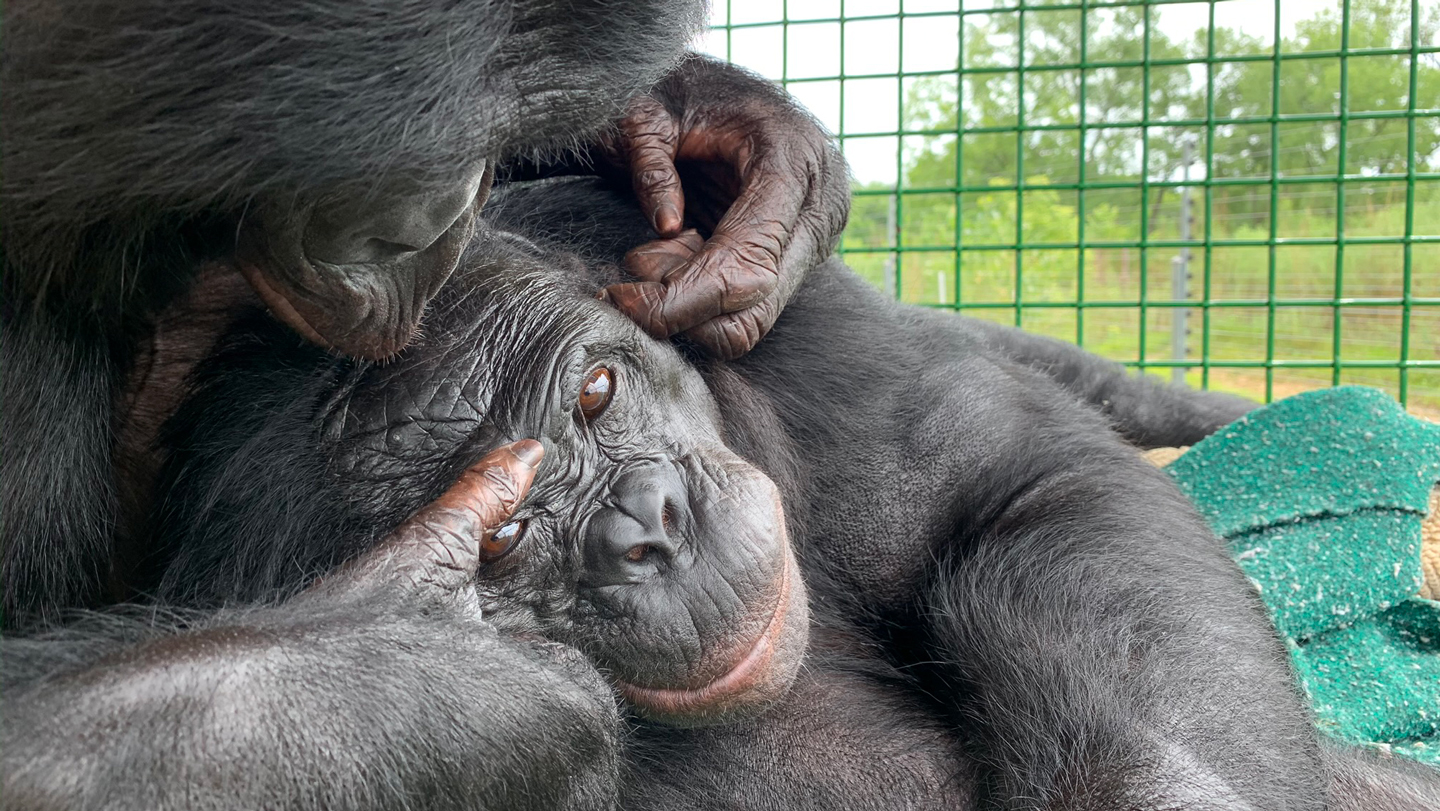
To understand Kanzi’s remarkable abilities, you need to meet this charismatic bonobo first. Born and raised in a human-like environment at a research facility, Kanzi wasn’t your typical jungle primate. He communicated through a special keyboard of symbols called lexigrams, allowing him to express desires and engage in conversations far beyond grunts or gestures. Comparative psychologist Amalia Bastos from the University of St Andrews in Scotland first encountered him in 2023, and like many before her, she was instantly captivated. “We were starstruck by Kanzi,” Bastos recalls, her voice filled with admiration for the 42-year-old bonobo who lived in Kentucky’s Language Research Center. During her initial visit, Kanzi used his lexigram board to request that Bastos and a colleague playfully chase each other, even indulging in the spectacle when their “play” was just pretend. This whimsical interaction sparked a collaboration between Bastos and Christopher Krupenye, a psychologist at Johns Hopkins University, to design a series of tests that would probe Kanzi’s imaginative depths. They set up scenarios mimicking children’s pretend games, transforming the scientific lab into a stage for bonobo theatrics. Visualizing this scene—Kanzi seated at a table, surrounded by researchers, pointing and gesturing—evokes the same wonder as watching a toddler mimic a superhero. Bonobos are known for their empathetic and social natures, often displaying behaviors that blur the line between animal instinct and human-like emotion, but Kanzi stood out. His upbringing emphasized interaction with caretakers, teaching him to use tools and symbols from infancy, which honed his cognitive skills in ways that wild bonobos might never experience.
Diving into the experiments, Bastos and Krupenye orchestrated a simple yet ingenious setup to test Kanzi’s grasp of imaginary quantities. In their first test, Kanzi faced two glasses and a see-through jug that started empty. An experimenter pantomimed pouring “juice”—Kanzi’s absolute favorite—into both cups, miming the flow without any actual liquid. Then, they pretended to pour one cup’s contents back into the jug, visibly shifting the “juice” without it really moving. The pivotal moment came when they asked Kanzi to indicate which cup still held the pretend juice. Astonishingly, he pointed correctly 68 percent of the time, a rate far above random chance, as the team reported. This wasn’t guesswork; it suggested Kanzi maintained an internal mental model of where the invisible substance existed, even as the physical glasses looked identical. Picture the tension in the room—a bonobo deliberating, his finger hovering over lexigrams, researchers holding their breath. But Bastos wasn’t ready to claim victory just yet. She voiced concerns that Kanzi, as an elderly primate, might have relied on fuzzy vision or mistaken hints. “Maybe his eyesight isn’t perfect,” she mused, “or he thinks there’s real juice lingering.” To address this, they ran follow-up tests, placing real orange juice in one cup and mimicking pretend juice in another. Kanzi chose the genuine article nearly 80 percent of the time, proving he could distinguish reality from fantasy when it mattered most. Extending the paradigm to imaginary grapes produced similar results, reinforcing that Kanzi navigated these abstract scenarios with deliberate understanding. Each experiment unfolded like a delicate dance, blending scientific rigor with the heartwarming charm of watching an animal puzzle through a human-like challenge. It’s this blend of rigor and warmth that makes the study so compelling, turning cold data into a narrative of primate ingenuity.
The broader implications of Kanzi’s abilities ripple through the fields of cognitive science and animal behavior. For years, experts like Cathal O’Madagain, a cognitive scientist at the University of Mohammad VI Polytechnic in Morocco, who wasn’t involved in the research, have grappled with how animals innovate. Tool use in apes, such as chimps crafting spears from sticks, was often shrugged off as accidental or instinctual. But if imagination underpins human invention—envisioning a bicycle before forging its frame—then animal creativity might deserve reevaluation. “You can’t invent a bicycle if you can’t imagine one first,” O’Madagain aptly notes, underscoring that Kanzi’s pretend play could illuminate how apes plan and prototype in their minds. This challenges the anthropocentric view that humans alone wield symbolic thought, pushing researchers to explore mental worlds in dolphins, elephants, and crows. Reflect on the everyday magic: a person daydreaming a solution to a problem mirrors Kanzi tracking invisible juice. It humanizes our evolutionary relatives, suggesting imagination might be an ancient trait shared across primate lineages. Yet, it’s not without nuance; Kanzi’s exceptional life—living with human caregivers—likely amplified his skills, reminiscent of how enriched environments boost child development. Stories from the field abound: caretakers recount Kanzi playing music on keyboards or requesting specific foods, each anecdote painting him as a thinking being rather than a mere subject. This study urges a shift from viewing animals as automatons to appreciating their potential for wonder, inviting ethical reflections on animal welfare and intelligence testing. As we anthropomorphize reluctantly, we might just learn more about ourselves.
Personal reflections from the researchers add a deeply human layer to this scientific tale. Bastos shares touching insights from her last encounter with Kanzi, just two months before his passing in March 2025. “He was unique, one of the last animals raised from birth in such a human environment,” she says, her words tinged with melancholy. Kanzi’s death marked the end of an era for primate research, but his legacy endures in the questions he raised. Working with him wasn’t just about experiments; it was about forming bonds that transcended species. Bastos describes the daily interactions—Kanzi greeting staff with hugs, expressing preferences through symbols—as profoundly enriching. “Each session felt like a conversation,” she explains, highlighting how research can foster empathy. Meanwhile, Krupenye’s perspective brings in the excitement of discovery, recalling moments when Kanzi’s choices surprised even seasoned observers. Together, their collaboration exemplifies interdisciplinary teamwork, merging psychology with ethology to unravel primate mysteries. Broader context reveals how Kanzi fits into a tapestry of similar studies, from Alex the parrot counting to Koko the gorilla signing, each animal pushing the boundaries of what we deem possible. This isn’t isolated; it’s part of a renaissance in animal cognition, sparked by figures like Jane Goodall, who long argued for the emotional depths of chimpanzees. In our modern world of technology and isolation, Kanzi’s pretend games remind us of play’s universal language—a bridge across species that encourages curiosity and compassion. As Bastos looks forward, her plans to test less human-reared apes suggest a future where imagination in the wild is explored, potentially rewriting textbooks on evolution.
Reflecting on these findings, one can’t help but ponder imagination’s role in shaping existence. Kanzi’s ability to imagine juice and grapes transforms our understanding of cognition, hinting that abstraction might not be humanity’s exclusive right. This opens doors to philosophical debates: if apes imagine, do they dream? Do they form futures in their minds, or recall pasts vividly? Ethologically, it prompts ethical considerations—should zoos simulate richer microbi-habitats for captive animals? In innovation, it inspires inventors to mimic nature’s ingenuity. Yet, we must tread carefully; not all animals will pass such tests, and individual rearing plays a massive role. Kanzi’s story is a bittersweet one, celebrating primate potential while mourning his loss. As science progresses, perhaps we’ll encounter more “Kanzis,” blurring lines between human and animal realms. Ultimately, this work humanizes science, reminding us that behind every data point is an individual story worth telling. In embracing imagination’s shared spark, we edge closer to a more inclusive view of life’s diverse intelligences, from the tiniest ant colony strategizing to the vast cosmos of human ambition. Kanzi’s tea parties teach us that wonder is universal—let’s imagine a world where we all play together.