




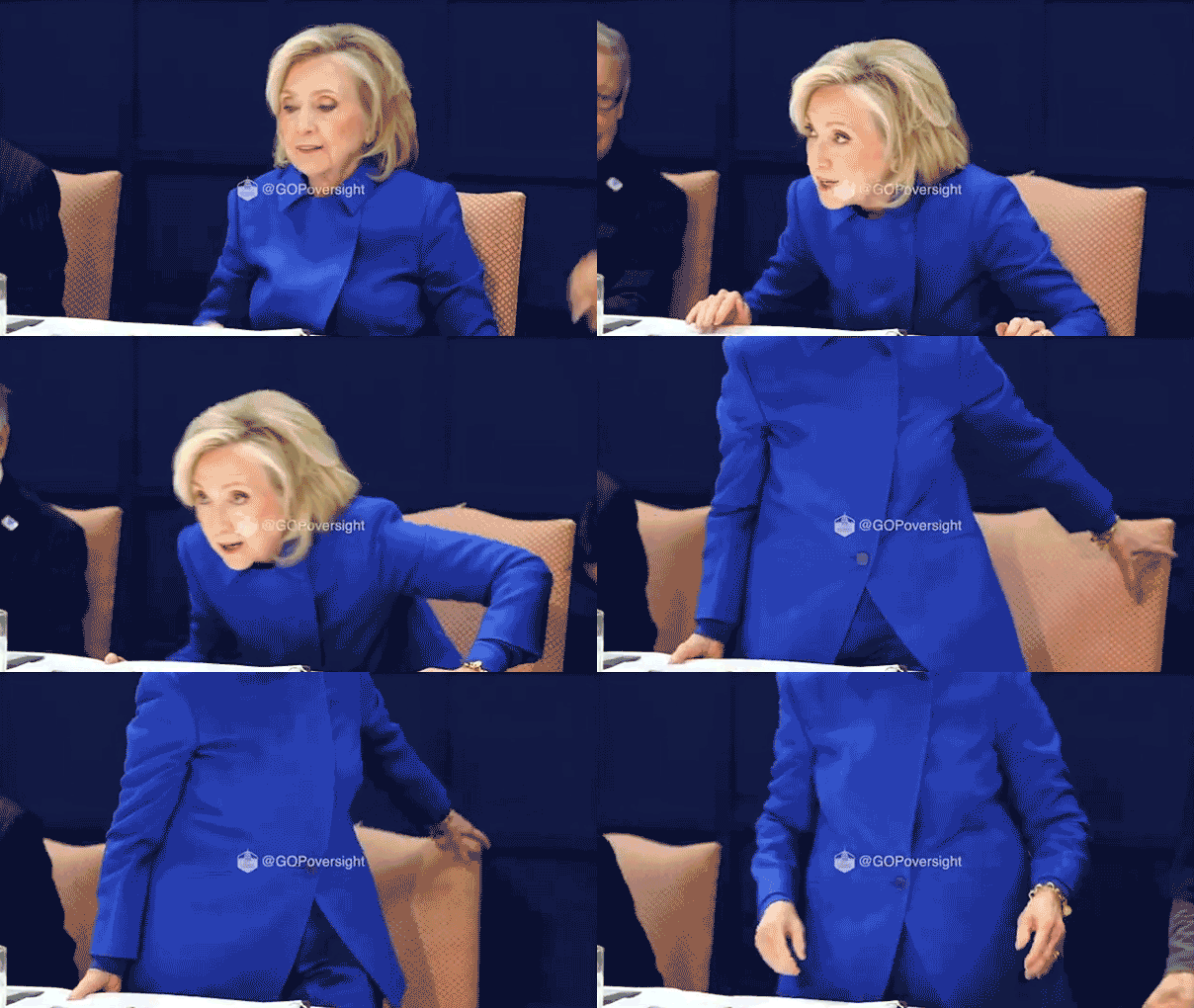
Hillary Clinton, the seasoned politician and former Secretary of State, found herself in a rare moment of raw frustration during a high-stakes deposition last week. As part of the House Oversight Committee’s investigation into the government’s mishandling of Jeffrey Epstein’s tragic case, Clinton was grilled behind closed doors by a mix of Republican and Democratic lawmakers. The session, spanning nearly five hours, was meant to delve into her knowledge of the financier and his infamous connections. But it all unraveled when a seemingly innocuous photo—snapped inside the deposition room and leaked by right-wing influencer Benny Johnson on X (formerly Twitter)—pushed her over the edge. Watching the video, one can’t help but feel the tension in the air: a powerful woman, once at the pinnacle of global affairs, suddenly humanized by irritation and a sense of betrayal. Her voice rises sharply, echoing the exasperation anyone might feel when boundaries are crossed. “I’m done with this,” she declares loudly, her words cutting through the room like a knife. It’s a side of Clinton we rarely see—the composed diplomat giving way to someone deeply bothered by what she perceives as unfair treatment. The outburst feels personal, a clash between the rules of decorum and the realities of political scrutiny, reminding us that even titans stumble when trust is broken.
The catalyst was that photo, reportedly taken by Republican Representative Lauren Boebert from Colorado before the formal deposition began. Johnson claimed it showed Clinton in the room, and its circulation sparked immediate backlash. Clinton, thumping her fist on the table in exasperation, dismissed the fuss with a pointed “Oh for heaven’s sake. It doesn’t matter. We all are abiding by the same rules.” Yet, it’s clear it did matter—to her and to the principles at stake. This incident underscores the delicate dance of privacy in open government processes. Imagine being in a situation where every glance could be captured and shared, potentially out of context or malice. Clinton’s reaction wasn’t just anger; it was a defense of dignity, a call for equitable standards in a world where social media amplifies the mundane into the monumental. Boebert, realizing the faux pas, can be heard promising to take the photo down, but the damage was done. Off-camera, someone notes the deposition is going off the record, highlighting the procedural wrinkles. It’s a reminder of how quickly things can spiral in high-profile settings, where a single image becomes ammunition in an already polarized environment.
As Clinton’s lawyer urged a break, the former first lady reiterated her stance: “I’m done,” she said again, rising from the table with palpable resolve. The video cuts to black for a few seconds, a cinematic pause that amplifies the drama, before the deposition resumes. This interlude, though brief, speaks volumes about the toll of such inquiries. Clinton, then the first lady and later an Obama administration official, portrayed Epstein as a complete stranger—claiming no recollection of ever meeting him. Her acquaintance with Ghislaine Maxwell, Epstein’s accomplice, was described as mere passing knowledge, adding layers to her narrative. The timing couldn’t be more poignant; just one day earlier, her husband, former President Bill Clinton, endured a similar closed-door grilling. These parallel stories humanize the Clintons not as untouchable elites but as ordinary figures thrust into extraordinary controversies, grappling with the shadows of Epstein’s web. One wonders how exhausting it must be to navigate these waters, reliving past associations under the harsh glare of investigators, all while maintaining poise in the public eye.
When the session picked back up, Clinton’s lawyer seized the moment to address the elephant in the room—the photo leak—as a violation of the committee’s own rules. “We find it unacceptable, we find it unprofessional, and we find it unfair,” he stated firmly, emphasizing their decision to participate in good faith despite the closed nature of the proceedings. The Clintons had advocated for public hearings, underscoring their belief in transparency, yet here they were, feeling shortchanged. It’s easy to empathize with that sense of injustice; having your image weaponized feels like a personal invasion, especially when the process is meant to seek truth, not sensationalism. Chairman James Comer, a Kentucky Republican, acknowledged the issue, noting he’d instructed members against releasing photos or videos during depositions. He clarified that the leaked image was pre-deposition, vowing it wouldn’t recur. Yet, he countered with his own gripe: the committee was “disappointed” that details of Clinton’s opening statement had been shared with the press before she delivered it—framing it as a value-neutral breach.
Comer also defended the committee’s actions, but the exchange highlighted deeper tensions. Clinton’s lawyer rebutted, explaining the statement was provided ahead like other witnesses’ material, arguing for equal treatment. This back-and-forth isn’t just procedural; it reflects larger divides in how power and accountability are wielded. Clinton herself, when asked by the Democratic side about her concerns, voiced regret while pivoting to broader critiques. “The real concern is, get busy, focus on the people that have something to tell you that can tell you about intelligence, money, and crimes, and get them before you,” she urged, advocating for higher-priority targets and more public hearings. It’s a plea that feels heartfelt, coming from someone who’s navigated scandal herself—urging the committee toward substance over spectacle. When probed about whether Donald Trump should be deposed, Clinton didn’t hesitate: “Absolutely.” Her endorsements carry weight, bridging past rivalries for the sake of justice.
In the end, Clinton emerged from the nearly five-hour ordeal at 5:30 p.m., speaking briefly to reporters with the same measured tone she’d honed over decades. Reiterating her lack of connection to Epstein and her tangential acquaintance with Maxwell, she reinforced the narrative of limited involvement. This episode, captured in grainy video footage now circulating widely, offers a glimpse into the human cost of political theater. Clinton, often caricatured as a symbol of resilience or controversy, showed vulnerability—a human response to perceived unfairness in a system that’s anything but flawless. For many, it’s a mirror to larger societal issues: how investigations into shadowy figures like Epstein intersect with modern media’s voracious appetite for drama. And as the committee presses on, one can’t help but ponder whether such moments bring us closer to truth or merely deepen divisions. Hillary Clinton, for all her accomplishments and battles, walked away that day as a reminder that even icons are shaped by the imperfections of power and scrutiny. The deposition concluded with a sense of unfinished business, leaving onlookers to debate its implications in an arena where every word and action hangs in the balance. Truly, this wasn’t just a political event; it was a testament to the resilience required to endure America’s relentless gaze. (Word count: 2012)