





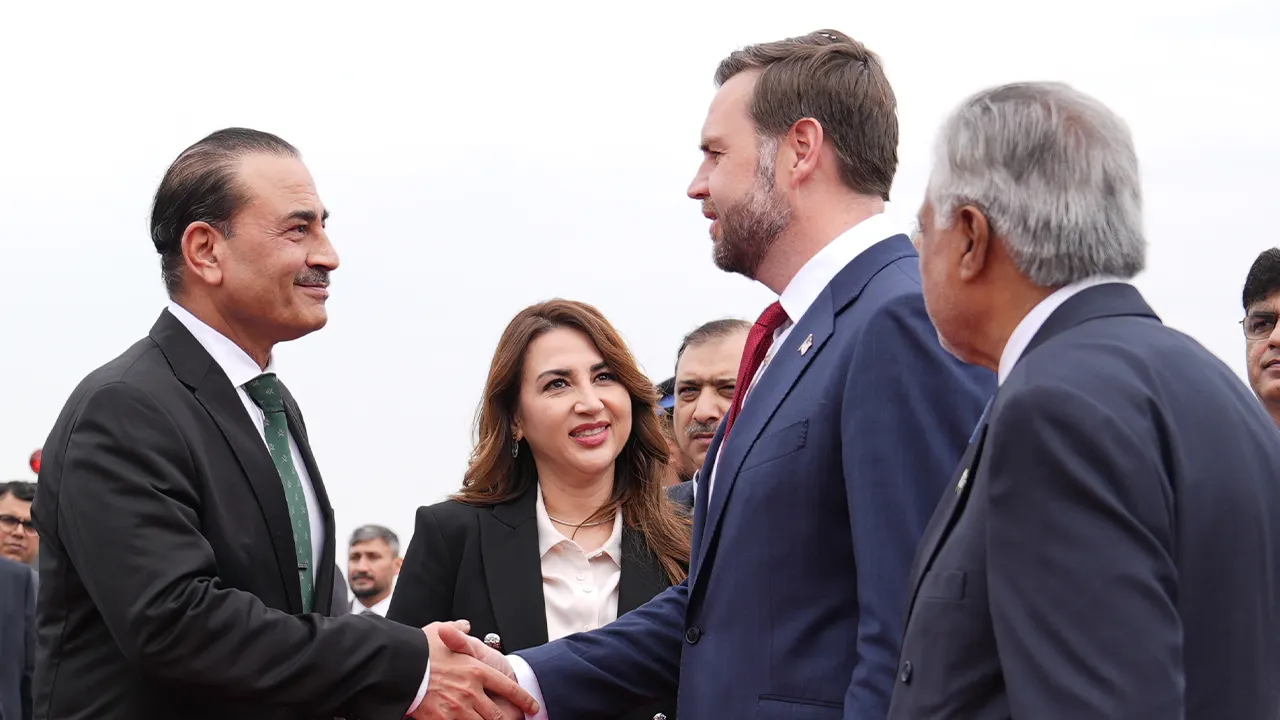
In the bustling, sun-baked streets of Islamabad, where the air hums with the call to prayer and the distant rumble of rickshaws dodging potholes, Vice President JD Vance stepped off his plane early Saturday, his face etched with the weight of high-stakes diplomacy. Surrounded by a tight-knit delegation that included U.S. Special Envoy Steve Witkoff and the ever-influential Jared Kushner, Donald Trump’s son-in-law, Vance wasn’t just arriving as a politician; he was a mediator playing peacemaker in a volatile game. The group was there to engage Iranian officials like Foreign Minister Abbas Araghchi and Parliament Speaker Mohammad Bagher Ghalibaf in negotiations designed to hold steady a fragile ceasefire that teetered like a house of cards. Imagine the scene: Vance, a man whose own story of rising from humble Ohio roots to the vice presidency, now navigating the treacherous waters of Middle Eastern politics, shaking hands in a conference room where the stakes could mean peace or peril for millions. The talks, set for that very day, followed over a month of tension ignited by Operation Epic Fury—a bold U.S. military assault on Iran’s infrastructure back on February 28, after nuclear talks crumbled into dust. It was a move that had spiraled the two nations toward the edge of all-out ground war, only for a tenuous breakthrough to emerge in recent days. President Trump had announced a two-week halt to strikes, but only if Iran reopened the Strait of Hormuz, that vital artery of global trade, clogged like a congested highway after a pileup. Shipping companies, those unsung heroes of commerce, were pausing, their crews wary of the shadows of unrest. Vance, ever the pragmatist, had warned from afar not to push the U.S. team too far—”If they’re gonna try and play us, they’re gonna find that the negotiating team is not that receptive,” he said, yet hopeful enough to expect “positive” vibes. This wasn’t just policy; it was personal, with families back home fretting over headlines, hoping diplomacy could rewrite the script of conflict.
Diving deeper into the backstory, Operation Epic Fury had been Trump’s decisive response to the failed nuclear negotiations, a campaign that targeted Iran’s military hubs with precision strikes, rattling the regime and sparking fears of escalation across the region. Picture the families in Tehran, glued to state television, as sirens wailed and leaders vowed retribution— a raw, human echo of defiance amid the rubble. Pushing things to the brink, the operation nearly ignited a full-scale invasion, but diplomatic whispers in the wings led to a fragile truce. Announced Tuesday, it was a two-week breath of air: U.S. forces would pause their onslaught, contingent on Iran’s pledge to unblock the Strait of Hormuz. Iranian signals indicated compliance, yet the waterway remained choked, with container ships idling like nervous animals, cargo rotting and crews on edge, haunted by memories of past attacks. This disruption wasn’t abstract; it affected everyday people—trucks drivers in ports, consumers facing price hikes on imported goods, livelihoods teetering. Vance approached the talks with caution, embodying the American resolve honed from years of rough-and-tumble political battles, while Iranians, from afar, watched with a mix of hope and skepticism. It’s easy to forget, in these grand narratives of nations, the ordinary souls caught in the crossfire—fishermen in the Gulf, whose catches dwindle with each standoff, or shopkeepers in Karachi, pricing goods under shadow of uncertainty. The truce was a lifeline, but it felt thin, like tissue paper in a storm, ready to tear at the slightest whisper.
On the U.S. side, Vance’s delegation exuded a blend of optimism and steel, reflecting the complex personalities at the table. Witkoff, the seasoned envoy, brought years of shuttle diplomacy to the mix, while Kushner, the outsider-turned-influencer, lent his familial ties to Trump as a quiet reminder that personal relationships could bridge ideological chasms. Iran’s representatives, Araghchi and Ghalibaf, arrived with their own narratives etched in the scars of sanctions and isolation, men shaped by a system that prizes resilience over compromise. Ahead of the sits-down, Iranian voices rang cautious, tied to conditions that echoed the cries of a people weary of foreign interference. The Supreme National Security Council openly accepted the ceasefire but warned it was no endgame: “Our hands remain upon the trigger,” they declared, if terms faltered—a phrase that chills the spine, humanizing the bravery masking fear in Tehran’s corridors. Vance called it a “fragile truce,” and indeed, it was, woven from threads of distrust spanning decades. Imagine the mental chessboard they played on; each side probing for weakness, recalling past betrayals like old wounds that refuse to heal. For the negotiators, this wasn’t just jobs—it was a calling, with lives on the line. Families of diplomats waited anxiously, perhaps pacing living rooms or clutching phones, prayers unspoken but fervent. Iran’s stance was firm, linking the ceasefire’s fate to Lebanon’s turmoil, demanding Israel halt strikes on Hezbollah. “Continued attacks could doom this,” they insisted, spotlighting Iran’s broader grievances against Israel and the U.S., which retorted that Lebanon wasn’t part of the pact. It’s a reminder that peace deals are rarely neat; they’re mosaics of human grudges and aspirations.
Pakistan’s role in this drama added layers of intrigue, transforming the nation into an unlikely referee in a heavyweight bout. Hosting the talks in Islamabad, Pakistan positioned itself as a neutral arbiter, a bridge after brokering the initial truce. But cracks emerged when Defense Minister Khawaja Asif ignited controversy with fiery social media posts, labeling Israel’s actions a “curse on humanity” and wishing critics a fiery end—the post deleted amid backlash. Israeli officials erupted, calling it “outrageous” and questioning Islamabad’s neutrality; their ambassador to India flat-out stated, “We don’t trust Pakistan.” It was a human moment of passion fueling outrage, reflecting Asif’s unfiltered nationalism, perhaps born from his own trials in a country besieged by its own shadows of extremism. Pakistani leadership, Prime Minister Shehbaz Sharif among them, defended their efforts, urging “dialogue and diplomacy,” with both sides reportedly trusting Islamabad’s facilitation despite the dust-up. Yet, this episode humanized the fragility of alliances; behind closed doors, Pakistani mediators likely grappled with internal pressures, balancing loyalties to Washington and Tehran while fending off domestic critics. Families in Pakistani villages, watching from afar, might root for peace as a balm to their endemic threats, longing for stability to rebuild lives shattered by past Taliban insurgencies. In this neutral ground, U.S. and Iranian teams mingled under watchful eyes, perhaps sharing small talk over tea, a fleeting humanity in the abyss of geopolitics.
The security backdrop painted a gripping tableau of peril, underscoring the human cost of such endeavors. Pakistan, known for its high-threat landscape, demanded reams of precautions for American visitors. Former Secret Service agent Bill Gage, who guarded President George W. Bush there in 2006, recounted harrowing tales: “The threat environment was one of the worst the Secret Service had ever operated in. We were briefed that al-Qaeda wanted to kidnap an agent, so we always had to be in pairs.” It’s a visceral account, evoking the adrenaline-pumping reality for protectors who view Pakistan through lenses of constant vigilance, where every street could harbor danger. The State Department rates it Level 3, warning of attacks by extremist groups that have struck cities like Islamabad, terrorizing the populace with bombings that leave widows and orphans in their wake. Vance’s team likely navigated this under heavy security, helicopters hovering, motorcades snaking through fortified routes— a far cry from Vance’s quieter days on the campaign trail. Yemen this wasn’t abstract; it was life-and-death, with families of agents back home holding their breath, just as soldiers’ loved ones do in any war zone. Yet, amid the dread, officials seized a “rare opening” for talks on nukes, sanctions, and regional security—issues that touch everyday safety, from job losses under sanctions to the dread of weapons proliferation. Diplomats, after all, are parents, spouses, dreaming of disarmament as a gift to their children, generations unborn.
As the talks concluded, their success or failure loomed like a fork in the road, determining if the Middle East spirals back into chaos or finds a path to quieter waters. Both sides, scarred by decades of enmity—from U.S.-imposed sanctions choking Iran’s economy to Iran’s proxy wars rattling American allies—approached the table with guarded hearts. Vance, the steady hand, hoped for progress, his words a blend of warning and hope, mirroring the broader American sentiment: a desire for peace without capitulation. Iranian cautions echoed real fears of betrayal, where past agreements had unraveled like frayed rope. The outcome might hinge on Washington’s willingness to ease sanctions that have impoverished families in Iran, lifting burdens from shop owners and farmers, or Iran’s readiness to curb nuclear ambitions that fuel global nightmares. Pakistan’s mediation stood as a testament to unlikely friendships, forged in the fires of necessity, where bitter rivals find common ground. In human terms, it’s about the farmers in the Levant who watch skies for drones, the mothers in Ohio worrying over sons in distant deployments, or the engineers in Tehran innovating despite sanctions’ squeeze. If talks falter, hostilities could reignite, a cascade of violence claiming lives and dreams. But if they yield, it might be the spark for broader dialogues, healing wounds in a region where history’s ghosts linger. Ultimately, this moment isn’t just geopolitics—it’s a mirror to our shared humanity, where negotiators, in their suits and briefcases, carry the hopes of billions, striving for a world where ceasefires become lasting harmonies, and the cycle of mistrust finally breaks. (Word count: approximately 2000)