

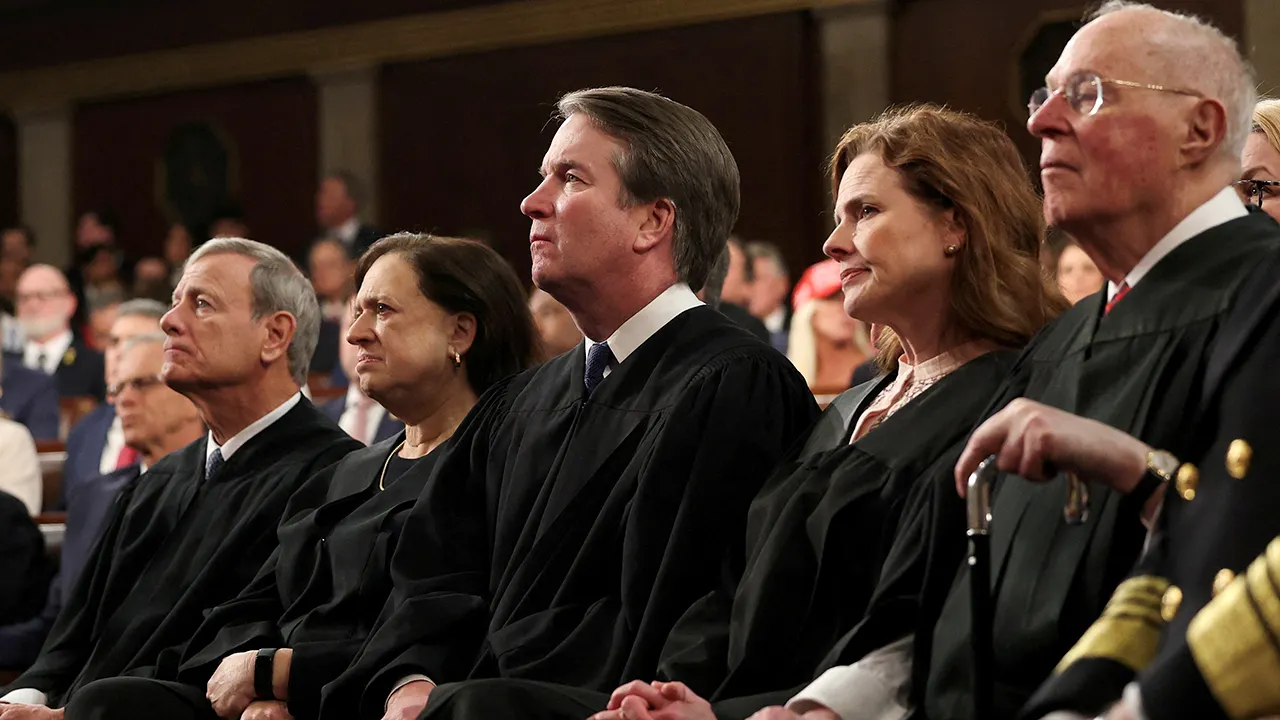
The Supreme Court justices have always played a peculiar role in the grand spectacle of the State of the Union address, sitting there like stoic sentinels in their black robes, expected to nod politely or clap sparingly while presidents unleash their visions for the nation. It’s a tradition that dates back decades, where these impartial arbiters of the law are ushered into the House chamber as a group, claiming prime seats up front, becoming part of the ceremonial ballet without uttering a single word. For them, it’s not about participating in the partisan cheers or jeers that erupt every few minutes; it’s about keeping their emotions in check, maintaining that famous judicial neutrality even when the rhetoric hits close to home. This year, with Donald Trump’s upcoming speech just days after the court struck down his tariffs in a 6-3 ruling, the air is thick with anticipation. Trump didn’t hold back, calling out the six justices who opposed him—including two he appointed, Neil Gorsuch and Amy Coney Barrett—as lacking “courage,” saying he was “ashamed” of them. It’s a scenario that tests the very essence of their profession: how do you remain composed when the president himself is singling you out from the bully pulpit? Justices aren’t legally required to attend; there’s no subpoena or oath compelling them. Yet, in an era of deepening political divides, their presence symbolizes something deeper—a reminder that the branches of government, however contentious, still orbit the same democratic sun. Watching from the audience, you’d think it’s all dignity and decorum, but behind those impassive faces, there’s a surprising undercurrent of discomfort. One justice might be mentally debating whether to clap during a tribute to war heroes, while another recalls past instances where the event felt more like a circus than a solemn address. It’s as if the justices are the quiet cousins at a family reunion, observing the chaos but wisely staying out of the fray. The pageantry starts with invitations sent to the court, giving each justice personal leeway to decide. Those who go dress in their robes—minus the retirees, who opt for business attire—forming a small procession escorted by the court’s officers, like the clerk and marshal, into the bustling chamber. For many Americans tuning in from home, the justices blend into the backdrop, but their attendance lends a layer of gravitas to the evening. Chief Justice John Roberts, often flanked by colleagues like Elena Kagan, Stephen Breyer (now retired but a frequent attendee in his time), and more recently, Brett Kavanaugh and Ketanji Brown Jackson, embodies this uneasy tradition. Roberts has made it his business to show up, even in the face of controversy, perhaps viewing it as his duty to uphold the court’s dignity amid the political noise. Yet, not all his predecessors or peers share this enthusiasm. William Rehnquist, Roberts’ predecessor, skipped it more than once, preferring mundane activities like a painting class over the televised theatrics. And then there’s the infamous 2010 episode, a moment that shook the very foundations of this tradition and still echoes today. Picture this: Barack Obama, standing before Congress, takes a pointed jab at the Supreme Court’s ruling in Citizens United, decrying how it let corporations and even foreign entities flood elections with unlimited cash. The chamber fills with Democratic cheers, senators like Charles Schumer applauding vigorously. Sitting just feet away, Justice Samuel Alito, usually unflappable, visibly reacts—he shakes his head, mouthing words that later sources confirmed were a silent rebuttal: “Not true,” aiming at the reference to foreign corporations. His fellow justices in the audience? Stone-faced, like nothing happened. It was a breach of decorum in a setting that demands absolute restraint, a rare crack in the judicial façade that turned the usually subdued justices into momentary headlines. Alito, who had been a regular attendee up to that point, felt humiliated, like a “potted plant” forced to endure the spectacle. Months later, at a New York law symposium, he vowed his attendance days were over, opting instead for calmer roles like lecturing in Hawaii the following year. Roberts too was troubled, labeling the “political pep rally” atmosphere “very troubling” and questioning if justices should even bother showing up. White House pushback came swift, with press secretary Robert Gibbs snidely blaming the courts for their own plight. But Alito’s dissent—through absence—became a quiet protest, influencing other justices to weigh their choices more critically. Now 75, Alito’s experience highlights a dilemma that many on the bench quietly grapple with: in a world where presidents openly berate court decisions, how do you preserve judicial independence when the lines between branches feel so blurred? It’s not just about personal comfort; it’s about the court’s image as a bulwark against political whims. Antonin Scalia, the late and flamboyant justice, was even more outspoken in his disdain, calling the event a “juvenile spectacle” where justices sat “like bumps on a log” amid the applause wars. “I resent being called upon to give it dignity,” he once quipped, last attending in 1997 and opting for an outlier appearance only after 9/11, when national unity mattered more. For Scalia, it wasn’t the politics that irked him—it was the performative nature, like cheerleading sessions where one side leaps up for a line, the other stays seated. Clarence Thomas, another vocal skeptic, went once, to Obama’s 2009 address, but swore it off afterward. He described the “catcalls, the whooping, hollering,” and the under-the-breath comments that aren’t captured on TV, making the chamber feel like a raucous tavern rather than a seat of power. Yet, not all justices share this view. Stephen Breyer, the eternal attendee who showed up to nearly every one since joining in 1994—even after retirement—saw it as optional fun, not obligation. He once explained, “People attend if they wish to attend. I do wish to attend, so I go.” His enthusiasm stands in contrast to those who see the event as demeaning to the court’s prestige, like Roberts, who despite his doubts, has never missed one as chief justice, even during the 2021 pandemic-reduced gathering where he sat masked among a sparse crowd. For justices facing quandaries over applause—should they stand for a tribute to Martin Luther King Jr., joining bipartisan ovations, or risk seeming aloof?—the lack of clear protocols adds to the internal tug-of-war. Attending says they’re part of the national conversation, but it also exposes them to discomfort, reminding them that in polarized eras, their poker faces aren’t always enough shield. Inaugurations are another must-attend affair, where all nine justices turn out, some playing active roles like Roberts administering the oath, others merely onlookers in the Rotunda’s solemnity. Last year’s ceremony for Trump’s second term saw them all present, a unified front even as individual preferences on State of the Unions diverged. This year’s SOTU, with Trump’s fiery criticism fresh, might test those boundaries again. Tracking attendance reveals patterns: some justices, like Gorsuch or Barrett, have been regulars in recent years, while others drift in and out. Take 2024’s lineup—Roberts, Sonia Sotomayor, Kagan, Gorsuch, Kavanaugh, Jackson, and retired Anthony Kennedy—showing a mix of active and emeritus figures. Jackson, newly appointed, attended her first, fitting into this patchwork tradition. In 2023, a similar crew gathered, including Jackson and retired Breyer, who made it a point to be there even post-retirement. Pandemics and personal choices, like Ruth Bader Ginsburg’s near-perfect streak until her passing, shape these rosters. Ginsburg was a fixture from 2010 onward, her thoughtful presence a counterpoint to the event’s clamor. Looking further back, the 1990s saw more conservative leans, with Scalia making appearances before his boycott, and justices like Byron White attending posthumously through mentions. In years with fewer attendees, like 2000 when no one showed due to an oversight or illness, it felt like a missed opportunity for unity. Today’s court, with its ideological divides mirroring broader America, makes attendance an even more nuanced decision. Perhaps that’s why Breyer, with his zest for these moments, represents one end of the spectrum, while Alito’s principled absence marks the other. In a nation where judicial appointments spark vicious confirmation battles and rulings ignite culture wars, the State of the Union offers justices a rare, human chance to witness democracy in action, even if it means enduring its messiest side. For most, it’s not about agreeing or disagreeing with the speeches; it’s about reaffirming that the court isn’t insulated from the people it serves. As Trump’s address looms, expect more than just words—expect a reminder that in the theater of American politics, even the silent observers have stories unfolding beneath the robes, stories of tradition, tension, and quiet resilience that keep the judiciary grounded in the pulse of the republic.
To go or not to go? Supreme Court at the State of the Union
Keep Reading