






A Year of Political Turbulence: Washington’s Chilling Controversies of 2025
The past year in Washington, D.C. has been marked by unprecedented political standoffs, dramatic policy shifts, and nationwide unrest as the second Trump administration implemented its agenda. The capital weathered a record-breaking government shutdown, saw the creation of controversial new government agencies, faced widespread protest movements, and experienced military deployments in American cities. These developments fundamentally altered the relationship between federal power and American citizens, creating divisions that resonated far beyond the Beltway.
The year began with Washington effectively frozen by a 43-day government shutdown, the longest in American history. The political impasse centered on healthcare funding, with Senate Democrats refusing to support any spending bill that didn’t extend enhanced Obamacare subsidies set to expire. The standstill put essential government services at risk, threatening SNAP benefits, federal paychecks, and even air traffic safety. Partisan finger-pointing dominated Capitol Hill until eight Senate Democrats and six House Democrats eventually broke ranks with their party leadership, reaching a compromise that reopened the government without securing the healthcare subsidies they had fought for. The shutdown set a tone of intense partisan division that would characterize much of the political landscape throughout the year.
President Trump wasted no time implementing his vision for smaller government, signing an executive order on Inauguration Day that established the Department of Government Efficiency (DOGE). Led by Tesla CEO Elon Musk as a “special government employee,” DOGE embarked on an aggressive campaign to cut federal spending. The agency claimed approximately $214 billion in savings through various measures including asset sales, contract cancellations, improper payment recoveries, and significant workforce reductions. These cuts had far-reaching implications, eliminating tens of thousands of federal jobs and slashing international programs including USAID and PEPFAR. While supporters celebrated these measures as necessary fiscal discipline, critics viewed them as reckless dismantling of vital government services and diplomatic tools.
The administration’s actions sparked significant backlash, with protest movements emerging nationwide under the “No Kings Days” banner. Beginning in February, the 50501 Movement organized demonstrations against what activists described as presidential “executive overreach.” These protests grew from initial gatherings on President’s Day (rebranded by organizers as “Not My President’s Day”) to massive demonstrations by October that drew millions of Americans to the streets. The movement’s persistence throughout the year reflected deep concerns about the administration’s use of executive power. Some protests took a more targeted approach, with Tesla properties becoming symbols of government overhaul, leading to incidents that Attorney General Pam Bondi characterized as “domestic terrorism.” These demonstrations represented one of the most sustained protest movements in recent American history, illustrating the profound divisions in how Americans viewed the legitimacy and appropriate scope of presidential authority.
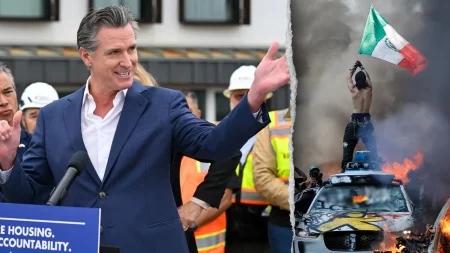
Immigration enforcement became another flashpoint as the administration made good on campaign promises to conduct “the largest mass deportation operation in American history.” ICE launched aggressive nationwide operations targeting undocumented immigrants, actions Republicans praised as essential border security measures but which faced fierce opposition from many quarters. Critics raised concerns about mistaken removals, due process violations, and the overall humanitarian impact of the enforcement surge. Democratic lawmakers joined protesters at ICE facilities and immigration courts, helping constituents understand their legal rights amid the crackdown. The tensions reached a critical point in June when anti-ICE protests in Los Angeles escalated into riots, prompting President Trump to take the extraordinary step of federalizing the National Guard over the governor’s objections—the first such action for domestic law enforcement in more than six decades. The immigration enforcement campaign represented one of the most controversial policy implementations of the year, raising fundamental questions about federal power and civil liberties.
Perhaps most alarming to many Americans was the unprecedented deployment of military personnel to American cities as part of the administration’s crime reduction strategy. After the controversial National Guard deployment in Los Angeles, Trump expanded the approach to Washington, D.C. in August, followed by similar actions in Chicago and Memphis. An attempted deployment in Portland was halted by court intervention. These actions drew sharp criticism from Democrats and civil liberties advocates, who characterized the militarization of domestic law enforcement as dangerous overreach likely to escalate rather than reduce tensions. The strategy’s controversial nature was tragically highlighted in late November when two National Guard members were shot near the White House, with Specialist Sarah Beckstrom, 20, losing her life in what authorities investigated as a potential terrorist attack. President Trump expressed solidarity with military and law enforcement personnel following the incident, but the event underscored the unprecedented and contentious nature of using military forces for domestic operations. As the year drew to a close, the question of appropriate boundaries between military and civilian affairs remained unresolved, embodying the broader tensions that defined American politics throughout this tumultuous year.