





Newsom’s Stark Warning: Trump as a Threat to American Democracy
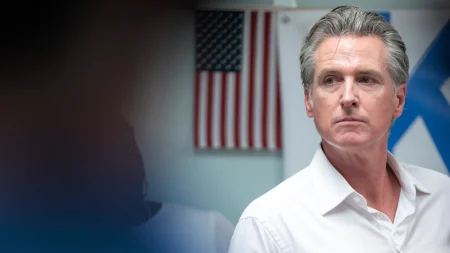
In a candid and passionate discussion on Ezra Klein’s New York Times podcast, California Governor Gavin Newsom delivered one of his most pointed critiques of former President Donald Trump. Speaking with remarkable frankness, Newsom characterized Trump as “one of the most destructive presidents and human beings” in his lifetime, expressing deep concern that America is becoming “unrecognizable” under Trump’s influence. The governor didn’t mince words about what he perceives as the grave stakes of the current political moment, declaring that “this republic is at real risk.” His comments reflect the growing alarm among many Democratic leaders about the direction of American democracy, particularly as tensions rise in the political landscape. Newsom’s blunt assessment showcases his positioning not just as a state leader but as a national voice in opposition to Trump and his vision for America.
Newsom’s criticism extended beyond Trump himself to encompass what he views as widespread institutional capitulation to the former president. He expressed particular frustration with what he called “crony capitalism,” specifically calling out universities, law firms, corporate leaders, and fellow governors from both parties who have been “complicit” in enabling Trump’s agenda. This reference likely points to the concerning trend observed throughout 2023, where elite universities, banking institutions, and prestigious law firms adjusted their policies in response to threats from the Trump administration, including the potential loss of federal funding for educational institutions. By highlighting this pattern of acquiescence, Newsom frames the threat to democracy as systemic rather than merely stemming from one individual, suggesting that powerful institutions abandoning their independence represents a dangerous erosion of democratic norms and safeguards.
The California governor, often mentioned as a potential Democratic presidential contender for 2028, has maintained a consistent opposition to Trump dating back to his first term in office. During the podcast conversation, Newsom revealed that he had previously “softened” on concerns about Trump potentially trying to remain in power beyond constitutional limits by seeking a third term – a remarkable admission that hints at evolving views about the former president’s respect for democratic constraints. Newsom’s characterization of Trump as “reckless” underscores his belief that protecting free and fair elections requires continuous vigilance and resistance. In perhaps the most emotionally charged moment of the interview, Newsom framed his political stance in deeply personal terms, stating that regardless of his future as “the future ex-governor,” what matters most is being able to “look at my kids in the goddamn eye” – suggesting that his opposition to Trump is fundamentally about moral integrity and responsibility to future generations.
The rhetorical battle between Newsom and Trump has intensified throughout recent months, with the California governor adopting increasingly provocative tactics to counter the former president. Newsom has taken to social media with posts mimicking Trump’s distinctive writing style, complete with capital letters and derogatory nicknames – essentially turning Trump’s own communication methods against him. Perhaps most controversially, the governor has employed AI-generated content to mock Trump, including a video depicting the former president along with Pentagon chief Pete Hegseth and White House deputy chief of staff Stephen Miller in handcuffs and crying. These aggressive communication strategies represent a significant escalation in Newsom’s approach to opposing Trump, moving beyond policy disagreements into the realm of personal ridicule and provocative visual imagery that mirrors some of Trump’s own controversial communication tactics.
The antagonism between these two political figures isn’t one-sided, however. Trump has consistently targeted Newsom with criticism and threats throughout his presidency and beyond. In a particularly striking example, Trump blamed Newsom for the devastating wildfires that swept through Southern California in January, attempting to pin responsibility for natural disasters on the governor’s leadership. Even more remarkably, Trump supported White House border czar Toman Homan’s threat to arrest Governor Newsom during federal immigration raids in Los Angeles over the summer – an extraordinary suggestion that the federal government might detain a sitting governor over policy disagreements regarding immigration enforcement. These incidents highlight how the conflict between Trump and Newsom transcends typical political rivalries, occasionally venturing into territory that challenges fundamental norms about federal-state relations and the boundaries of political disagreement.
The increasingly heated exchanges between Newsom and Trump reflect the broader polarization of American politics, but they also signal Newsom’s potential national ambitions. As a Democratic governor from the nation’s most populous state, Newsom appears to be positioning himself as one of the leading anti-Trump voices in the Democratic Party, perhaps with an eye toward 2028. His willingness to engage Trump directly and forcefully – matching the former president’s combative style rather than simply critiquing it – suggests a calculated political strategy that may resonate with Democratic voters seeking champions who can effectively counter Trump’s rhetoric. Yet Newsom’s approach also risks further inflaming already tense political divisions, raising questions about whether such confrontational tactics ultimately strengthen or weaken democratic discourse. What remains clear is that both men represent sharply contrasting visions of America’s future, with their personal animosity serving as a microcosm of the nation’s deeper political divides.